

You find a door.
The Nothings Suite
Nothing to see here! But don’t move along! You can really see the nothing here! Examine the nothing! Think about the nothing! The nothing is where it all begins!
In Quantum Mechanics, Nothingness Is the Potential To Be Anything | Quanta Magazine
Try as they might, scientists can’t truly rid a space or an object of its energy. But what “zero-point energy” really means is up for interpretation.
70-year-old quantum prediction comes true, as something is created from nothing
In our common experience, you can't get something for nothing. In the quantum realm, something really can emerge from nothing.

A quote by Umberto Eco
When men stop believing in God, it isn't that they then believe in nothing: they believe in everything.

Noumenon
In philosophy, a noumenon (/ˈnuːmənɒn/, /ˈnaʊ-/; from Ancient Greek: νοούμενoν; pl.: noumena) is knowledge[1] posited as an object that exists independently of human sense.[2] The term noumenon is generally used in contrast with, or in relation to, the term phenomenon, which refers to any object of the senses. Immanuel Kant first developed the notion of the noumenon as part of his transcendental idealism, suggesting that while we know the noumenal world to exist because human sensibility is merely receptive, it is not itself sensible and must therefore remain otherwise unknowable to us.[3] In Kantian philosophy, the noumenon is often associated with the unknowable "thing-in-itself" (German: Ding an sich). However, the nature of the relationship between the two is not made explicit in Kant's work, and remains a subject of debate among Kant scholars as a result.

Non-place
Non-place or nonplace is a neologism coined by the French anthropologist Marc Augé to refer to anthropological spaces of transience where human beings remain anonymous, and that do not hold enough significance to be regarded as "places" in their anthropological definition. Examples of non-places would be motorways, hotel rooms, airports and shopping malls. The term was introduced by Marc Augé in his work Non-places: introduction to an anthropology of supermodernity, although it bears a strong resemblance to earlier concepts introduced by Edward Relph in Place and Placelessness and Melvin Webber in his writing on the 'nonplace urban realm'.

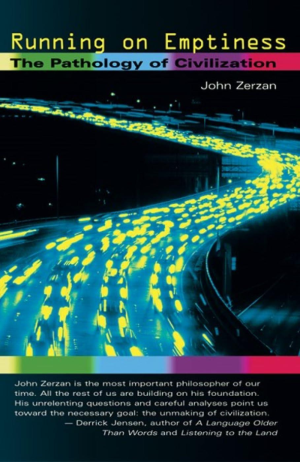
Running On Emptiness
John Zerzan Running On Emptiness The Pathology of Civilization 2002
What are non-things - Interni Magazine
Interni Magazine - In his book ‘Le non cose’ (The non-things), the philosopher Byong-chul Han reflects on the hyper-connected society where the constant attention to data and information fades the (concrete) power of things. Destabilizing us

“The Door Problem”
Game design is one of those nebulous terms to people outside the game industry that’s about as clear as the “astrophysicist” job title is to me. It’s also my job, so I find myself explaining what game design means to a lot of people from different backgrounds, some of whom don’t know anything about games.
Black square (“and so on to infinity…” inscribed in Latin around its edges) representing the nothingness that was prior to the universe, as pictured by the great occult philosopher Robert Fludd, who himself passed into infinity #onthisday in 1637. publicdomainreview.org/essay/black-on-black?utm_cont… #OTD
there is a piece to be written about this "no contact" as a very specific kind of moral panic about status, intergenerational mobility, and maybe dementia. because it is wild how much this no contact thing riles up older people.

Michael Hobbes
Another one. The premise: Young people are cutting off their parents for minor mistakes and misunderstandings. The lead anecdote: A woman severs ties with her family for refusing to get vaccinated before her wedding — to a man who *lost his mother and brother to COVID*

