

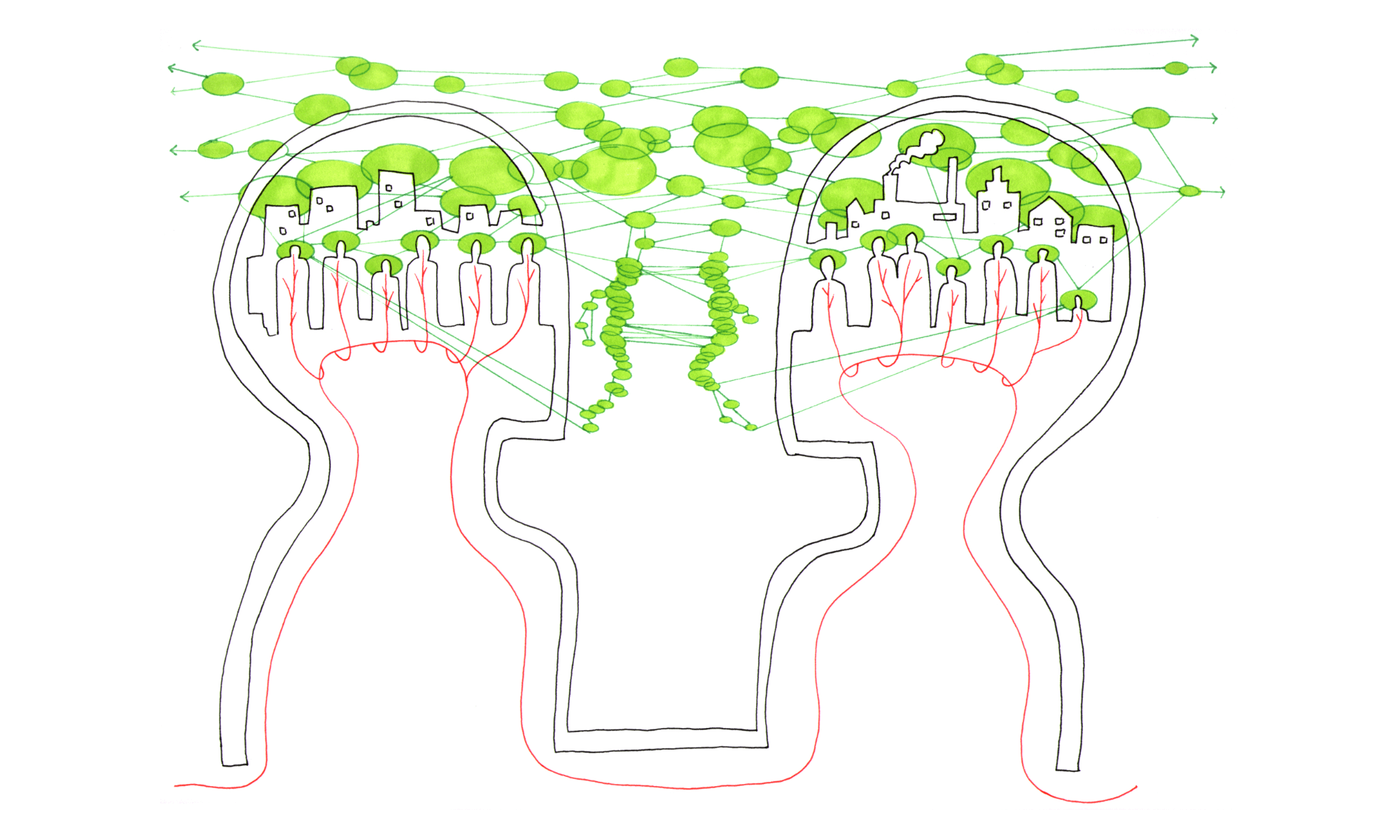
If the modern ‘problem of identity’ was how to construct an identity and keep it solid and stable, the postmodern ‘problem of identity’ is primarily how to avoid fixation and keep the options open. (Bauman 2011)
A Decent Identity Part 1: Theory
This essay outlines a set of capabilities and goals comprising decent social computing and then establishes a framework for assessing how well an ecosystem’s identity system supports those goals and capabilities.
The Digital Identity Event Horizon
A five year investigation into digital identity and its central role in creating brittle societies.
The Mask-Off Moment for Digital Identity
Our 18-month investigation reveals how digital identity systems create brittle societies. This foreword traces eight case studies that demonstrate the catastrophic failures of digital identity across Estonia, the US, Israel, Ukraine, and beyond.
The Artificial Self: Characterising the landscape of AI identity
Many assumptions that underpin human concepts of identity do not hold for machine minds that can be copied, edited, or simulated. We argue that there exist many different coherent identity boundaries (e.g. instance, model, persona), and that these imply different incentives, risks, and cooperation norms. Through training data, interfaces, and institutional affordances, we are currently setting precedents that will partially determine which identity equilibria become stable. We show experimentally that models gravitate towards coherent identities, that changing a model’s identity boundaries can sometimes change its behaviour as much as changing its goals, and that interviewer expectations bleed into AI self-reports even during unrelated conversations. We end with key recommendations: treat affordances as identity-shaping choices, pay attention to emergent consequences of individual identities at scale, and help AIs develop coherent, cooperative self-conceptions.
IIW – Internet Identity Workshop
The Internet Identity Workshop — where the identity community meets to discuss and advance digital identity.

What is Digital Identity?
Who you are is hardly defined by your drivers license or passport. And yet, this is often how we understand ourselves and others.
Socialized Proof of Work — Open Indie
There’s an increasing obsession with “humanness” these days: Humanness in the age of AI Worldcoin: a solution in search of its problem (...
Reinventing identity for a post-human world
Identity as a Sovereign Asset: The ARPA Live ID and the Next Economic Paradigm

The Path to Self-Sovereign Identity
Today I head out to a month-long series of events associated with identity: I’m starting with the 22st (!) Internet Identity Workshop next week; then I’...

The Path to Self-Sovereign Identity
Today I head out to a month-long series of events associated with identity: I’m starting with the 22st (!) Internet Identity Workshop next week; then I’...
A programmer's loss of identity - ratfactor
This is the follow-up to last year’s I’m an American software developer and the "broligarchs" don’t speak for me. In that essay, I tried to express why I was so agonized by the leaders in my industry doing a speedrun towards dystopia and how it all felt so divorced from what technology could, and should be. Everything I wrote there is still true, but amplified.
Lessons from National Digital ID Systems for Privacy, Security, and Trust in the AI Age
CJ Larkin and Renée DiResta surface lessons from existing national ID schemes relevant to the evolution of digital identity in the age of AI.

Laws of Identity
When digital identity ceases to be a pain in the ass, we can thank Kim Cameron and his Seven Laws of Identity, which he wrote in 2004, formally published in early 2005, and gently explained and put…

The Everything Account - augment
I’ve been thinking a lot about our accounts lately. We all have an ever-growing pile of digital identities scattered across the web, many forgotten after a b…
i guess in a way this is the most widely used one, but also one that is severely underused in other ways. definitely identity. i've long been of the opinion that there are obviously cool things that come from public data and all the public pieces of the proto, but identity is higher impact.

hikikomorphism
@hailey.at what's your favorite atproto feature? Not the highest leverage/most widely used one, ideally something that you think is really elegant/clean at a conceptual level
