

We reviewed 22 ML conference submissions this summer. Fifteen had fabricated citations, hallucinated authors, or clear LLM slop, so we complain about that a bit, and release the paper references audit we now run.
Mikel Artetxe on Twitter / X
3/4 papers I reviewed and 2/3 reviews I got this ARR cycle were AI slop. Fraudsters are already outnumbering honest researchers. Unless drastic measures are urgently adopted, conference publications will have zero value or even become negative signal, and academia will be toast.— Mikel Artetxe (@artetxem) September 19, 2026
Thomas G. Dietterich on Twitter / X
We are seeing a new trend in submissions to @arxiv (and presumably to conferences and journals): Authors submitting papers whose contents they likely do not understand. 1/— Thomas G. Dietterich (@tdietterich) September 13, 2026
Fraudulent citations, blamed on AI hallucinations, are becoming more common in research papers
“Fabricated” citations that do not reference real academic papers are spreading in the literature, polluting the public record of science, a new study found

Citing Less Critically: LLMs Reshape the Rhetoric and Reach of Scientific Citation
Scientific citations carry rhetorical intent. Scholars may cite prior work positively (supporting), negatively (contrasting), or neutrally (mentioning). As large language models (LLMs) increasingly assist scientific writing, whether they reproduce citations with the same rhetorical intent as humans remains unclear. We introduce a masked-citation task to compare human and LLM-generated citation behavior. For each citation context, an LLM generates a replacement citation sentence, producing a counterfactual corpus directly comparable to human citation. We analyze what, whom, and how models cite, using an LLM-as-a-judge to classify citation intent and a 20-million-edge coauthorship network to measure social distance between cited authors. Across six popular LLMs and 1,746 top NLP conference papers (63k+ contexts, 132k+ citations), three patterns emerge: (1) Compared with human citation, LLMs cite significantly less critically; (2) LLMs over-cite popular and older papers, a tendency amplified for contrasting citations where human writing more often draws on recent, niche work; (3) Whereas humans often cite within their close social network, especially for supporting citations, LLMs tend to draw on more socially distant authors. Together, these differences are double-edged: LLM citation reaches beyond a scholar's close collaborators while being less critical and amplifying visibility bias, reshaping the rhetoric and reach of scientific citation.

Anka Reuel | @ankareuel.bsky.social on Twitter / X
+1. To all slop authors, I’m not sure if you realize that senior reviewers (often the same ppl you apply to for grad school) see your real name. Last year I PC’d and an author (who I knew…) submitted 8 slop papers, all rejected. Guess who I’d never work with or admit to my lab. https://t.co/chrg1vrOqc— Anka Reuel | @ankareuel.bsky.social (@AnkaReuel) September 19, 2026
NovGauge: A Fine-Grained Benchmark for Diagnosing LLMs'...
Large language models (LLMs) are increasingly used in peer review at major AI conferences, yet novelty remains a persistent weak point. Existing benchmarks assess novelty as a single holistic...
Reproducible, citation-aware automated paper reviews @seanjungblluth.bsky.social - ATmosphereConf 20
Scientific production in the era of Large Language Models
Large Language Models (LLMs) are rapidly reshaping scientific research. We analyze these changes in multiple, large-scale datasets with 2.1M preprints, 28K peer review reports, and 246M online accesses to scientific documents. We find: 1) scientists adopting LLMs to draft manuscripts demonstrate a large increase in paper production, ranging from 23.7-89.3% depending on scientific field and author background, 2) LLM use has reversed the relationship between writing complexity and paper quality, leading to an influx of manuscripts that are linguistically complex but substantively underwhelming, and 3) LLM adopters access and cite more diverse prior work, including books and younger, less-cited documents. These findings highlight a stunning shift in scientific production that will likely require a change in how journals, funding agencies, and tenure committees evaluate scientific works.
Why Are We Still Doing This?
Hi! If you like this piece and want to support my work, please subscribe to my premium newsletter. It’s $70 a year, or $7 a month, and in return you get a weekly newsletter that’s usually anywhere from 5000 to 185,000 words, including vast, extremely detailed analyses

Hallucinated citations are polluting the scientific literature. What can be done?
Tens of thousands of publications from 2025 might include invalid references generated by AI, a Nature analysis suggests.
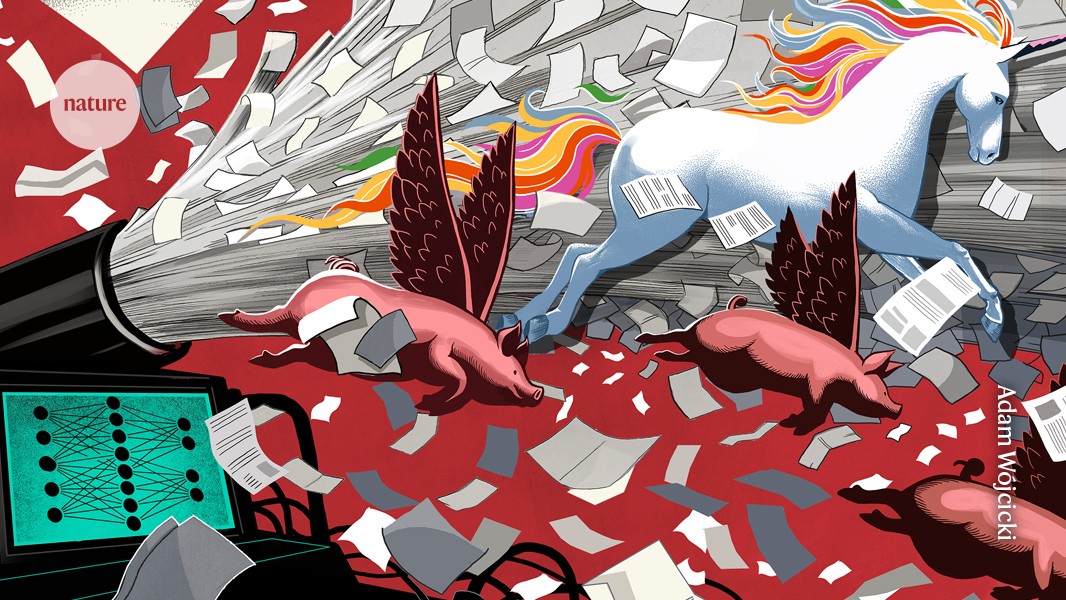
Hallucinated citations are polluting the scientific literature. What can be done?
Tens of thousands of publications from 2025 might include invalid references generated by AI, a Nature analysis suggests.
Hallucinated citations are polluting the scientific literature. What can be done?
Tens of thousands of publications from 2025 might include invalid references generated by AI, a Nature analysis suggests.
How AI slop is causing a crisis in computer science
Preprint repositories and conference organizers are having to counter a tide of ‘AI slop’ submissions.
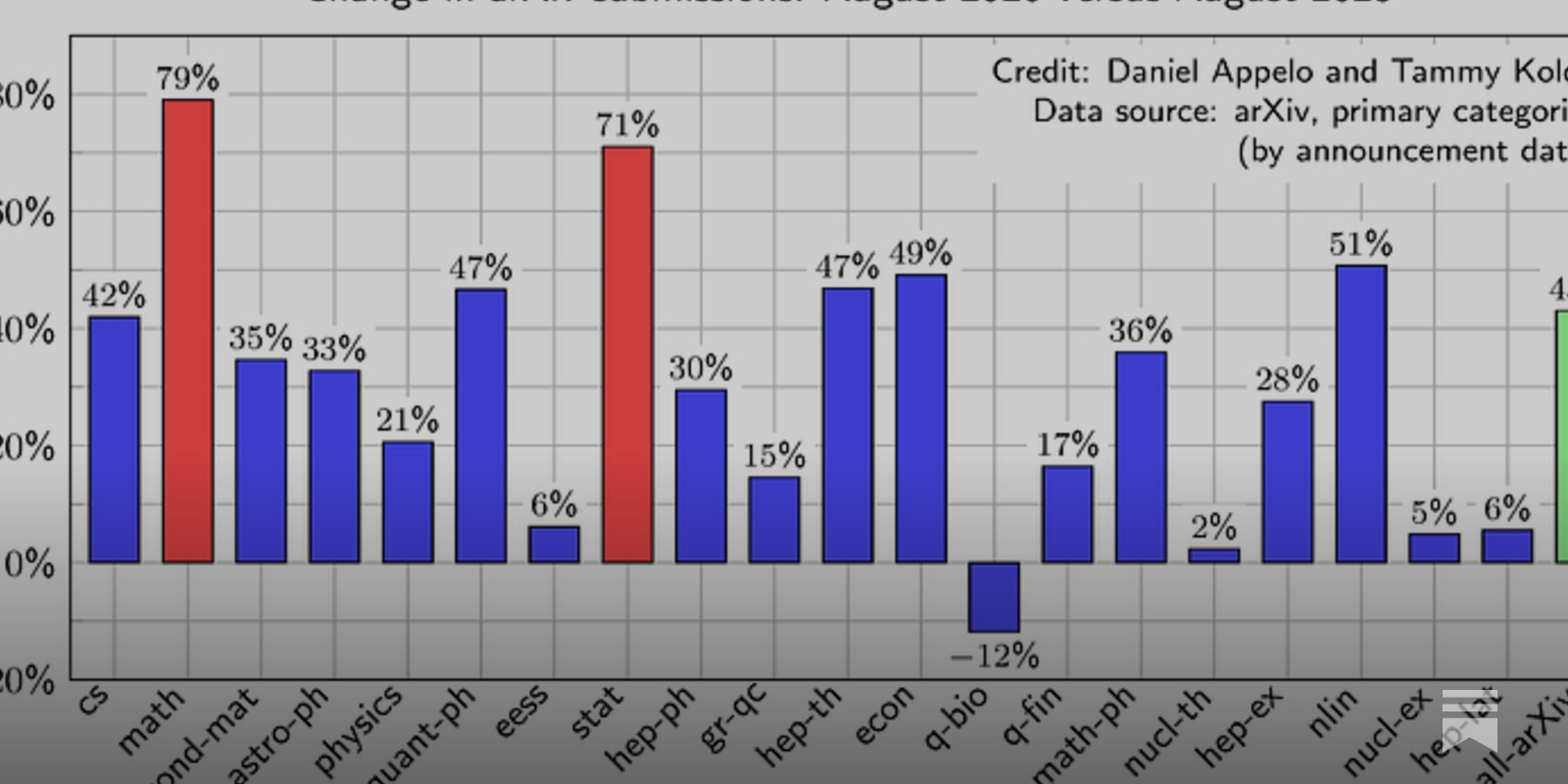
A Breakdown of arXiv Submissions in Mathematics
Guest post with Daniel Appelo (Virginia Tech)
I read this result as: LLMs do more bullshit citations, name-dropping without engaging.

infoDOCKET
Citing Less Critically: #LLMs Reshape the Rhetoric and Reach of #Scientific #Citation (New Research Article (preprint); via @arxiv.bsky.social) arxiv.org/abs/2609.01432 #scholcomm #citations #libraries #AI #GenAI
This is the summer of micro-papers: small ideas, shared freely, archived for posterity. I've had 2 separate emails and multiple new citations based on my micro-paper I wrote for micro-papers back in 2023.

The Micro-Paper: Towards cheaper, citable research ideas and conversations
arxiv.org
