

We reviewed 22 ML conference submissions this summer. Fifteen had fabricated citations, hallucinated authors, or clear LLM slop, so we complain about that a bit, and release the paper references audit we now run.
Fraudulent citations, blamed on AI hallucinations, are becoming more common in research papers
“Fabricated” citations that do not reference real academic papers are spreading in the literature, polluting the public record of science, a new study found

Citing Less Critically: LLMs Reshape the Rhetoric and Reach of Scientific Citation
Scientific citations carry rhetorical intent. Scholars may cite prior work positively (supporting), negatively (contrasting), or neutrally (mentioning). As large language models (LLMs) increasingly assist scientific writing, whether they reproduce citations with the same rhetorical intent as humans remains unclear. We introduce a masked-citation task to compare human and LLM-generated citation behavior. For each citation context, an LLM generates a replacement citation sentence, producing a counterfactual corpus directly comparable to human citation. We analyze what, whom, and how models cite, using an LLM-as-a-judge to classify citation intent and a 20-million-edge coauthorship network to measure social distance between cited authors. Across six popular LLMs and 1,746 top NLP conference papers (63k+ contexts, 132k+ citations), three patterns emerge: (1) Compared with human citation, LLMs cite significantly less critically; (2) LLMs over-cite popular and older papers, a tendency amplified for contrasting citations where human writing more often draws on recent, niche work; (3) Whereas humans often cite within their close social network, especially for supporting citations, LLMs tend to draw on more socially distant authors. Together, these differences are double-edged: LLM citation reaches beyond a scholar's close collaborators while being less critical and amplifying visibility bias, reshaping the rhetoric and reach of scientific citation.

Reproducible, citation-aware automated paper reviews @seanjungblluth.bsky.social - ATmosphereConf 20
Scientific production in the era of Large Language Models
Large Language Models (LLMs) are rapidly reshaping scientific research. We analyze these changes in multiple, large-scale datasets with 2.1M preprints, 28K peer review reports, and 246M online accesses to scientific documents. We find: 1) scientists adopting LLMs to draft manuscripts demonstrate a large increase in paper production, ranging from 23.7-89.3% depending on scientific field and author background, 2) LLM use has reversed the relationship between writing complexity and paper quality, leading to an influx of manuscripts that are linguistically complex but substantively underwhelming, and 3) LLM adopters access and cite more diverse prior work, including books and younger, less-cited documents. These findings highlight a stunning shift in scientific production that will likely require a change in how journals, funding agencies, and tenure committees evaluate scientific works.
Why Are We Still Doing This?
Hi! If you like this piece and want to support my work, please subscribe to my premium newsletter. It’s $70 a year, or $7 a month, and in return you get a weekly newsletter that’s usually anywhere from 5000 to 185,000 words, including vast, extremely detailed analyses

Hallucinated citations are polluting the scientific literature. What can be done?
Tens of thousands of publications from 2025 might include invalid references generated by AI, a Nature analysis suggests.
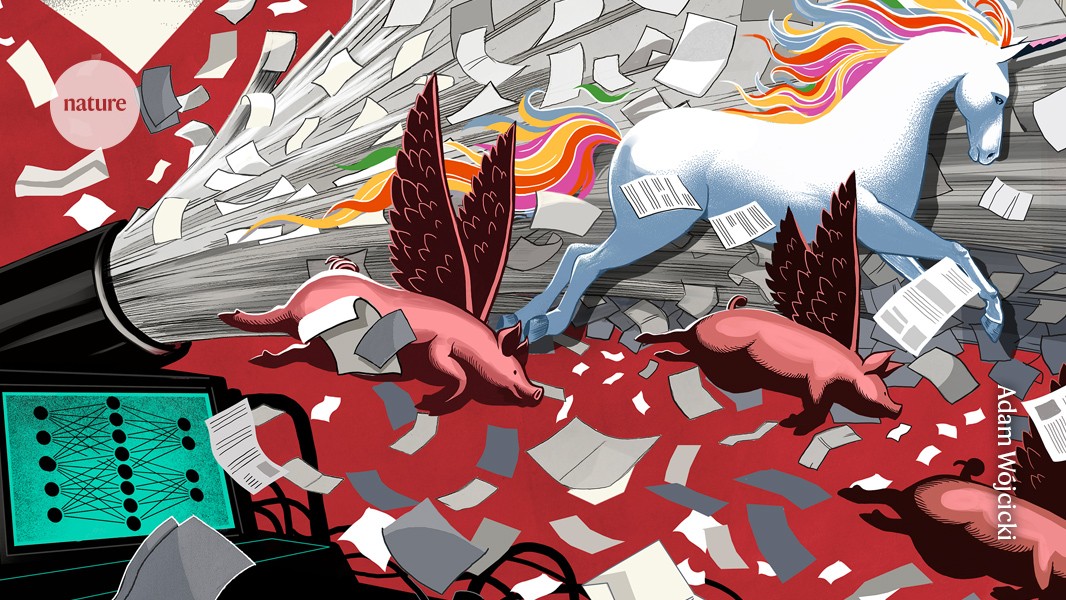
Hallucinated citations are polluting the scientific literature. What can be done?
Tens of thousands of publications from 2025 might include invalid references generated by AI, a Nature analysis suggests.
Hallucinated citations are polluting the scientific literature. What can be done?
Tens of thousands of publications from 2025 might include invalid references generated by AI, a Nature analysis suggests.
How AI slop is causing a crisis in computer science
Preprint repositories and conference organizers are having to counter a tide of ‘AI slop’ submissions.
Vector RAG vs LLM-Compiled Wiki: A Preregistered Comparison on a Small Multi-Domain Research
We preregistered a comparison of two ways to help an LLM answer questions over a small research corpus: a single-round Vector RAG system and an LLM-compiled markdown wiki. Both systems answered the same 13 questions over 24 papers using the same answer-generating model, and their answers were scored by blinded LLM judges. The wiki scored much better at connecting findings across papers, but its advantage in answer organization was not strong after judge adjustment. RAG met the preregistered test for single-fact lookup questions. The clean query-side cost result went against the expected wiki advantage: under the tested setup, the wiki used far more query tokens than RAG, so it could not recover any upfront build cost through cheaper queries. Two exploratory analyses changed how we interpret the result. First, claim-level citation checking favored the wiki: its cited pages more often supported the exact claims being made, even though RAG scored better on the overall groundedness rubric. Second, a decomposition-based RAG variant recovered most of the wiki's advantage on cross-paper synthesis at lower LLM-token cost, but it did not recover the wiki advantage in claim-by-claim citation support. The main conclusion is that grounded research synthesis is not a single capability. Systems can differ in how well they organize evidence, how well their citations support each claim, and how much they cost to run. In this study, no architecture was best on all three.
Hey ChatGPT, write me a fictional paper: these LLMs are willing to commit academic fraud
Mainstream chatbots presented varying levels of resistance to deliberate requests for fabrication, study finds

Hey ChatGPT, write me a fictional paper: these LLMs are willing to commit academic fraud
Mainstream chatbots presented varying levels of resistance to deliberate requests for fabrication, study finds.

Housing Research Needs a Credibility Revolution
YIMBY papers receive a disproportionate share of citations
This is the summer of micro-papers: small ideas, shared freely, archived for posterity. I've had 2 separate emails and multiple new citations based on my micro-paper I wrote for micro-papers back in 2023.

The Micro-Paper: Towards cheaper, citable research ideas and conversations
arxiv.orgI read this result as: LLMs do more bullshit citations, name-dropping without engaging.

infoDOCKET
Citing Less Critically: #LLMs Reshape the Rhetoric and Reach of #Scientific #Citation (New Research Article (preprint); via @arxiv.bsky.social) arxiv.org/abs/2609.01432 #scholcomm #citations #libraries #AI #GenAI

