Draw a card to spark creative thinking
Combinatorial Creativity
Combinatorial creativity recombines existing ideas to spark novel, valuable innovations in cognition, AI, and design.

Design Thinking by IDEO: Human-Centered Innovation
Learn how IDEO uses design thinking to help teams solve complex problems through human-centered innovation, creativity, collaboration, and impact.

Beyond the Artifact: Power as a Lens for Creativity Support Tools
Design Thinking
In the past, design has most often occurred fairly far downstream in the development process and has focused on making new products aesthetically attractive or enhancing brand perception through smart, evocative advertising. Today, as innovation’s terrain expands to encompass human-centered processes and services as well as products, companies are asking designers to create ideas rather than to simply dress them up. Brown, the CEO and president of the innovation and design firm IDEO, is a leading proponent of design thinking—a method of meeting people’s needs and desires in a technologically feasible and strategically viable way. In this article he offers several intriguing examples of the discipline at work. One involves a collaboration between frontline employees from health care provider Kaiser Permanente and Brown’s firm to reengineer nursing-staff shift changes at four Kaiser hospitals. Close observation of actual shift changes, combined with brainstorming and rapid prototyping, produced new procedures and software that radically streamlined information exchange between shifts. The result was more time for nursing, better-informed patient care, and a happier nursing staff. Another involves the Japanese bicycle components manufacturer Shimano, which worked with IDEO to learn why 90% of American adults don’t ride bikes. The interdisciplinary project team discovered that intimidating retail experiences, the complexity and cost of sophisticated bikes, and the danger of cycling on heavily trafficked roads had overshadowed people’s happy memories of childhood biking. So the team created a brand concept—“Coasting”—to describe a whole new category of biking and developed new in-store retailing strategies, a public relations campaign to identify safe places to cycle, and a reference design to inspire designers at the companies that went on to manufacture Coasting bikes. [hbr_brightcove id=”4443548301001″]

On Design Thinking | Maggie Gram
By embracing “design thinking,” we attribute to design a kind of superior epistemology: a way of knowing, of “solving,” that is better than the old and local and blue-collar and municipal and unionized and customary ways. We bring in “design thinkers” — some of them designers by trade, many of them members of adjacent knowledge fields — to “empathize” with Kaiser hospital nurses, Gainesville city workers, church leaders, young mothers, and guerrilla fighters the world over.

Creative Computing Group by @tgoerke.bsky.social — Grain
Let's start a group at CODIP to explore creative computing. Let's not start by defining creativity nor computing. It would be a trap. Let's collect artifacts instead. Images, text, thoughts,...
Random Object Creativity Technique — Think Jar Collective
Michael Michalko shares a useful technique for generating relevant creative ideas using random words to inspire creativity.

Muse: Designing a studio for ideas
Physical workspaces inspire a fast, fluid digital tool for creative thinking.
Platform Design: Interfaces, Incentives, Emergence & Second-Order Thinking
Platform design isn't just product design at scale. Learn the four concepts that set it apart—with a detailed Lego case study showing how great platforms enable creativity.
Watch and Link Disparate Ideas — Think Jar Collective
An important skill to develop to enhance thinking creatively is to be able to link disparate ideas. This article lays out some provocations to spark creative collisions for innovation

Creative Computing Institute
Working at the intersection of creativity and computational technologies.

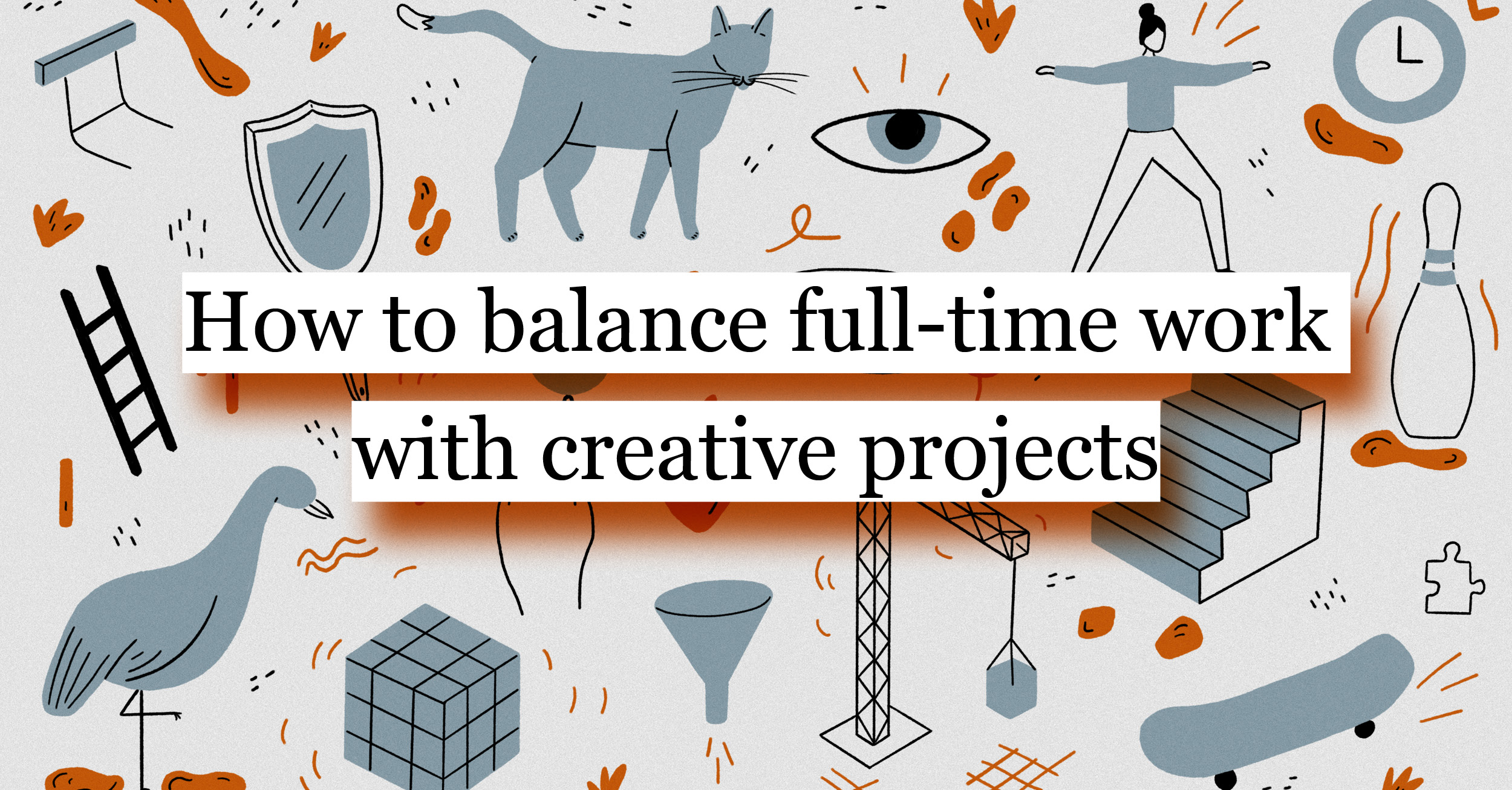
How to balance full-time work with creative projects – The Creative Independent
A guide to finding the right day job, protecting your time, and building creative habits by Jeffrey Silverstein. Illustrated by Sunny Eckerle.
Worst Possible Idea
There are many brainstorming methods (including bodystorming, p.30, brainwriting 6-3-5, p.32 and group passing, p.82) that are each useful in different circumstances. However, sometimes it can be difficult for people in a group setting to generate ideas. This may be because people are too stuck in current ways of thinking, or they might be concerned about being judged by others for the ideas they propose. Giving people the permission to come up with their worst possible ideas creates a playful, safe environment and helps to get a brainstorming session off to a good start. Ideas might build on each other during the process, and it is indeed possible to generate an idea or way of thinking about the problem that can be fed back into the design process. Managers that have used this method with their teams report that it outperforms by far any other brainstorming method (Dorf, 2017), largely because of its ability to energise a room and enable lateral thinking.
How to prioritize your project ideas – The Creative Independent
Game and interaction designer Ryan Mather offers tips on how to get organized and decide what to spend your time on.
Lotus Blossom
Focus the power of brainstorming using a structured, visual representation of ideas—pushing you to fill out every box with new ideas.. Time: 60+minutes Group Size: 2+ people Level: Beginner
Creative Technologists are moving from the margins to the center
Once an obscure job title, creative technology is becoming a new way of working, and a core capability inside modern product teams. Soon…