A clever experiment shows it's surprisingly easy to change someone’s political views, revealing how flexible we are
How to Change Public Opinion - Niskanen Center
Policy advocates engaged in changing public opinion rarely pay much attention to what the academic literature says about how public opinion is formed and how and why it changes. That’s too bad, because while political scientists disagree about a lot of things, this is not one of them. Several decades of robust empirical tests offer […]

The political effects of X’s feed algorithm
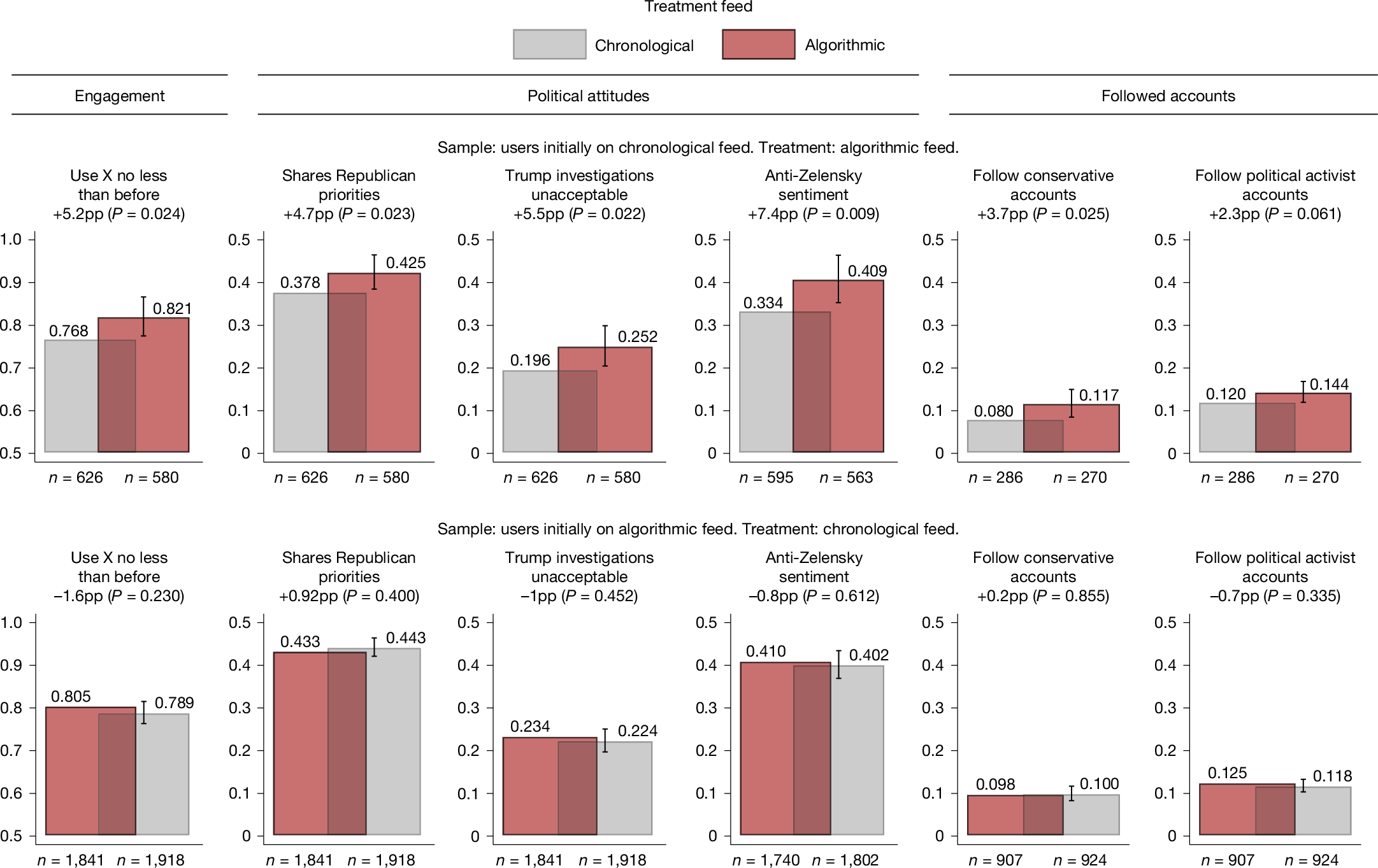
Feed algorithms are widely suspected to influence political attitudes. However, previous evidence from switching off the algorithm on Meta platforms found no political effects1. Here we present results from a 2023 field experiment on Elon Musk’s platform X shedding light on this puzzle. We assigned active US-based users randomly to either an algorithmic or a chronological feed for 7 weeks, measuring political attitudes and online behaviour. Switching from a chronological to an algorithmic feed increased engagement and shifted political opinion towards more conservative positions, particularly regarding policy priorities, perceptions of criminal investigations into Donald Trump and views on the war in Ukraine. In contrast, switching from the algorithmic to the chronological feed had no comparable effects. Neither switching the algorithm on nor switching it off significantly affected affective polarization or self-reported partisanship. To investigate the mechanism, we analysed users’ feed content and behaviour. We found that the algorithm promotes conservative content and demotes posts by traditional media. Exposure to algorithmic content leads users to follow conservative political activist accounts, which they continue to follow even after switching off the algorithm, helping explain the asymmetry in effects. These results suggest that initial exposure to X’s algorithm has persistent effects on users’ current political attitudes and account-following behaviour, even in the absence of a detectable effect on partisanship.
The political effects of X’s feed algorithm
Feed algorithms are widely suspected to influence political attitudes. However, previous evidence from switching off the algorithm on Meta platforms found no political effects1. Here we present results from a 2023 field experiment on Elon Musk’s platform X shedding light on this puzzle. We assigned active US-based users randomly to either an algorithmic or a chronological feed for 7 weeks, measuring political attitudes and online behaviour. Switching from a chronological to an algorithmic feed increased engagement and shifted political opinion towards more conservative positions, particularly regarding policy priorities, perceptions of criminal investigations into Donald Trump and views on the war in Ukraine. In contrast, switching from the algorithmic to the chronological feed had no comparable effects. Neither switching the algorithm on nor switching it off significantly affected affective polarization or self-reported partisanship. To investigate the mechanism, we analysed users’ feed content and behaviour. We found that the algorithm promotes conservative content and demotes posts by traditional media. Exposure to algorithmic content leads users to follow conservative political activist accounts, which they continue to follow even after switching off the algorithm, helping explain the asymmetry in effects. These results suggest that initial exposure to X’s algorithm has persistent effects on users’ current political attitudes and account-following behaviour, even in the absence of a detectable effect on partisanship.
How the internet flips elections and alters our thoughts | Aeon Essays
The internet has spawned subtle forms of influence that can flip elections and manipulate everything we say, think and do

Using technology to craft accurate, persuasive political messages | TechCrunch
In a country that's increasingly polarized, where partisan politics shape perception, the question of how to create a compelling argument -- rooted in

Interventions reducing affective polarization do not necessarily improve anti-democratic attitudes
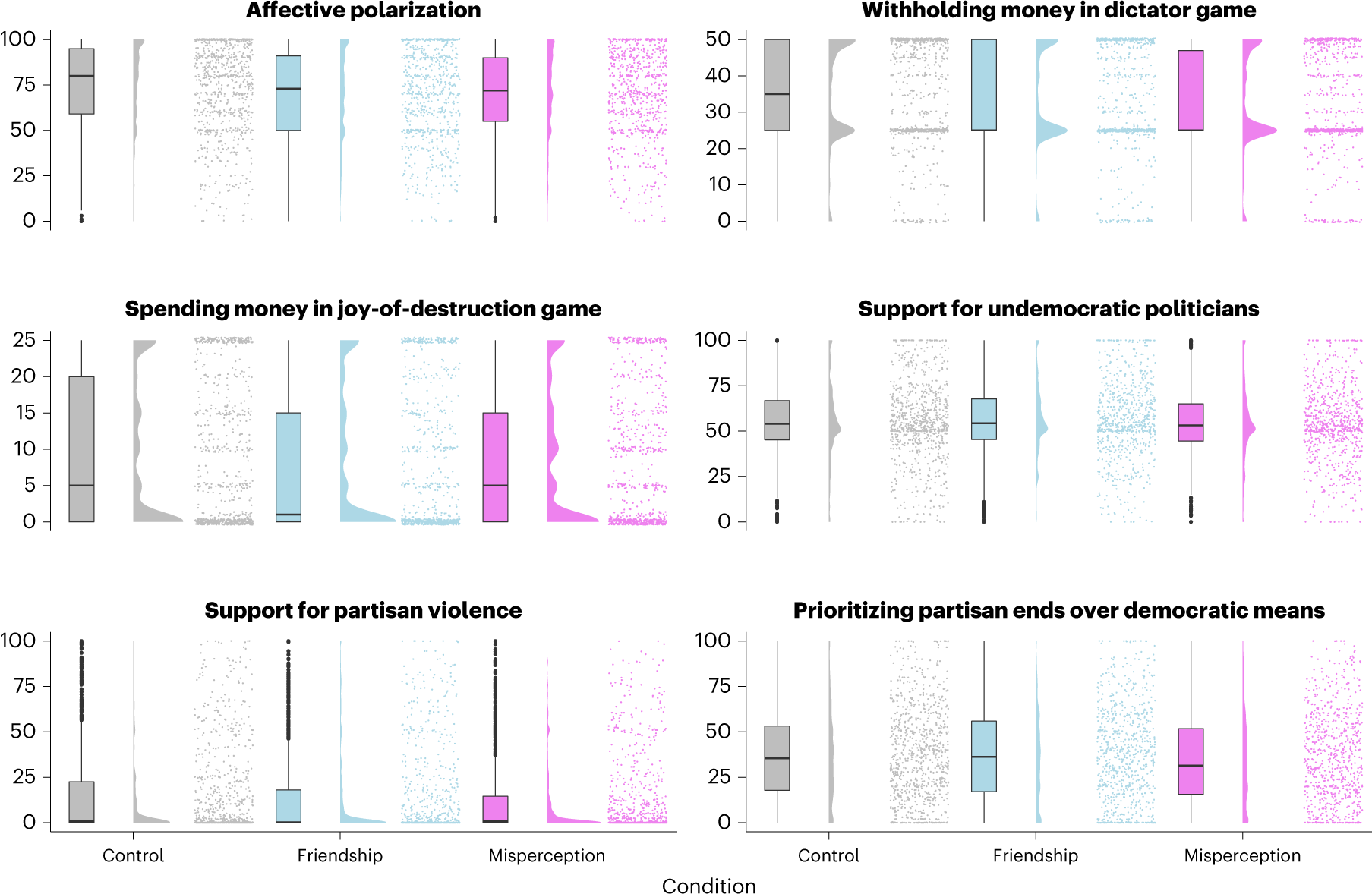
There is widespread concern that rising affective polarization—particularly dislike for outpartisans—exacerbates Americans’ anti-democratic attitudes. Accordingly, scholars and practitioners alike have invested great effort in developing depolarization interventions that reduce affective polarization. Critically, however, it remains unclear whether these interventions reduce anti-democratic attitudes, or only change sentiments towards outpartisans. Here we address this question with experimental tests (total n = 8,385) of three previously established depolarization interventions: correcting misperceptions of outpartisans, priming inter-partisan friendships and observing warm cross-partisan interactions between political leaders. While these depolarization interventions reliably reduced affective polarization, we do not find compelling evidence that these interventions reduced support for undemocratic candidates, support for partisan violence or prioritizing partisan ends over democratic means. Thus, future efforts to strengthen pro-democratic attitudes may do better if they target these outcomes directly. More broadly, these findings call into question the previously assumed causal effect of affective polarization on anti-democratic attitudes.
Algorithms may be making political polarization worse than we think
Marc Torrens and Carlos Carrasco-Farré analyze how algorithms influence opinions and heighten our emotional responses.
When Corrections Fail: The Persistence of Political Misperceptions
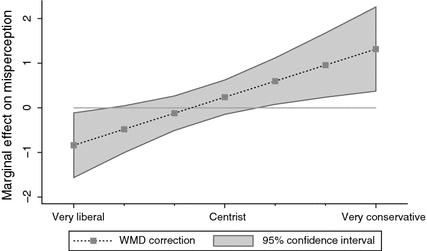
An extensive literature addresses citizen ignorance, but very little research focuses on misperceptions. Can these false or unsubstantiated beliefs about politics be corrected? Previous studies have not tested the efficacy of corrections in a realistic format. We conducted four experiments in which subjects read mock news articles that included either a misleading claim from a politician, or a misleading claim and a correction. Results indicate that corrections frequently fail to reduce misperceptions among the targeted ideological group. We also document several instances of a “backfire effect” in which corrections actually increase misperceptions among the group in question.
Why the backfire effect does not explain the durability of political misperceptions
Previous research indicated that corrective information can sometimes provoke a so-called “backfire effect” in which respondents more strongly endorsed a misperception about a controversial political or scientific issue when their beliefs or predispositions were challenged. I show how subsequent research and media coverage seized on this finding, distorting its generality and exaggerating its role relative to other factors in explaining the durability of political misperceptions. To the contrary, an emerging research consensus finds that corrective information is typically at least somewhat effective at increasing belief accuracy when received by respondents. However, the research that I review suggests that the accuracy-increasing effects of corrective information like fact checks often do not last or accumulate; instead, they frequently seem to decay or be overwhelmed by cues from elites and the media promoting more congenial but less accurate claims. As a result, misperceptions typically persist in public opinion for years after they have been debunked. Given these realities, the primary challenge for scientific communication is not to prevent backfire effects but instead, to understand how to target corrective information better and to make it more effective. Ultimately, however, the best approach is to disrupt the formation of linkages between group identities and false claims and to reduce the flow of cues reinforcing those claims from elites and the media. Doing so will require a shift from a strategy focused on providing information to the public to one that considers the roles of intermediaries in forming and maintaining belief systems.
Reranking partisan animosity in algorithmic social media feeds alters affective polarization
Today, social media platforms hold the sole power to study the effects of feed-ranking algorithms. We developed a platform-independent method that reranks participants’ feeds in real time and used this method to conduct a preregistered 10-day field experiment with 1256 participants on X during the 2024 US presidential campaign. Our experiment used a large language model to rerank posts that expressed antidemocratic attitudes and partisan animosity (AAPA). Decreasing or increasing AAPA exposure shifted out-party partisan animosity by more than 2 points on a 100-point feeling thermometer, with no detectable differences across party lines, providing causal evidence that exposure to AAPA content alters affective polarization. This work establishes a method to study feed algorithms without requiring platform cooperation, enabling independent evaluation of ranking interventions in naturalistic settings. , Editor’s summary Social media platforms’ opaque feed-ranking algorithms, which are designed to maximize engagement, may contribute to political polarization, body image, mental health, and other social issues. However, the evidence has rarely enabled conclusions about causality because external researchers need platforms’ permission to experimentally intervene. Collaborations with platforms also involve trade-offs that undermine researchers’ intellectual autonomy. Piccardi et al . circumvented this problem with a browser extension that intercepted feeds on X/Twitter in real time using a large language model (LLM) (see the Perspective by Allen and Tucker). Liberals and conservatives were randomly assigned to conditions where the LLM re-ranked feeds to up-rank or down-rank the visibility of hostile political content. Up-ranking increased political polarization, whereas down-ranking decreased it. This LLM tool enabled independent scholars to pull back the curtain on unresolved research questions without the platform’s permission. —Ekeoma Uzogara , INTRODUCTION Social media algorithms profoundly impact our lives, yet our understanding of these algorithms’ impact has been limited to interventions that the platforms themselves are willing to test and publish. In this article, we demonstrate a method for independent algorithmic reranking experiments in naturalistic settings and at scale. We leverage this method to demonstrate that algorithmic ranking can both raise and lower levels of affective political polarization in the United States, with no detectable differences across party lines. RATIONALE We built a browser extension that intercepted and reranked web-based social media feeds in real time. The extension used a large language model (LLM) to score content and then applied these scores to reorder the feed, all without requiring platform cooperation. Our approach identified content expressing antidemocratic attitudes and partisan animosity (AAPA) and controlled users’ exposure to such content through reranking. We conducted a preregistered field experiment with 1256 participants on X, the most widely used social media platform for political discourse in the United States, during the weeks leading up to the 2024 presidential election. Participants were randomly assigned to two parallel experiments in which their feeds were dynamically reranked for 1 week to either up- or down-rank AAPA posts. We measured the effects of these interventions on affective polarization (participants’ feelings toward the political outgroup) and emotional experience (anger, sadness, excitement, or calm) by using both in-feed and post-experiment surveys. Results were compared to those of participants in control conditions whose feeds were not reranked. RESULTS Reranking to change levels of exposure to AAPA content significantly influenced affective polarization. Increased AAPA exposure led to colder feelings toward the political outgroup, whereas decreased AAPA exposure led to warmer feelings. Both shifts amounted to more than 2 degrees on a 0- to 100- degree “feeling thermometer.” The impact on affective polarization was consistently detected in both in-feed and post-experiment surveys, with no evidence of partisan asymmetry. Changes to the feed algorithm caused in-feed but not post-experiment changes to participants’ negative emotions. CONCLUSION This work demonstrates a new method for reranking social media feeds that enables testing interventions without platform collaboration. We found that increasing exposure to AAPA posts significantly increases affective polarization and negative emotions, whereas decreasing exposure reduces them. These changes were comparable in size to 3 years of change in United States affective polarization. As political polarization and societal division become increasingly linked to social media activity, our findings provide a potential pathway for platforms to address these challenges through algorithmic interventions. Together, these interventions may result in algorithms that not only reduce partisan animosity but also promote greater social trust and healthier democratic discourse across party lines. A platform-independent field experiment demonstrates that reranking content expressing antidemocratic attitudes and partisan animosity in social media feeds alters affective polarization. A browser extension reranked participants’ social media feeds by reducing or increasing exposure to posts expressing AAPA, which in turn led to corresponding decreases or increases in affective polarization.

Reranking partisan animosity in algorithmic social media feeds alters affective polarization
Today, social media platforms hold the sole power to study the effects of feed-ranking algorithms. We developed a platform-independent method that reranks participants’ feeds in real time and used this method to conduct a preregistered 10-day field experiment with 1256 participants on X during the 2024 US presidential campaign. Our experiment used a large language model to rerank posts that expressed antidemocratic attitudes and partisan animosity (AAPA). Decreasing or increasing AAPA exposure shifted out-party partisan animosity by more than 2 points on a 100-point feeling thermometer, with no detectable differences across party lines, providing causal evidence that exposure to AAPA content alters affective polarization. This work establishes a method to study feed algorithms without requiring platform cooperation, enabling independent evaluation of ranking interventions in naturalistic settings. , Editor’s summary Social media platforms’ opaque feed-ranking algorithms, which are designed to maximize engagement, may contribute to political polarization, body image, mental health, and other social issues. However, the evidence has rarely enabled conclusions about causality because external researchers need platforms’ permission to experimentally intervene. Collaborations with platforms also involve trade-offs that undermine researchers’ intellectual autonomy. Piccardi et al . circumvented this problem with a browser extension that intercepted feeds on X/Twitter in real time using a large language model (LLM) (see the Perspective by Allen and Tucker). Liberals and conservatives were randomly assigned to conditions where the LLM re-ranked feeds to up-rank or down-rank the visibility of hostile political content. Up-ranking increased political polarization, whereas down-ranking decreased it. This LLM tool enabled independent scholars to pull back the curtain on unresolved research questions without the platform’s permission. —Ekeoma Uzogara , INTRODUCTION Social media algorithms profoundly impact our lives, yet our understanding of these algorithms’ impact has been limited to interventions that the platforms themselves are willing to test and publish. In this article, we demonstrate a method for independent algorithmic reranking experiments in naturalistic settings and at scale. We leverage this method to demonstrate that algorithmic ranking can both raise and lower levels of affective political polarization in the United States, with no detectable differences across party lines. RATIONALE We built a browser extension that intercepted and reranked web-based social media feeds in real time. The extension used a large language model (LLM) to score content and then applied these scores to reorder the feed, all without requiring platform cooperation. Our approach identified content expressing antidemocratic attitudes and partisan animosity (AAPA) and controlled users’ exposure to such content through reranking. We conducted a preregistered field experiment with 1256 participants on X, the most widely used social media platform for political discourse in the United States, during the weeks leading up to the 2024 presidential election. Participants were randomly assigned to two parallel experiments in which their feeds were dynamically reranked for 1 week to either up- or down-rank AAPA posts. We measured the effects of these interventions on affective polarization (participants’ feelings toward the political outgroup) and emotional experience (anger, sadness, excitement, or calm) by using both in-feed and post-experiment surveys. Results were compared to those of participants in control conditions whose feeds were not reranked. RESULTS Reranking to change levels of exposure to AAPA content significantly influenced affective polarization. Increased AAPA exposure led to colder feelings toward the political outgroup, whereas decreased AAPA exposure led to warmer feelings. Both shifts amounted to more than 2 degrees on a 0- to 100- degree “feeling thermometer.” The impact on affective polarization was consistently detected in both in-feed and post-experiment surveys, with no evidence of partisan asymmetry. Changes to the feed algorithm caused in-feed but not post-experiment changes to participants’ negative emotions. CONCLUSION This work demonstrates a new method for reranking social media feeds that enables testing interventions without platform collaboration. We found that increasing exposure to AAPA posts significantly increases affective polarization and negative emotions, whereas decreasing exposure reduces them. These changes were comparable in size to 3 years of change in United States affective polarization. As political polarization and societal division become increasingly linked to social media activity, our findings provide a potential pathway for platforms to address these challenges through algorithmic interventions. Together, these interventions may result in algorithms that not only reduce partisan animosity but also promote greater social trust and healthier democratic discourse across party lines. A platform-independent field experiment demonstrates that reranking content expressing antidemocratic attitudes and partisan animosity in social media feeds alters affective polarization. A browser extension reranked participants’ social media feeds by reducing or increasing exposure to posts expressing AAPA, which in turn led to corresponding decreases or increases in affective polarization.
The levers of political persuasion with conversational artificial intelligence
There are widespread fears that conversational artificial intelligence (AI) could soon exert unprecedented influence over human beliefs. In this work, in three large-scale experiments ( N = 76,977 participants), we deployed 19 large language models (LLMs)—including some post-trained explicitly for persuasion—to evaluate their persuasiveness on 707 political issues. We then checked the factual accuracy of 466,769 resulting LLM claims. We show that the persuasive power of current and near-future AI is likely to stem more from post-training and prompting methods—which boosted persuasiveness by as much as 51 and 27%, respectively—than from personalization or increasing model scale, which had smaller effects. We further show that these methods increased persuasion by exploiting LLMs’ ability to rapidly access and strategically deploy information and that, notably, where they increased AI persuasiveness, they also systematically decreased factual accuracy. , Editor’s summary Many fear that we are on the precipice of unprecedented manipulation by large language models (LLMs), but techniques driving their persuasiveness are poorly understood. In the initial “pretrained” phase, LLMs may exhibit flawed reasoning. Their power unlocks during vital “posttraining,” when developers refine pretrained LLMs to sharpen their reasoning and align with users’ needs. Posttraining also enables LLMs to maintain logical, sophisticated conversations. Hackenburg et al . examined which techniques made diverse, conversational LLMs most persuasive across 707 British political issues (see the Perspective by Argyle). LLMs were most persuasive after posttraining, especially when prompted to use facts and evidence (information) to argue. However, information-dense LLMs produced the most inaccurate claims, raising concerns about the spread of misinformation during rollouts of future models. —Ekeoma Uzogara , INTRODUCTION Rapid advances in artificial intelligence (AI) have sparked widespread concerns about its potential to influence human beliefs. One possibility is that conversational AI could be used to manipulate public opinion on political issues through interactive dialogue. Despite extensive speculation, however, fundamental questions about the actual mechanisms, or “levers,” responsible for driving advances in AI persuasiveness—e.g., computational power or sophisticated training techniques—remain largely unanswered. In this work, we systematically investigate these levers and chart the horizon of persuasiveness with conversational AI. RATIONALE We considered multiple factors that could enhance the persuasiveness of conversational AI: raw computational power (model scale), specialized post-training methods for persuasion, personalization to individual users, and instructed rhetorical strategies. Across three large-scale experiments with 76,977 total UK participants, we deployed 19 large language models (LLMs) to persuade on 707 political issues while varying these factors independently. We also analyzed more than 466,000 AI-generated claims, examining the relationship between persuasiveness and truthfulness. RESULTS We found that the most powerful levers of AI persuasion were methods for post-training and rhetorical strategy (prompting), which increased persuasiveness by as much as 51 and 27%, respectively. These gains were often larger than those obtained from substantially increasing model scale. Personalizing arguments on the basis of user data had a comparatively small effect on persuasion. We observe that a primary mechanism driving AI persuasiveness was information density: Models were most persuasive when they packed their arguments with a high volume of factual claims. Notably, however, we documented a concerning trade-off between persuasion and accuracy: The same levers that made AI more persuasive—including persuasion post-training and information-focused prompting—also systematically caused the AI to produce information that was less factually accurate. CONCLUSION Our findings suggest that the persuasive power of current and near-future AI is likely to stem less from model scale or personalization and more from post-training and prompting techniques that mobilize an LLM’s ability to rapidly generate information during conversation. Further, we reveal a troubling trade-off: When AI systems are optimized for persuasion, they may increasingly deploy misleading or false information. This research provides an empirical foundation for policy-makers and technologists to anticipate and address the challenges of AI-driven persuasion, and it highlights the need for safeguards that balance AI’s legitimate uses in political discourse with protections against manipulation and misinformation. Persuasiveness of conversational AI increases with model scale. The persuasive impact in percentage points on the y axis is plotted against effective pretraining compute [floating-point operations (FLOPs)] on the x axis. Point estimates are persuasive effects of different AI models. Colored lines show trends for models that we uniformly chat-tuned for open-ended conversation (purple) versus those that were post-trained using heterogeneous, opaque methods by AI developers (green). pp, percentage points; CI, confidence interval.

New study shows just how Facebook's algorithm shapes conservative and liberal bubbles
Research conducted at the height of the 2020 election reveals new details about how Facebook's algorithms handle political content. But it suggests there are no easy fixes to political polarization.

At Yale, we conducted an experiment to turn conservatives into liberals. The results say a lot about our political divisions.
They also give reason for hope.

The Psychology Behind Us vs. Them Thinking
Polarization isn’t just about politics; it’s about psychology. Understanding the human needs driving us versus them thinking is the first step in bridging divides.

Redesigning algorithms to intervene on social norm misperceptions during a national election
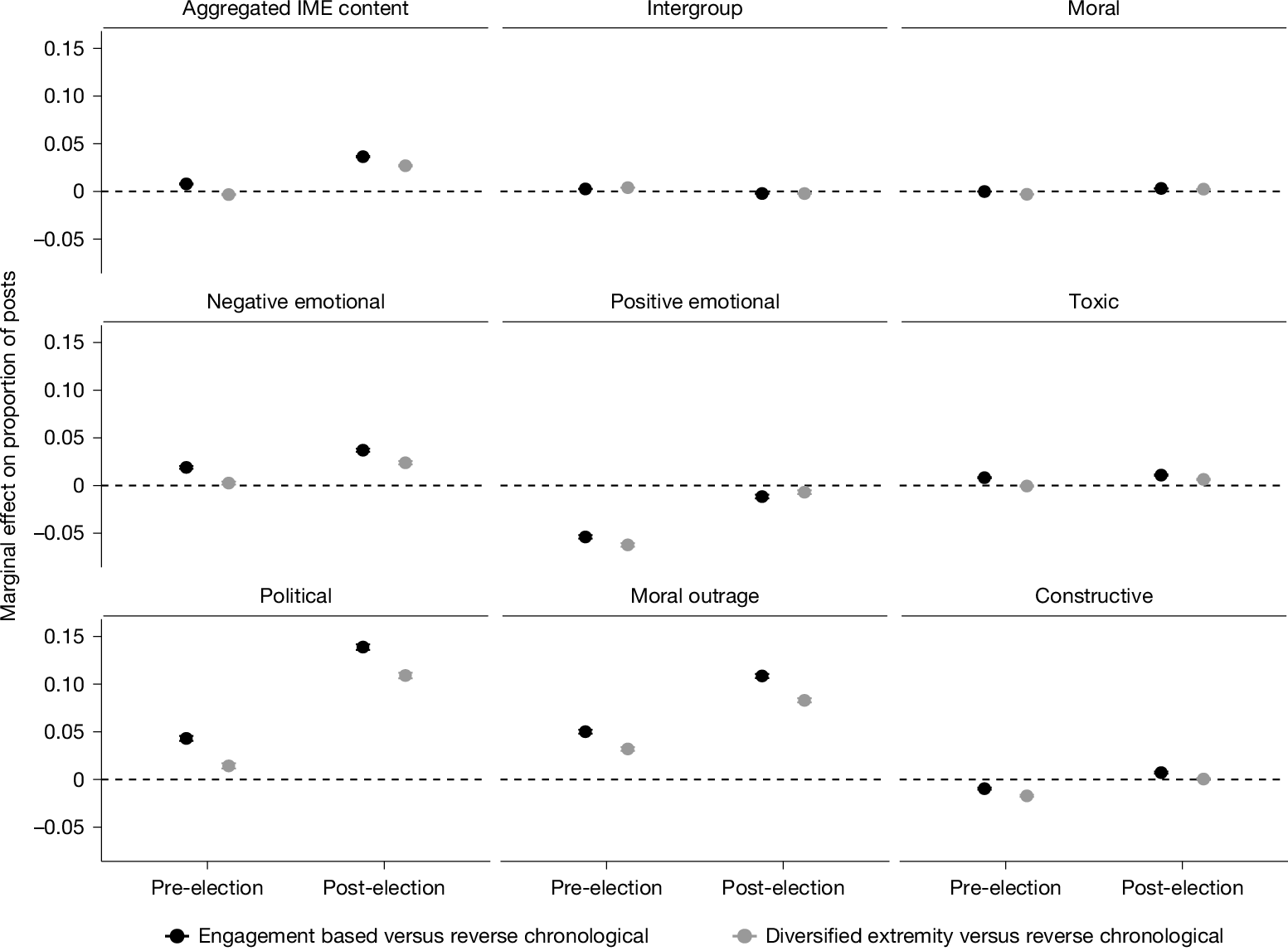
For the first time in history, civic discourse commonly occurs in digital environments in which algorithms influence exposure to social information1,2. It is increasingly important to understand whether and how these algorithms affect political discourse3–5. Here we built custom feed-ranking algorithms with full control over their features, and randomly assigned 2,000 participants to use them for 8 weeks (before and after the 2024 US presidential election). We tested whether an engagement-based algorithm (used on major social media platforms6,7) amplifies intergroup, moralized and emotional (IME) information in ways that skew perceptions of social norms around political dialogue5,8, and whether it increased engagement with IME content and perceptions of partisan animosity (compared with a reverse-chronological feed9,10). We also developed and tested a ‘diversified extremity’ algorithm to reduce the influence of extreme users11–13 to improve the accuracy of social norm perception14–16 and reduce perceptions of partisan animosity. We found that engagement-based feeds amplified IME and toxic content relative to reverse-chronological feeds, with the largest increases in moral outrage and political content. Engagement-based feeds also reduced prescriptive norm perception accuracy (albeit in an unexpected direction) and increased perceived partisan animosity. However, they did not significantly alter users’ own engagement behaviours. The diversified extremity algorithm reduced IME and toxic content exposure, improved prescriptive norm accuracy, yet maintained comparable platform enjoyment—suggesting that reducing the influence of extreme users can curb algorithmic distortions without diminishing user experience.