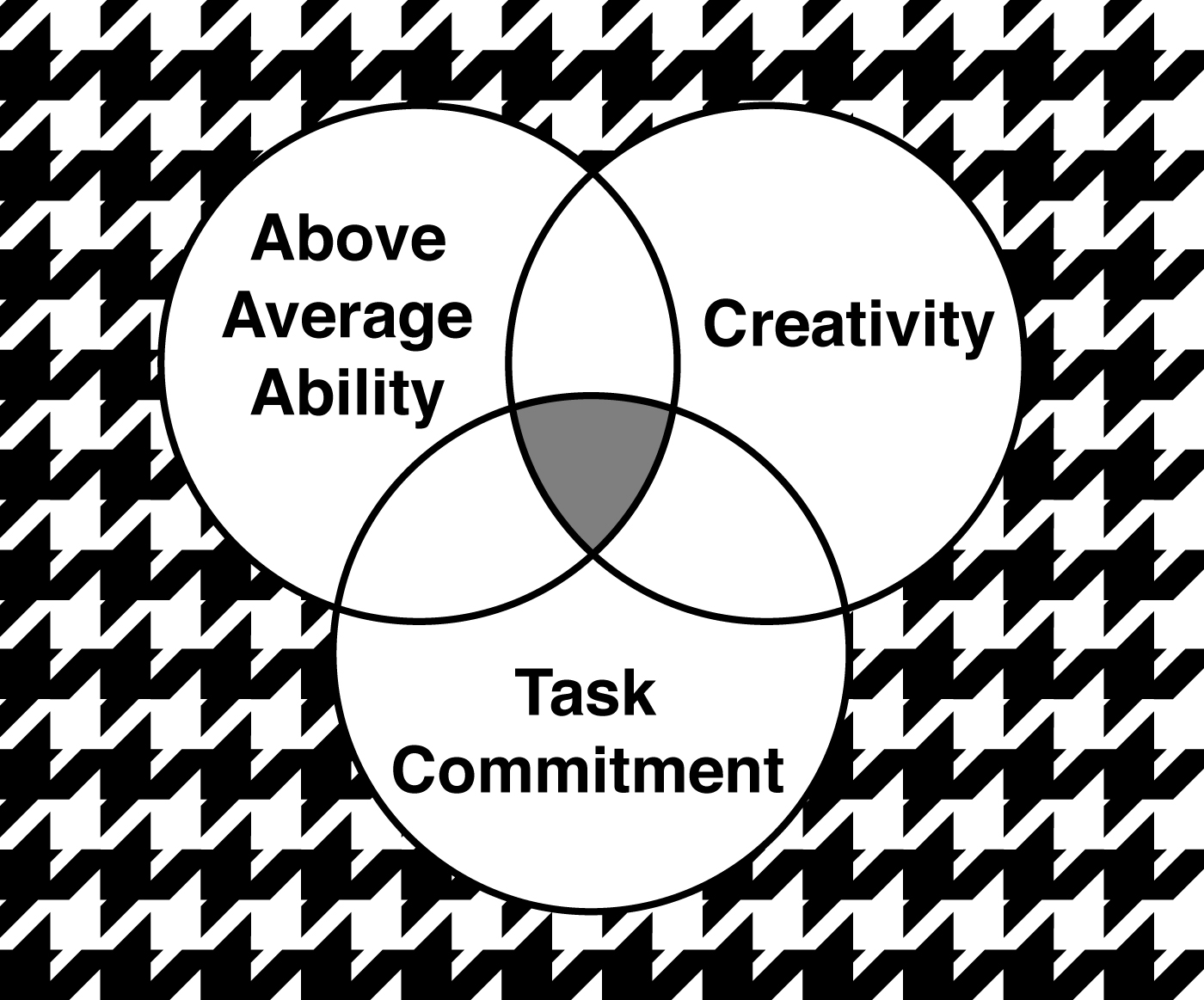
In Baum, S. M., Reis, S. M., & Maxfield, L. R. (Eds.). (1998). Nurturing the gifts and talents of primary grade students. Mansfield Center, CT: Creative ...
The Missed Neurodiversity: advocate for recognition and resources for gifted individuals - BC Association of Clinical Counsellors
Note: This article includes additional questions and answers and supplementary resources from the Member Profile interview with Debbie Clelland, RCC, published in the Fall 2021 issue of BCACC’s Insights magazine. “When […]
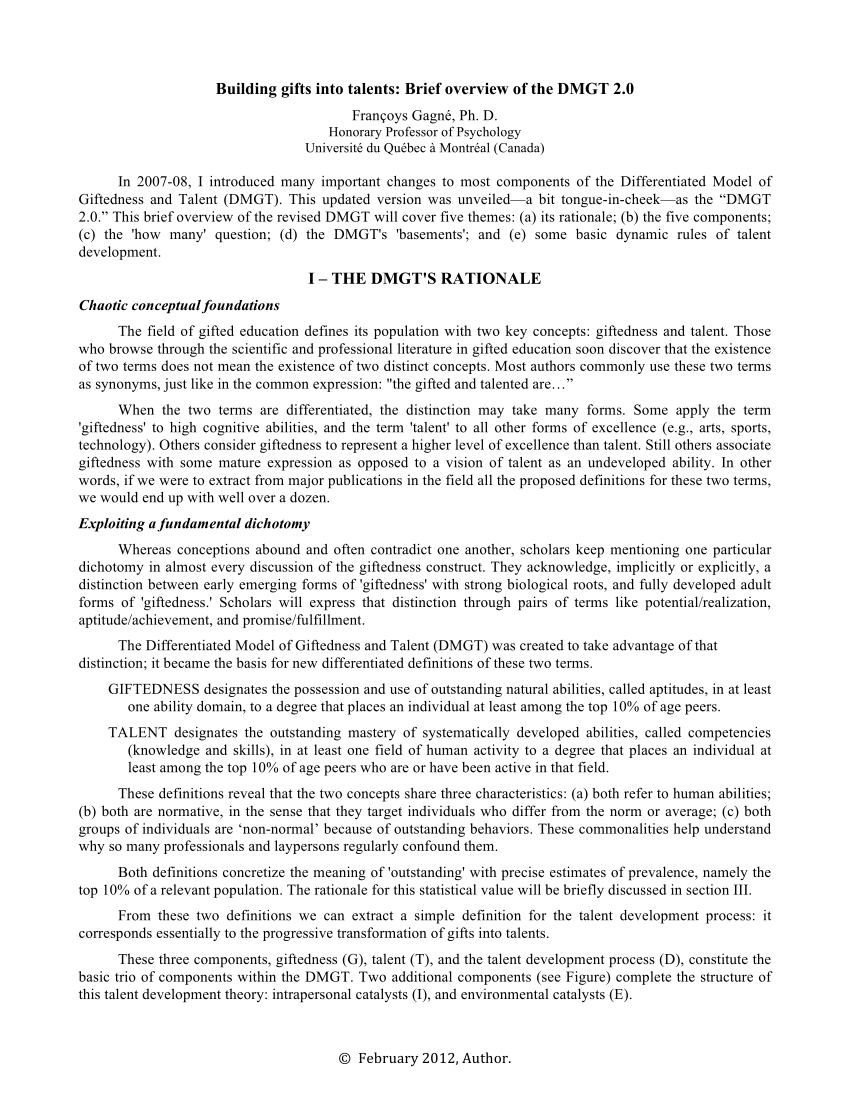
(PDF) Building gifts into talents: Detailed overview of the DMGT 2.0
PDF | On Jan 1, 2009, F. Gagné published Building gifts into talents: Detailed overview of the DMGT 2.0 | Find, read and cite all the research you need on ResearchGate
Living With the Gift of Giftedness: An Exploratory Study on the Well-Being of Intellectually Gifted Adults
While it is now argued that intellectual giftedness is not causally associated with well-being, the individual and environmental determinants associated remain empirically underexplored. Trying to fill this gap, this study investigated potential risk and protective factors on the well-being and mental health of 219 Canadian intellectually gifted adults. Exploratory transversal analyses were conducted between 11 determinants frequently evoked in the literature on intellectually gifted individuals and hedonic well-being (positive/negative affect; ∝ = .85-.87; satisfaction with life; ∝ = .88), eudemonic well-being (existential crisis/meaning in life; ∝ = .76-.87; interpersonal connection; ∝ = 92) and psychopathologies. Results show that twice-exceptionality and lower socioeconomic status are risk factors for the development of psychopathologies, while being married/in civil union and having a higher perceived level of potential achievement are protective factors for hedonic and eudemonic well-being. Results are discussed in light of previous knowledge about gifted individuals.

Geniuses with Autism & Asperger's | Hidden Talents ABA
Discover 15 inspiring figures with Autism or Asperger's, showcasing their contributions and resilience throughout history.

From gifted to high potential and twice exceptional: A state-of-the-art meta-review
Despite the abundant literature on intelligence and high potential individuals, there is still a lack of international consensus on the terminology and clinical characteristics associated to this population. It has been argued that unstandardized use of diagnosis tools and research methods make comparisons and interpretations of scientific and epidemiological evidence difficult in this field. If multiple cognitive and psychological models have attempted to explain the mechanisms underlying high potentiality, there is a need to confront new scientific evidence with the old, to uproot a global understanding of what constitutes the neurocognitive profile of high-potential in gifted individuals. Another particularly relevant aspect of applied research on high potentiality concerns the challenges faced by individuals referred to as "twice exceptional" in the field of education and in their socio-affective life. Some individuals have demonstrated high forms of intelligence together with learning, affective or neurodevelopmental disorders posing the question as to whether compensating or exacerbating psycho-cognitive mechanisms might underlie their observed behavior. Elucidating same will prove relevant to questions concerning the possible need for differential diagnosis tools, specialized educational and clinical support. A meta-review of the latest findings from neuroscience to developmental psychology, might help in the conception and reviewing of intervention strategies.
Lived experience of twice-exceptional adults
How educational programs can support the development of gifts and/or exceptional talents and the challenges faced by Autistic twice-exceptional students.

Talent is everywhere, opportunity is not. We are all losing out because of this
The world needs ideas and innovation to make progress. Creative and talented people are everywhere, but the opportunity to develop is limited to only a small number of well-off children. The world loses out as a result.
(PDF) The Four-C Model of Creativity: Culture and Context
PDF | In this chapter, we highlight the Four-C Model of creativity, which traces creative development from mini-c (personal creativity) to little-c... | Find, read and cite all the research you need on ResearchGate

Studi0xAlasky | Creative + Innovation Strategist
Alexa Chirnoaga | Interdisciplinary Strategist ✶ Creative + Innovation ✶ Visual Storytelling

Intersections in Music Education: Implications of Universal Design for Learning, Culturally Responsive Education, and Trauma-Informed Education for P–12 Praxis
To increase equity in music education, teachers can strive to know each student as a whole child, proactively remove barriers to learning, and seek to honor students’ multifaceted and intersectional identities. In this article, we first define intersectionality and examine demographics in music education. Then, we summarize three asset-based pedagogical approaches (Universal Design for Learning, Culturally Responsive Education, and Trauma-Informed Education) and synthesize their similarities. Finally, we present implications in the form of generative ideas for music educator praxis, or values-guided action. We hope our suggestions help music educators create music experiences where students (and families) feel seen, safe, welcomed, and valued as musicians and people. We also hope our suggestions can contribute to music teacher collegiality and collaboration by providing educators with tools to develop positive relationships with colleagues who are different from themselves.

What Makes Us Smart?
Human creativity does not solely rely on our individual cognitive abilities, but instead emerges from the recombination of ideas, practices, and approaches that result from social interactions and id...

Association for Talent Development | ATD
Association for Talent Development offers top resources, training, research, and team solutions to help L&D professionals develop talent and transform organizations worldwide.

Center for Educational Progress | CEP | Substack
A think tank centered on orienting education toward a culture of excellence. Click to read Center for Educational Progress, a Substack publication with thousands of subscribers.
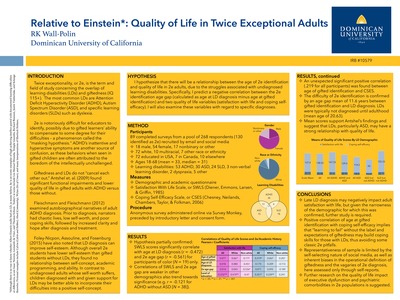
Relative to Einstein: Quality of Life in Twice Exceptional Adults
Twice exceptionality, or 2e, is the recently-coined term for the intersection of learning disabilities (LDs) and giftedness in an individual. Typically, these learning disabilities encompass ADHD, ASD, and/or specific learning disorders such as dyslexia. Because giftedness may obscure or compensate for a student’s academic struggles, and because institutional fixation on disability may overshadow intelligence, twice exceptionality is often missed by teachers and other authority figures in a child’s life. Given the ongoing difficulties of screening for twice exceptionality, it is likely that many 2e students have gone unidentified throughout most of their academic careers, without receiving the accommodations that would most benefit their studies. Furthermore, 2e adults whose schooling predated widespread awareness of twice exceptionality are more likely to have been diagnosed later in life. The twin prongs of identification and intervention for 2e youth make up the bulk of studies in the field. Today’s 2e youth are better-identified, better-studied, and better-supported than any previous generation, but 2e adults remain an understudied population. In addition to the difficulties and contradictions inherent in twice exceptionality, late identification and lack of support are likely to have negatively impacted twice exceptional adults, both in and out of the classroom. The present study will examine the ability of 2e adults to effectively cope with stressors in their lives, as well as their current level of life satisfaction. Approximately fifty or more 2e adults will be recruited through email and social media, and via the disability department of a small liberal arts university. Participants will be asked about their diagnostic histories and their experiences with higher education, and will then complete the Satisfaction With Life Scale (Diener, E., Emmons, R. A., Larsen, R. J., & Griffin, S., 1985) and Coping Self-Efficacy Scale (Chesney, M.A., Neilands, T.B., Chambers, D.B., Taylor, J.M., & Folkman, S., 2006). Data will be collected and analyzed in March and April 2017. We hypothesize that there will be a relationship between the age of identification as twice exceptional and adult quality of life, operationalized by Satisfaction with Life and Coping Self-Efficacy. Additionally, we will explore the relationships between specific diagnoses and these variables, as well as factors of race and gender. This study will provide information on an underserved and understudied group, and we hope it will provide a deeper understanding of the needs and strengths of this population.