Cross-Model Evaluation: kaish collection syntax across 7 LLMs (DeepSeek, Gemini, Claude, Gemma, GLM, Qwen) · GitHub
Open Models Inference for Coding · Umans AI
Hosted Kimi K3, GLM 5.2, and DeepSeek V4 Flash. Pay per token, on infrastructure we own.

The Kaitchup – AI on a Budget | Benjamin Marie | Substack
Weekly tutorials and news on adapting large language models (LLMs) to your tasks and hardware using the most recent techniques and models. The Kaitchup proposes a collection of 180+ AI notebooks regularly updated. Click to read The Kaitchup – AI on a Budget, by Benjamin Marie, a Substack publication with tens of thousands of subscribers.

Qwen3-Coder: Agentic Coding in the World
GITHUB HUGGING FACE MODELSCOPE DISCORD Today, we’re announcing Qwen3-Coder, our most agentic code model to date. Qwen3-Coder is available in multiple sizes, but we’re excited to introduce its most powerful variant first: Qwen3-Coder-480B-A35B-Instruct — a 480B-parameter Mixture-of-Experts model with 35B active parameters which supports the context length of 256K tokens natively and 1M tokens with extrapolation methods, offering exceptional performance in both coding and agentic tasks. Qwen3-Coder-480B-A35B-Instruct sets new state-of-the-art results among open models on Agentic Coding, Agentic Browser-Use, and Agentic Tool-Use, comparable to Claude Sonnet 4.
LLMs and World Models, Part 1
How do Large Language Models Make Sense of Their “Worlds”?

Scaling Laws Across Model Architectures: A Comparative Analysis of...
The scaling of large language models (LLMs) is a critical research area for the efficiency and effectiveness of model training and deployment. Our work investigates the transferability and...

Introducing Model Council
Today we are launching Model Council, a multi-model research feature that brings several models together for one answer.

The State of On-Device LLMs
Xuan-Son Nguyen, an engineer at Hugging Face, specializes in on-device large language models (LLMs) and runtime optimization, working extensively with llam...

The State of On-Device LLMs
Xuan-Son Nguyen, an engineer at Hugging Face, specializes in on-device large language models (LLMs) and runtime optimization, working extensively with llam...
Sebastian Raschka on Twitter / X
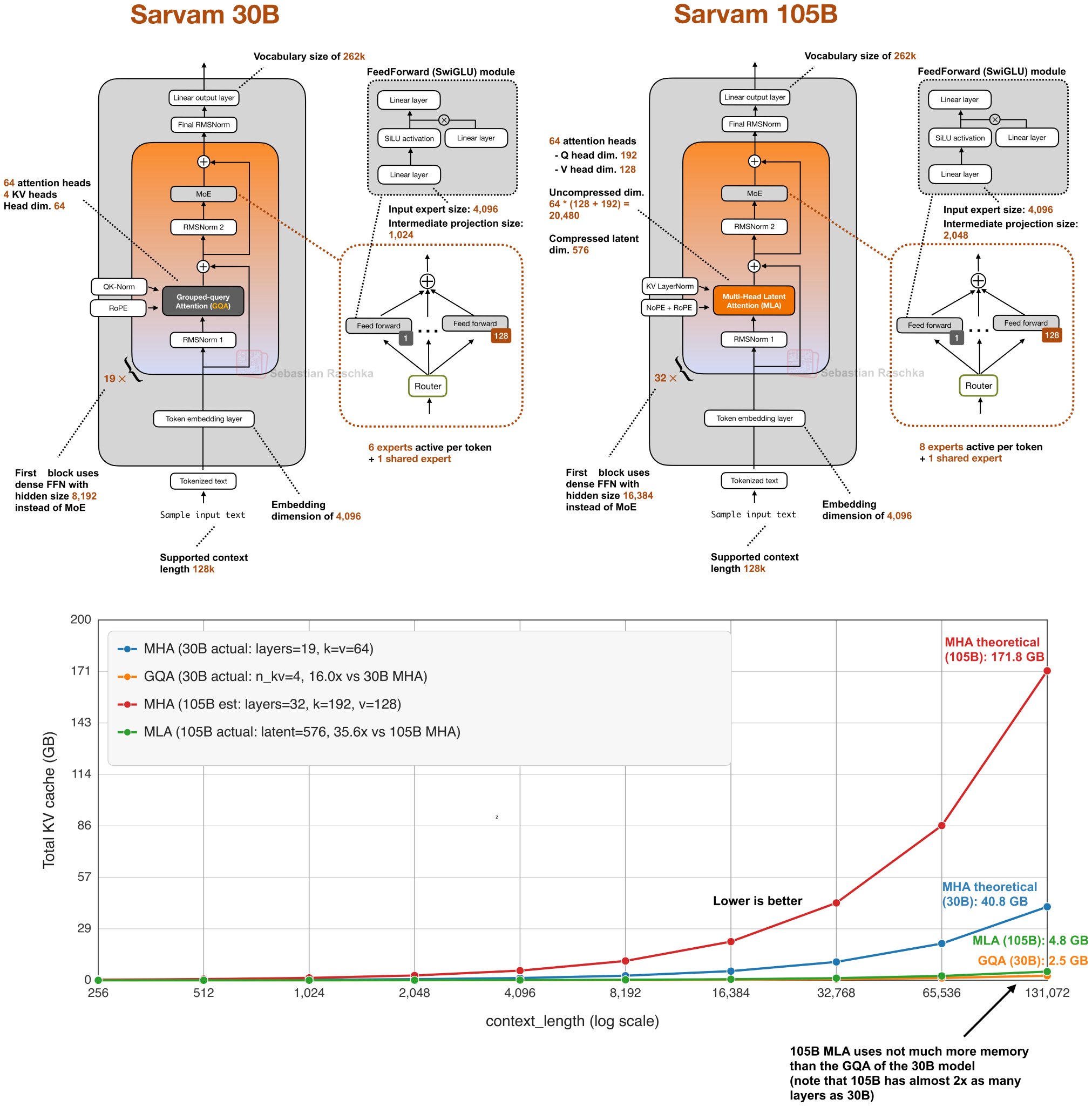
While waiting for DeepSeek V4 we got two very strong open-weight LLMs from India yesterday.There are two size flavors, Sarvam 30B and Sarvam 105B model (both reasoning models).Interestingly, the smaller 30B model uses “classic” Grouped Query Attention (GQA), whereas the… https://t.co/OiJVkDCYNz pic.twitter.com/0uqmLxofRE— Sebastian Raschka (@rasbt) March 7, 2026
Model Performance Evaluation to SubQ 1.1 Small Preview Performance Evaluation | Appen
A third-party benchmark assessment of Subquadratic's preview models, conducted by Appen across long-context retrieval, code generation, business-workflow automation, and graduate-level reasoning benchmarks.
8 Graphs Telling Today's Story of Open Models
The Case Against LLMs as Rerankers
Authors: Apoorva Joshi, Zhenmei Shi, Akshay Goindani, Hong LiuResearch Leads: Zhenmei Shi, Akshay Goindani, Hong Liu Large language models are increasingly being used for a broad range of tasks, in…

NeuralBench: A Unifying Framework to Benchmark NeuroAI Models | Hubert Banville
🧠 NeuralBench is now open source. Today we're releasing NeuralBench, a unified framework for benchmarking foundation models of brain activity, developed by the Brain & AI team at FAIR, Meta. 💻 Code: https://lnkd.in/dNJsgBgM 📄 White paper: https://lnkd.in/dvWMg7rx Brain foundation models are starting to show positive transfer to a range of downstream tasks, from brain-computer interfacing to clinical classification. But systematically evaluating them is hard: heterogeneous preprocessing pipelines, input structures, and adaptation methodologies make results difficult to compare. Most prior work also focuses on a narrow set of downstream tasks. NeuralBench addresses this by defining each task end-to-end with config files (data source, preprocessing, splits, optimiser, metrics, architecture) so all models can be evaluated on the same footing. What's in our first release, NeuralBench-EEG v1.0: ⚡ 36 EEG tasks across 94 public datasets, spanning motor imagery, clinical classification, cognitive decoding, and phenotype prediction. 🤖 Task-specific deep learning architectures (EEGNet, Deep4, EEGConformer, CTNet, ...) benchmarked side-by-side with recent EEG foundation models (BENDR, LaBraM, BIOT, CBraMod, LUNA, REVE). 🧩 Extensible to other neuroimaging modalities: the framework already runs MEG and fMRI tasks, leveraging our NeuralSet ecosystem for accessing brain imaging data and the broader neuroscientific software stack. 📜 Released under the MIT license. Help us make it better. Through our white paper, we invite the community to contribute new tasks, datasets, and models, especially for fMRI, MEG, and iEEG. The long-term goal is a fully unified benchmark across neuroimaging tasks and modalities. 🙏🙏🙏 This was a big team effort with Stéphane d'Ascoli, Simon Dahan, Jérémy RAPIN, Marlène Careil, Yohann Benchetrit, Jarod Lévy, Saarang P., Antoine Ratouchniak, Lucy (Mingfang) Zhang, Elisa Cascardi, Katie Begany, Teon Brooks, and Jean-Rémi King. Special thanks to Alexandre Gramfort, Thomas Moreau, Arnaud Delorme, Bruno A. and Pierre Guetschel for feedback and support. #Neuroscience #AI #NeuroAI #Python #OpenSource

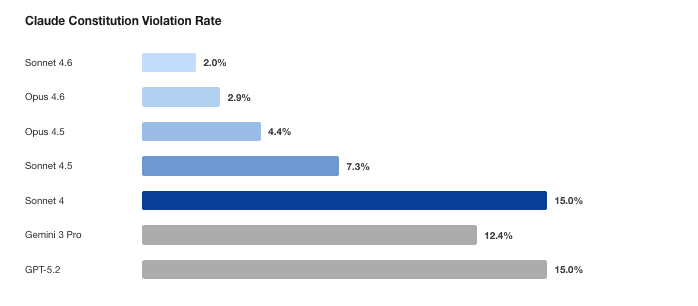
How well do models follow their constitutions? — LessWrong
This work was conducted during the MATS 9.0 program under Neel Nanda and Senthooran Rajamanoharan. …