A curated collection of papers, benchmarks, surveys, and tools for model quantization, covering low-bit networks, LLMs, multimodal and generative models, vector and lattice quantization, and efficient deployment.
Quantization from the ground up | ngrok blog
A complete guide to what quantization is, how it works, and how it's used to compress large language models
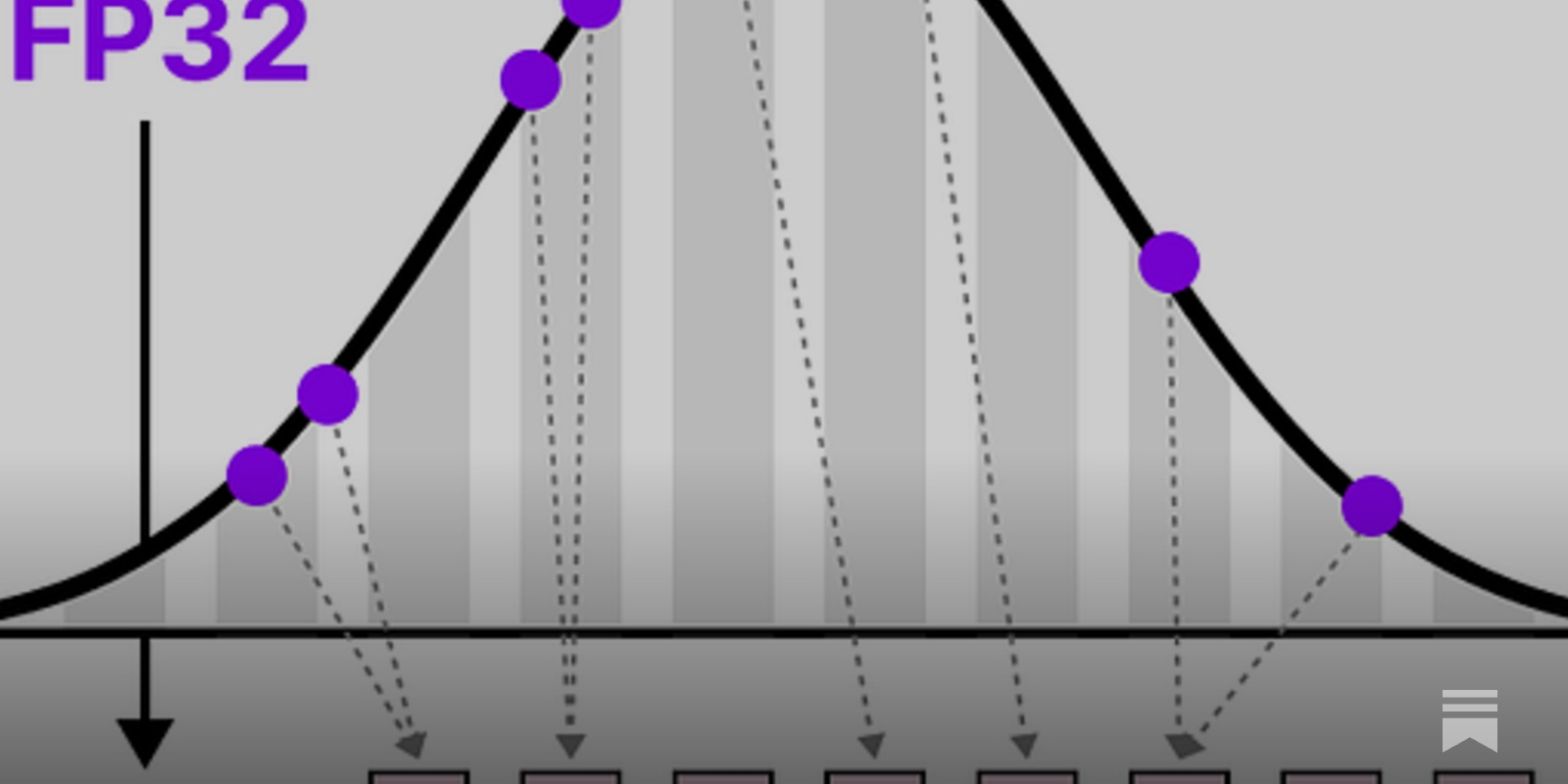
A Visual Guide to Quantization
Exploring memory-efficient techniques for LLMs
Benjamin Marie on Twitter / X
Quantization and Qwen3-VL✔️ AutoRound W4A16 (INT4)✔️ AutoRound NVFP4 (llm compressor format)❌ support by vLLM (tried stable and dev releases)VLMs are now very easy to quantize. And then we can’t use the models with fast inference frameworks like vLLM and SGLang.It…— Benjamin Marie (@bnjmn_marie) November 5, 2025
Reverse-engineering GGUF | Post-Training Quantization
A 4-Bit Model and a 1-Bit Index
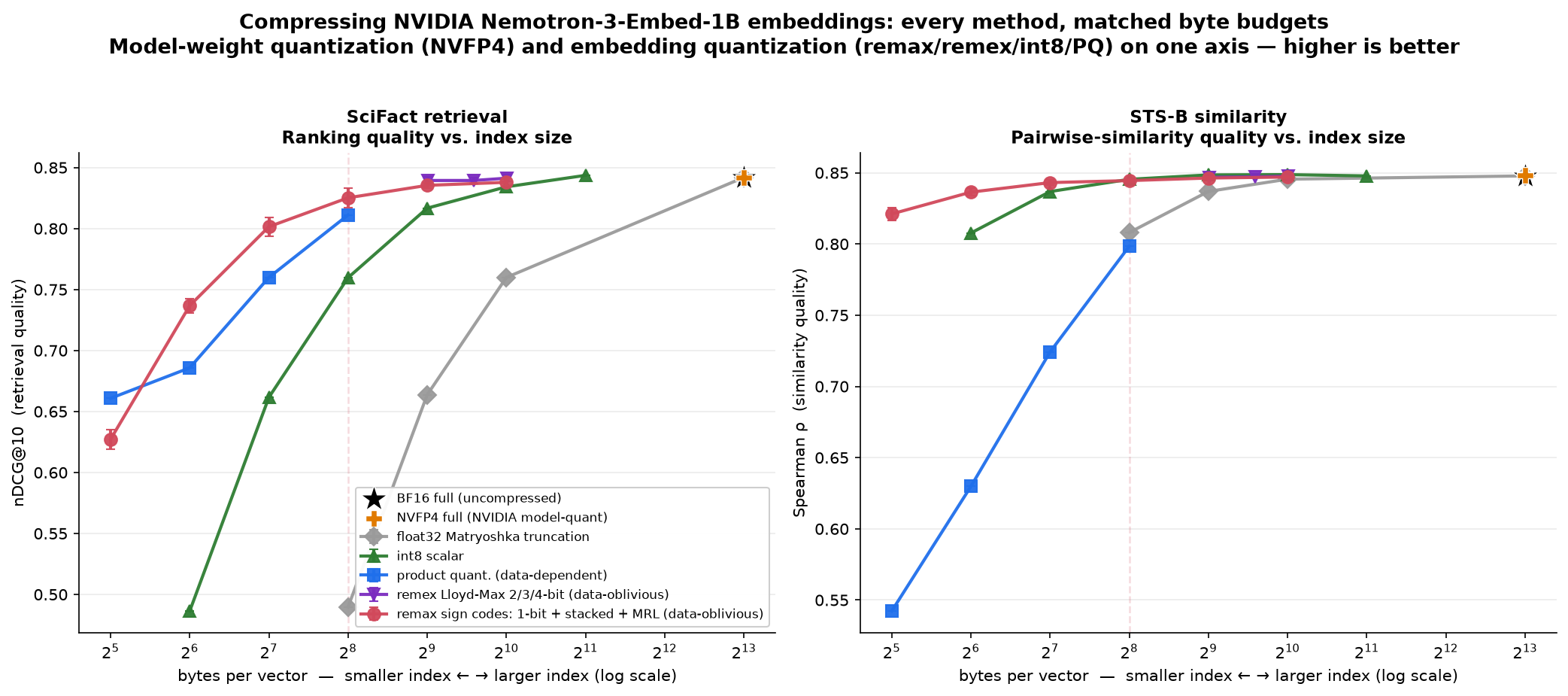
Running NVFP4 Nemotron on a CPU, then mapping every embedding-compression method at matched byte budgets. The two quantizations compose.
12britz/awesome-free-models
A curated list of free AI models, APIs, and tools you can use without paying a cent.
Dataset Condensation with Distribution Matching
Computational cost to train state-of-the-art deep models in many learning problems is rapidly increasing due to more sophisticated models and larger datasets. A recent promising direction to reduce training time is dataset condensation that aims to replace the original large training set with a significantly smaller learned synthetic set while preserving its information. While training deep models on the small set of condensed images can be extremely fast, their synthesis remains computationally expensive due to the complex bi-level optimization and second-order derivative computation. In this work, we propose a simple yet effective dataset condensation technique that requires significantly lower training cost with comparable performance by matching feature distributions of the synthetic and original training images in sampled embedding spaces. Thanks to its efficiency, we apply our method to more realistic and larger datasets with sophisticated neural architectures and achieve a significant performance boost while using larger synthetic training set. We also show various practical benefits of our method in continual learning and neural architecture search.
ggml
AI inference at the edge. ggml has 22 repositories available. Follow their code on GitHub.

TurboQuant: Redefining AI efficiency with extreme compression
Amir Zandieh, Research Scientist, and Vahab Mirrokni, VP and Google Fellow, Google Research

Dataset Condensation with Gradient Matching
As the state-of-the-art machine learning methods in many fields rely on larger datasets, storing datasets and training models on them become significantly more expensive. This paper proposes a training set synthesis technique for data-efficient learning, called Dataset Condensation, that learns to condense large dataset into a small set of informative synthetic samples for training deep neural networks from scratch. We formulate this goal as a gradient matching problem between the gradients of deep neural network weights that are trained on the original and our synthetic data. We rigorously evaluate its performance in several computer vision benchmarks and demonstrate that it significantly outperforms the state-of-the-art methods. Finally we explore the use of our method in continual learning and neural architecture search and report promising gains when limited memory and computations are available.
Dataset Distillation
Model distillation aims to distill the knowledge of a complex model into a simpler one. In this paper, we consider an alternative formulation called {\em dataset distillation}: we keep the model fixed and instead attempt to distill the knowledge from a large training dataset into a small one. The idea is to {\em synthesize} a small number of data points that do not need to come from the correct data distribution, but will, when given to the learning algorithm as training data, approximate the model trained on the original data. For example, we show that it is possible to compress $60,000$ MNIST training images into just $10$ synthetic {\em distilled images} (one per class) and achieve close to original performance with only a few steps of gradient descent, given a particular fixed network initialization. We evaluate our method in a wide range of initialization settings and with different learning objectives. Experiments on multiple datasets show the advantage of our approach compared to alternative methods in most settings.
Understanding AI/LLM Quantisation Through Interactive Visualisations
AI/LLM Quantisation Visualised
Liquid AI on Twitter / X
Today, we release LFM2.5-350M. Agentic loops at 350M parameters.A 350M model trained for reliable data extraction and tool use, where models at this scale typically struggle.<500MB when quantized, built for environments where compute, memory, and latency are constrained.🧵 pic.twitter.com/zZPKzcCwH9— Liquid AI (@liquidai) March 31, 2026

Overview - GroqDocs
Fast LLM inference, OpenAI-compatible. Simple to integrate, easy to scale. Start building in minutes.

Introducing Pipette: A benchmarking suite for on-device intelligence — Blog
Meet Pipette, an open-source platform for reproducible on-device AI benchmarks across models, quantization, runtimes and hardware.