

A reasonably fast DAG-CBOR parser for Python
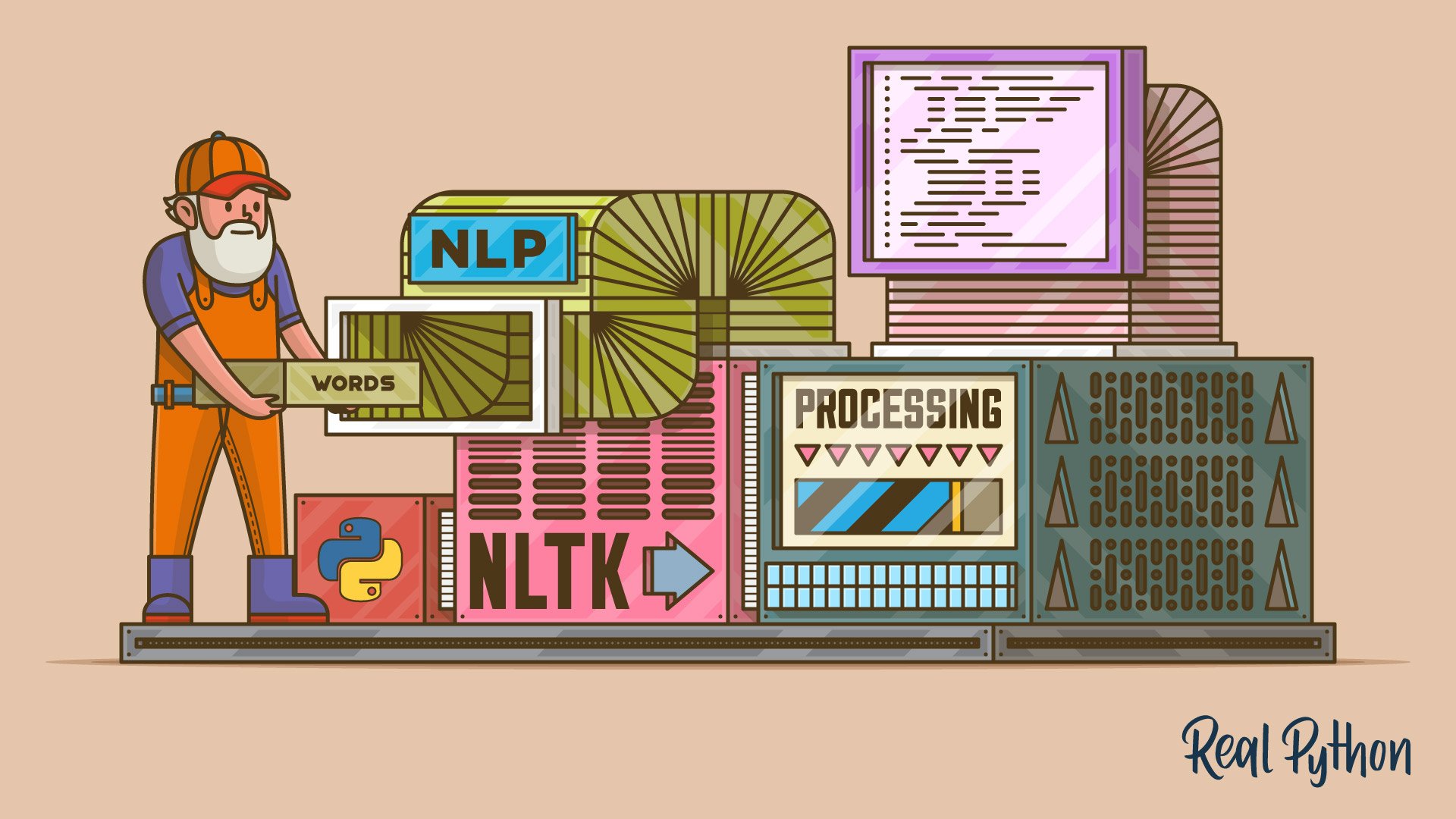
Natural Language Processing With Python's NLTK Package – Real Python
In this beginner-friendly tutorial, you'll take your first steps with Natural Language Processing (NLP) and Python's Natural Language Toolkit (NLTK). You'll learn how to process unstructured data in order to be able to analyze it and draw conclusions from it.
Engineering High-Performance Parsers with Data-Oriented Design
Notes from building Yuku: the AST is flat arrays of u32 indices instead of a pointer tree, and memory layout, allocation, strings, unicode, and serialization all follow from that one decision.
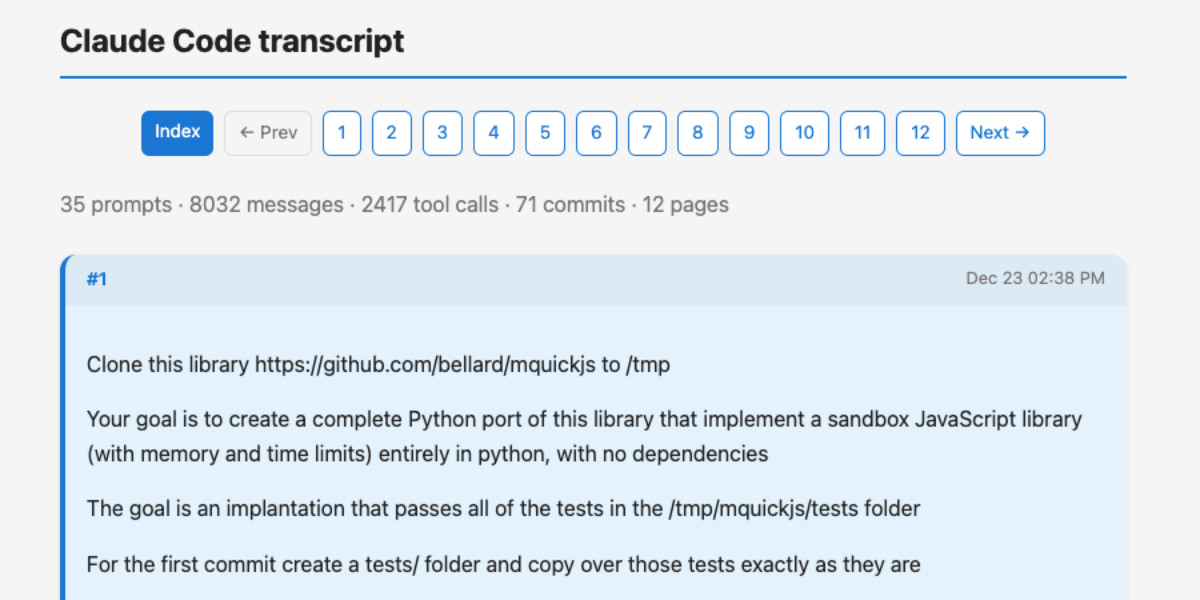
A new way to extract detailed transcripts from Claude Code
I’ve released claude-code-transcripts, a new Python CLI tool for converting Claude Code transcripts to detailed HTML pages that provide a better interface for understanding what Claude Code has done than …
Efficient and flexible incremental parsing | ACM Transactions on Programming Languages and Systems
Previously published algorithms for LR (k) incremental parsing are inefficient, unnecessarily restrictive, and in some cases incorrect. We present a simple algorithm based on parsing LR(k) sentential forms that can incrementally parse an arbitrary number ...

Introduction - Tree-sitter
Tree-sitter is a parser generator tool and an incremental parsing library. It can build a concrete syntax tree for a source file and efficiently update the syntax tree as the source file is edited. Tree-sitter aims to be:
MarshalX/python-libipld
🏎️ Fast Python library to work with IPLD: DAG-CBOR, CID, CAR, multibase
DSPy on Twitter / X
DSPy is the highest-bandwidth language to talk to computers in a just-precise-enough way.First 36 lines below:1. Take arbitrarily long content: `chunks`.2. Build a global Table of Contents.3. Distribute chunks into sections to be written.4. Recursively write each section. pic.twitter.com/7NN61isFLs— DSPy (@DSPyOSS) May 13, 2025

NLTK Book
This version of the NLTK book is updated for Python 3 and NLTK 3. The first edition of the book, published by O'Reilly, is available at http://nltk.org/book_1ed/. (There are currently no plans for a second edition of the book.)
SciPy 1.0: fundamental algorithms for scientific computing in Python
SciPy is an open-source scientific computing library for the Python programming language. Since its initial release in 2001, SciPy has become a de facto standard for leveraging scientific algorithms in Python, with over 600 unique code contributors, thousands of dependent packages, over 100,000 dependent repositories and millions of downloads per year. In this work, we provide an overview of the capabilities and development practices of SciPy 1.0 and highlight some recent technical developments.

Structured LLM output from ATProto Lexicons
LangExtract
A Python library for extracting structured information from unstructured text using LLMs with precise source grounding and interactive visualization.
kellyjonbrazil/jc
CLI tool and python library that converts the output of popular command-line tools, file-types, and common strings to JSON, YAML, or Dictionaries. This allows piping of output to tools like jq and simplifying automation scripts.