

Lore is a next-generation, open source revision control system
Learn about Lore: next-generation open source version control
Maintained by Epic Games, Lore is designed for unprecedented scalability of both data and teams. It’s optimized for projects that combine code with large binary assets.
The Lore Version Control System - Lore Developer Documentation
A reference document explaining the rationale, goals, and theoretical design of Lore. This is not a peer-reviewed paper; it is a public-facing standalone description of the system, intended to make the why of Lore - the problems it was built to solve and the design choices that follow from those problems - as legible as a reader can make it without reading the source code.
v2 Editor Manifesto
The manifesto for our brand new rich text editor with version control capabilities, v2. In this post, we describe the basic principles, design decisions and our vision for v2, alongside reflecting on the current state and potential future of knowledge production in society.
Universal Version Control
Building tools to help people explore alternatives, keep track of history, and collaborate better, across all kinds of media.

01 · Universal version control
We believe that simple, powerful, universal version control tools could help all kinds of creators produce better work.
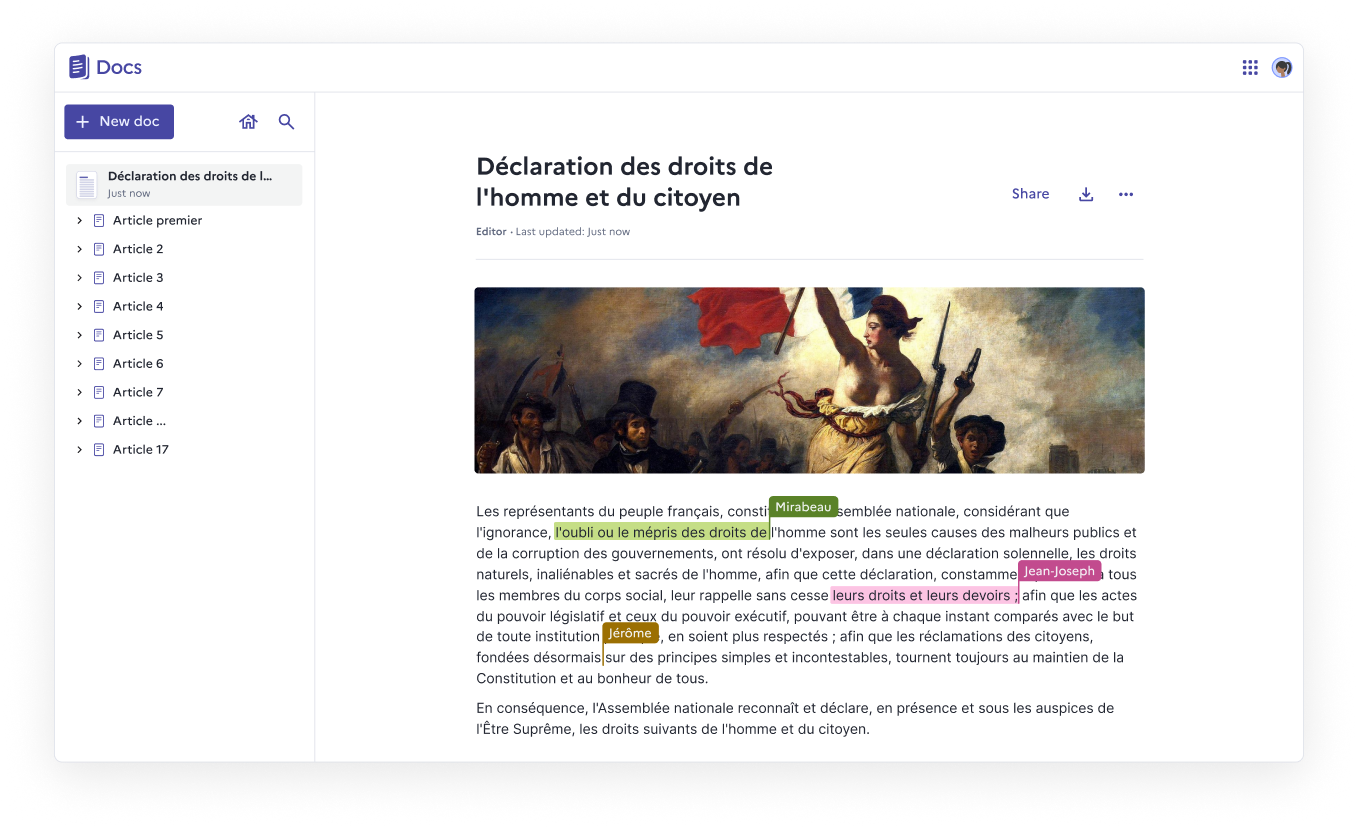
Docs — Turn your team's content into knowledge
Docs is the open-source document editor that turns your team's content into knowledge: real-time collaboration, structured knowledge, and full data ownership. Self-host it anywhere, or try a public instance in seconds.
Software Is Made Between Commits
From the Zed Blog: Agents turned the conversation into the real source of our software. DeltaDB is the version control built for it.
lore.farm — Collectivized Canon for Fictional Worlds
Create fictional worlds and build a shared canon with your community from across the ATmosphere. Includes support for Bluesky, Branchline, and more!

Announcing Changesets v3 | Changesets
A tool to manage versioning and changelogs with a focus on monorepos
panproto/panproto
One engine for schematic version control within and across any schema language.
Home – DVC
Open-source version control system for Data Science and Machine Learning projects. Git-like experience to organize your data, models, and experiments.
Redesigning source control at Anthropic
As our merges per day grew more than tenfold, source control became our biggest development bottleneck. Here, we share how we migrated to an in-house version control system in five months.

Discovered an open source alternative to DeepWiki recently, made by @sashimikun-void.bsky.social & friends. I believe that app archetype is an outstanding use case for ‘version-control everything, so your AI-agent can’t break anything or make a mess’. Chime in here: github.com/AsyncFuncAI/deepwiki-open/iss…

CRDT storage (universal version-control) · Issue #181 · AsyncFuncAI/deepwiki-open
github.com