

A neurosymbolic perspective on LLMs. Contribute to ExtensityAI/symbolicai development by creating an account on GitHub.
François Chollet on Twitter / X
I would have assumed it was fairly obvious, but in case it's not: a million-line codebase (also known as a "harness"), running at inference time, orchestrating thousands of calls to a neural network for any given task, is the exact definition of a "neurosymbolic architecture"— François Chollet (@fchollet) August 6, 2026
Vehicle: Bridging the Embedding Gap in the Verification of...
Neuro-symbolic programs, i.e. programs containing both machine learning components and traditional symbolic code, are becoming increasingly widespread. Finding a general methodology for verifying...

GitHub - humanlayer/12-factor-agents at sidebar
What are the principles we can use to build LLM-powered software that is actually good enough to put in the hands of production customers? - GitHub - humanlayer/12-factor-agents at sidebar

Andrej Karpathy on Twitter / X
The race for LLM "cognitive core" - a few billion param model that maximally sacrifices encyclopedic knowledge for capability. It lives always-on and by default on every computer as the kernel of LLM personal computing.Its features are slowly crystalizing:- Natively multimodal… https://t.co/2jsVevkTSJ— Andrej Karpathy (@karpathy) June 27, 2025
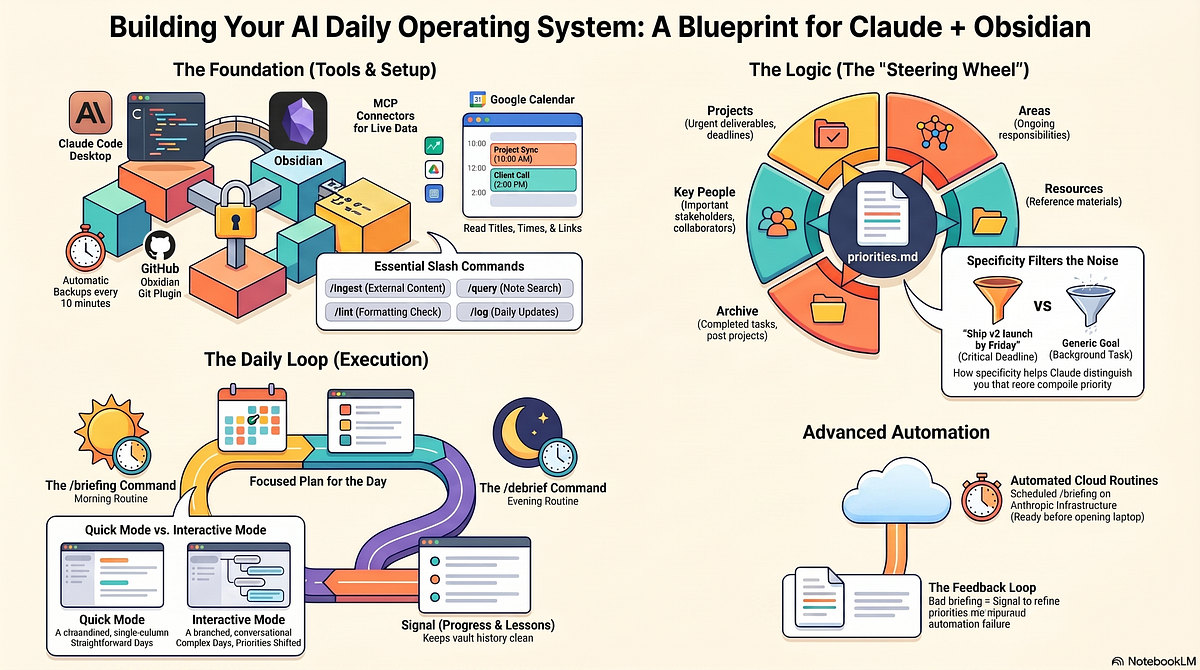
Automate AI Second Brain(LLM Wiki Pattern) With Claude Code and Obsidian
TLDR:Build an AI second brain with Claude Code & Obsidian. Automate daily briefings, backups & calendar sync.

NeuroAI
Neuroscience, cognitive science, and AI are all questing for principles that help generalization. Learn more through a live, synchronous program designed for focused, hands-on learning.
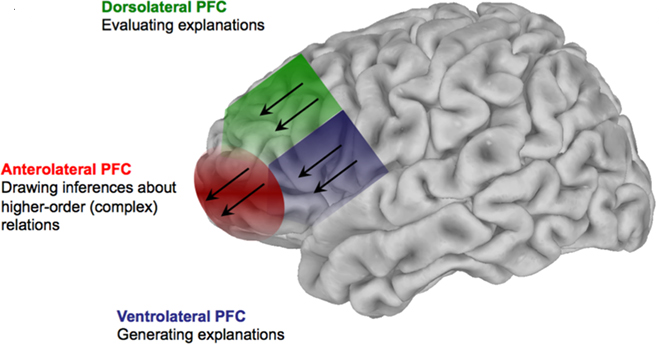
How LLMs are and are not like the brain
Hi from buttondown! At the bottom of this newsletter is a bit of administrivia about the new platform How LLMs are and are not like the brain Beneath all the...
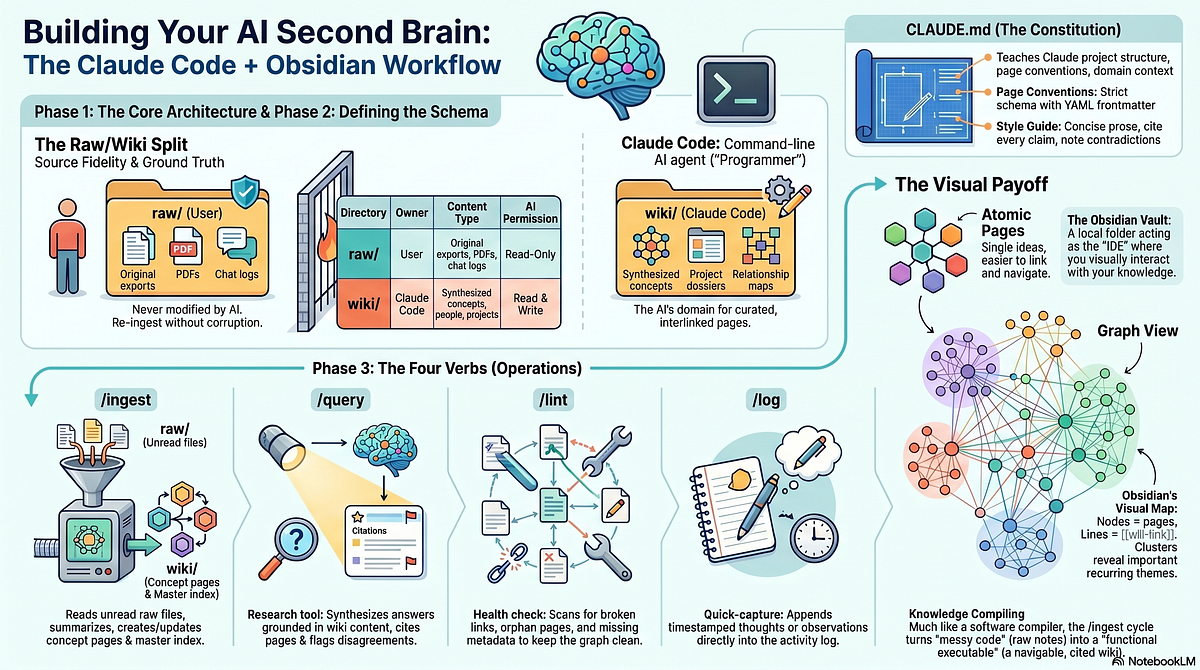
Build an AI Second Brain(LLM Wiki Pattern) With Claude Code and Obsidian
TLDR:Build an AI-powered knowledge base in Obsidian. Use Claude Code slash commands to ingest, link, and query your notes into a smart…
LLM Neuroanatomy: How I Topped the LLM Leaderboard Without Changing a Single Weight
ML, Biotech, Hardware, and Coordination Problems. Sometimes I write about hard problems and how to solve them.
AI Data Centers Will Be Obsolete (Geometric Reasoning Explained)
My AI Skeptic Friends Are All Nuts
My smartest friends have bananas arguments about LLM coding.

My AI Skeptic Friends Are All Nuts
My smartest friends have bananas arguments about LLM coding.
MainPage8
The InfoCentral project has historically been focused more heavily upon the symbolic (human-meaningful) side of AI. This included derivatives of Semantic Web and related knowledge representation research, which were dependent on human effort to curate and categorize structured data. The symbolic approach to AI has largely lost the race to the neuro/neuro-symbolic (opaque vectors, statistical) side of AI research, notably the success of the Large Language Model (LLM) paradigm. Due to its faculties with natural language, remarkably little human involvement is needed to infer structure and meaning from traditional (mostly unstructured) information. As such, some of the approaches previously explored in the InfoCentral project have lost relevance. That said, LLM-based tools can perhaps help us finish the symbolic side of the grand AI project, by doing the tedious work that humans were reluctant to do! It has long been theorized that a combination of approaches will ultimately provide the most robust and performant systems, able to work with messy transient unstructured information while also building networks of verifiable persistent structured information that both humans and machines can cross-verify. This may prove useful in both ensuring that future AI systems remain aligned to human goals and values and that inevitable abuses and failures can be easily recovered from. To that end, some research results of this project may be re-usable in a new context.
#neuroscience #ai #python #opensource #neuroai | Jean-Rémi King
⚡ We're happy to release NeuralSet: a fast, simple, and scalable Python framework for Neuro-AI. Already supports: 🧠 fMRI, EEG, MEG, iEEG, spikes… recordings 💬 text, 🔊 audio, ▶️ video, 🏞️ image… embeddings 📦 `pip install neuralset` 💻 Code: https://lnkd.in/eamwxBUY 📄 Paper: https://lnkd.in/epbreyDy Made possible thanks to: Hubert Banville, Katie Begany, Corentin Bel, Yohann Benchetrit, Teon Brooks, Marlène Careil, Simon Dahan, Stéphane d'Ascoli, Alexandre Défossez, Linnea Evanson, PhD, Pablo J. Diego Simón, Julien Gadonneix, Sophia Houhamdi, Shubh Khanna, Jarod Lévy, Pierre Orhan, Antoine Ratouchniak, Joséphine Raugel, Andrea Elena Santos Revilla, Alexis Thual, Lucy (Mingfang) Zhang, Jérémy RAPIN #Neuroscience #AI #Python #OpenSource #NeuroAI