

100% local ML models for meeting transcription and analysis
The Obsidian heads were right.
talat - the local transcription app for meetings, dictation, and recordings
talat is the local transcription app for meetings, dictation, and recordings: an AI note-taker that captures both sides of every conversation and transcribes in real time, entirely on your own computer. Nothing you say is ever uploaded.

✨🧠 Tribe v2, our latest model of human brain responses to sound, sight and language can now be (partly) explored on your phone📱: ▶️demo: https://lnkd.in/eT6uFMnm 📄paper: https://lnkd.in/eDbFsmHx… | Jean-Rémi King | 10 comments
✨🧠 Tribe v2, our latest model of human brain responses to sound, sight and language can now be (partly) explored on your phone📱: ▶️demo: https://lnkd.in/eT6uFMnm 📄paper: https://lnkd.in/eDbFsmHx 💻code: https://lnkd.in/eTtKHu_7 | 10 comments on LinkedIn
SpecAssist: Smart Glasses with Real-time speech recognition and transcription for the hearing impaired
Download Reference Data on IJERT | On 01-07-2023 by Noel Jacob, Rajat Mathew, Sathwik P Nair, Prof. Divya Sunny published SpecAssist: Smart Glasses with Real-time speech recognition and transcription for the hearing impaired
Introducing TRIBE v2: AI Model Predicts Human Brain Responses | AI at Meta posted on the topic | LinkedIn
Today we're introducing TRIBE v2, a foundation model trained to predict how the human brain responds to almost any sight or sound. Building on our Algonauts 2025 award-winning architecture, TRIBE v2 draws on 500+ hours of fMRI recordings from 700+ people to create a digital twin of neural activity. It enables zero-shot predictions for new subjects, languages, and tasks, consistently outperforming standard modeling approaches. We’re releasing the model, codebase, paper, and an interactive demo to help researchers advance neuroscience, apply brain insights to build better AI, and use computational simulation to speed up breakthroughs in neurological disease diagnosis and treatment. Try the demo and learn more here: https://go.meta.me/tribe2 | 175 comments on LinkedIn
turantekin/Parrot
Meeting recorder for your Mac with a live AI copilot. On-device transcription, answers from your own docs mid-call. Local-first and open source.
Announcing transcribe.cpp
Meet transcribe.cpp, a new open-source C/C++ speech-to-text inference library with portable, GPU-accelerated support for multiple STT models. Developed through Mozilla.ai's Builders in Residence program, it makes adding fast, local transcription to applications easier than ever.
Launching a free, open-source, on-device transcription app
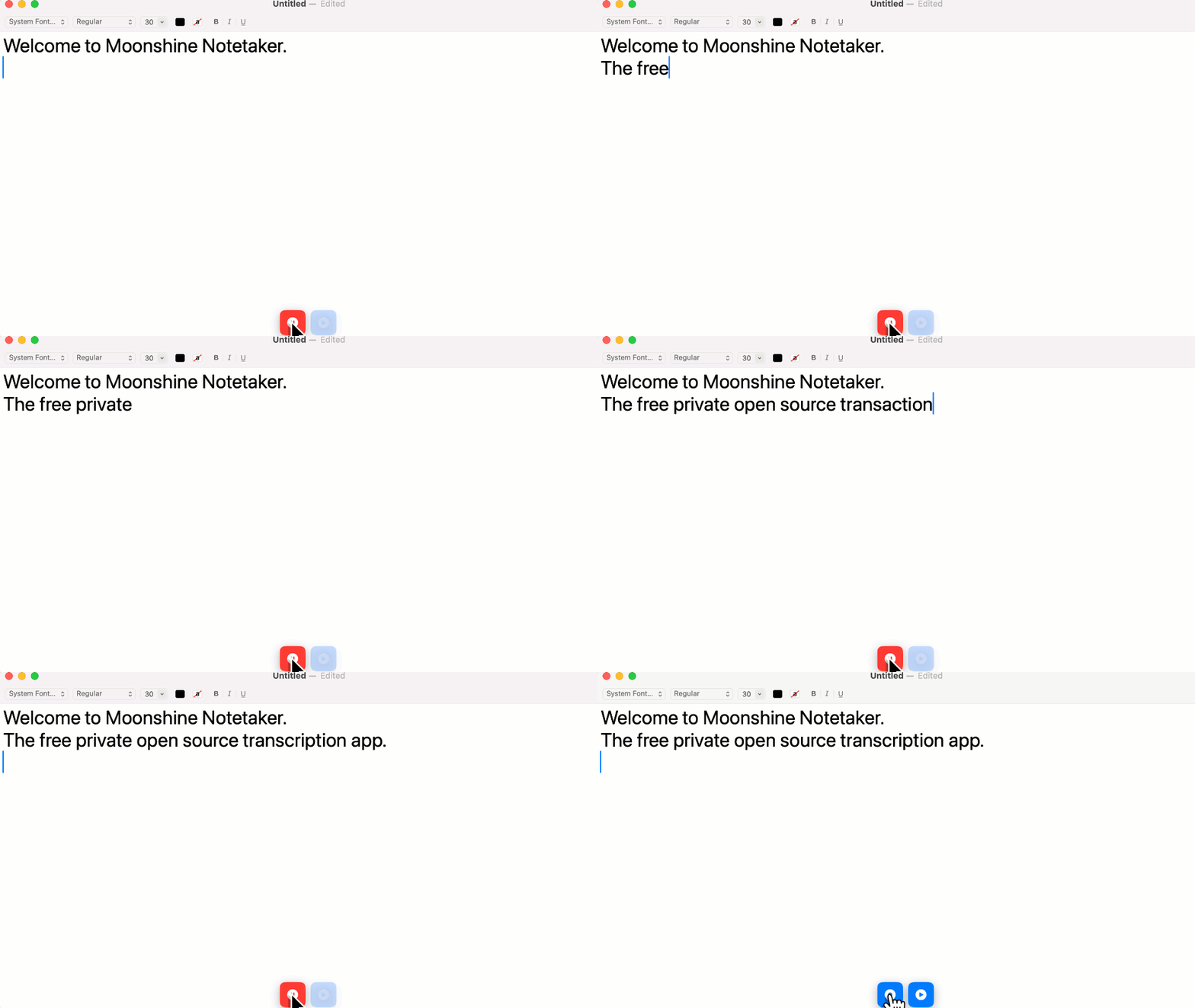
TL;DR – Please try Moonshine Note Taker on your Mac! For years I’ve been telling people that AI wants to be local, that on-device models aren’t just a poor man’s alternative…
Foundation Model Predicts Brain Responses to Visual and Auditory Stimuli | Elisa Cascardi posted on the topic | LinkedIn
Thrilled to share this work with the world! Today, we're releasing a foundation model that predicts how the human brain responds to almost any sight or sound -- and replace the need for human scans to significantly fast-track neuroscience and clinical research. 🧠 With this model, we can simulate brain responses to advance our understanding of the brain -- without the need for costly human brain scans 🌐 By using improved understanding of how efficient our brains perceive the world around us, we can guide the development of more advanced AI systems 👩⚕️ With computer-simulated experimentation, we can now speedup clinical research to diagnose neurological diseases and find treatments faster We've open sourced the model and code for researchers to use and build on, and an interactive demo for you to learn more -- see below! 📄 Paper: https://lnkd.in/e7cbunJp 💻 Code: https://lnkd.in/ebwBVuJp ▶️ Demo: https://lnkd.in/eEUVxP4S 🤗 Model: https://lnkd.in/e2T8nPJP So thrilled to be a part of this team with Stéphane d'Ascoli Jean-Rémi King Jérémy RAPIN Yohann Benchetrit Teon Brooks Katelyn Begany Joséphine Raugel Hubert Banville and for the great teamwork with Diego Marcos Dominic Giardini bringing this research to life! #neuroscience #AI #aiforscience #opensource #neuroAI
Voice AI & Voice Agents | An Illustrated Primer
A comprehensive guide to voice AI in 2026
nubrain - A foundation model for neural decoding
Building the world's largest dataset of human brain activity.

SpectraBase - Spectral Database
Access to millions of NMR, IR, Raman, UV-Vis, and mass spectra*
🚨 We're very happy to introduce TRIBE v2: a foundation model of the human brain's responses to sight, sound, and language. Leveraging 1,000+ hours of fMRI across 720 subjects, it generalizes… | Stéphane d'Ascoli | 16 comments
🚨 We're very happy to introduce TRIBE v2: a foundation model of the human brain's responses to sight, sound, and language. Leveraging 1,000+ hours of fMRI across 720 subjects, it generalizes zero-shot to new stimuli, tasks and people, finetunes efficiently, and enables in-silico experiments. ❓How does it work? Stemming from our v1, which won the Algonauts 2025 challenge, TRIBE v2 combines video, audio, and language embeddings to predict brain activity for any brain, then adapts to each individual. Key results: 📊 High-quality predictions — TRIBE v2 predicts brain activity across cortical and subcortical regions, significantly better than standard linear models, with a log-linear scaling law and no plateau in sight. 🎯 Zero-shot generalization — Without retraining, the predictions of TRIBE v2 are more correlated with group-averaged brain responses than almost any individual fMRI scan! A short finetuning step vastly improves over linear models trained, from scratch, on each individual. 🧪 In-silico experiments — Can we do useful experiments with TRIBE v2? Yes: classic vision and language paradigms replicate in-silico. It zero-shot recovers the FFA, PPA, EBA, VWFA, Broca's lateralization, and syntactic responses in STG — all without training on these artificial tasks. 🔍 Interpretability & multimodality — ICA on the weights rediscovers known functional networks (auditory, language, motion, default mode, visual) from naturalistic data alone. Ablating modalities further maps how vision, audition, and language integrate, with the largest gains at the temporo-parietal-occipital junction. 🧠 This effort is a step toward a foundation model of the human brain. Much remains to be understood, but we hope this opens a path for neuroscience, AI, and medical research alike. All code, weights, and a live demo are open — find it useful or mistaken in some conditions? Let us know, new test cases can only help improving this effort. 📄 Paper: https://lnkd.in/e7cbunJp 💻 Code: https://lnkd.in/ebwBVuJp ▶️ Demo: https://lnkd.in/eEUVxP4S 🤗 Model: https://lnkd.in/e2T8nPJP Joint work with Jérémy RAPIN, Yohann Benchetrit, Teon Brooks, Katie Begany, Joséphine Raugel, Hubert Banville and Jean-Rémi King. 🙏 Special thanks to Elisa Cascardi, Diego Marcos, Dominic Giardini, AI at Meta, and the open-source and neuroscience communities (in particular Lune Bellec and Bertrand Thirion for the amazing Courtois NeuroMod and IBC datasets) | 16 comments on LinkedIn
A foundation model of vision, audition, and language for in-silico neuroscience | Research - AI at Meta
Cognitive neuroscience is fragmented into specialized models, each tailored to specific experimental paradigms, hence preventing a unified model of...
ResolVI: addressing noise and bias in spatial transcriptomics
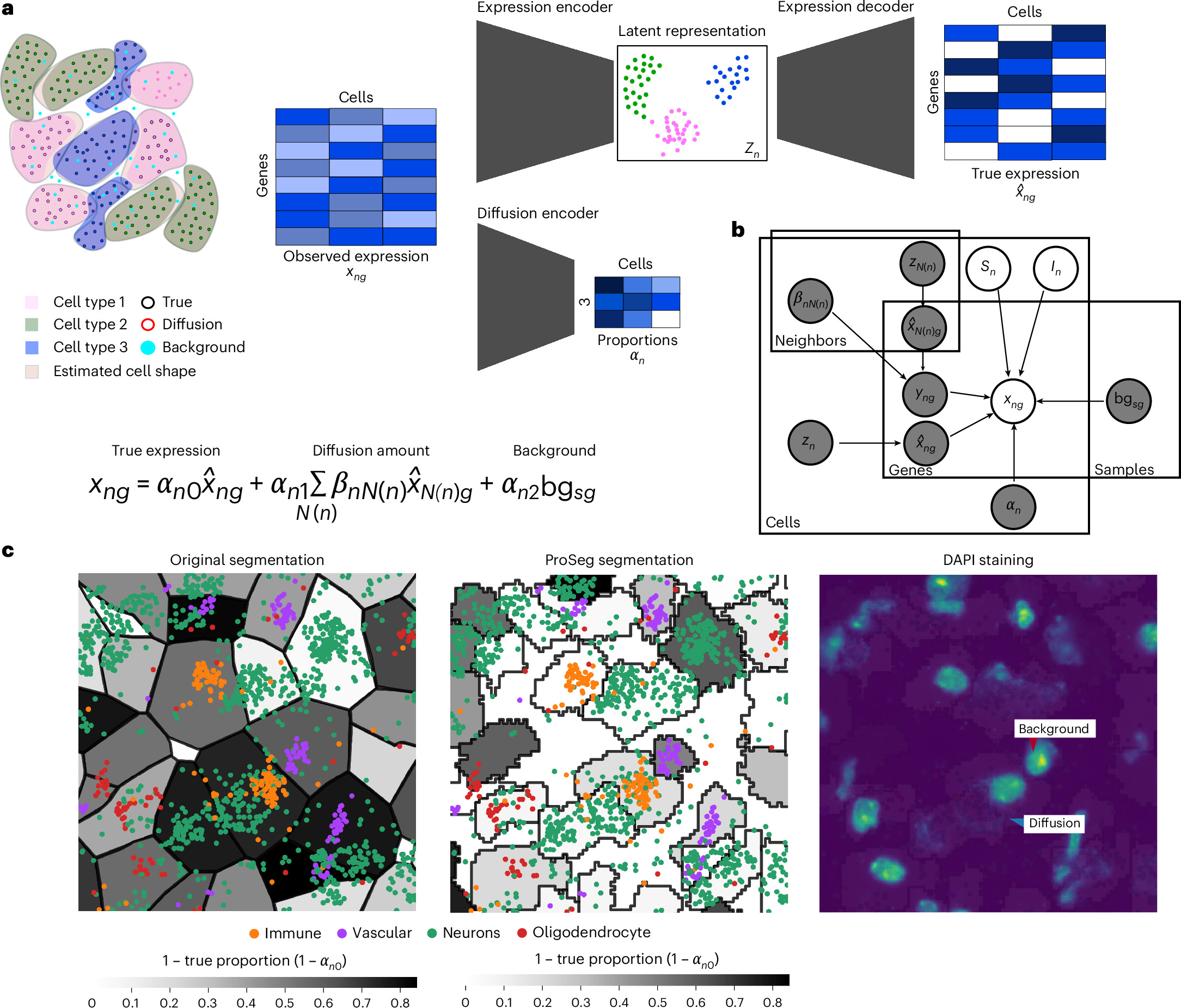
Technologies for estimating RNA expression at high throughput, in intact tissue slices and with high spatial resolution (spatial transcriptomics) shed new light on how cells communicate and tissues function. A fundamental step in analyzing data generated by subcellular resolution spatial transcriptomics technologies is quantification, namely, segmenting the plane into regions, each approximating a cell, and then collating the molecules inside each region to estimate the cellular expression profile. Despite many advances in this area, a persistent problem is that of the incorrect assignment of molecules to cells, which limits many current applications to the level of a priori-defined cell subsets and complicates the discovery of novel cell states. Here we develop resolVI, a model that operates downstream of any segmentation algorithm to generate a probabilistic representation, correcting for the misassignment of molecules, as well as for batch effects and other nuisance factors. We demonstrate that resolVI improves our ability to distinguish between cell states, identify subtle expression changes in space and perform integrated analysis across datasets. ResolVI is available as open source software within scvi-tools.
Introducing **transcribe.cpp** 🎙️ A new open-source C/C++ speech-to-text inference library for fast, local transcription. ✅ Multiple GGUF STT models ✅ GPU acceleration (Metal, Vulkan & CUDA) ✅ Portable across platforms Built through @mozilla.ai's BiR program. Blog: blog.mozilla.ai/announcing-transcribe-cpp/

Announcing transcribe.cpp
blog.mozilla.ai