

Mbin: a federated content aggregator, voting, discussion and microblogging platform
Looking AT the Blue Skies of Bluesky
The pitfalls of centralized social networks, such as Facebook and Twitter/X, have led to concerns about control, transparency, and accountability. Decentralized social networks have emerged as a result with the goal of empowering users. These decentralized approaches come with their own trade-offs, and therefore multiple architectures exist. In this paper, we conduct the first large-scale analysis of Bluesky, a prominent decentralized microblogging platform. In contrast to alternative approaches (e.g. Mastodon), Bluesky decomposes and opens the key functions of the platform into subcomponents that can be provided by third party stakeholders. We collect a comprehensive dataset covering all the key elements of Bluesky, study user activity and assess the diversity of providers for each sub-components.

Bluesky and the AT Protocol: Usable Decentralized Social Media
Bluesky is a new social network built upon the AT Protocol, a decentralized foundation for public social media. It was launched in private beta in February 2023, and has grown to over 10 million registered users by October 2024. In this paper we introduce the architecture of Bluesky and the AT Protocol, and explain how the technical design of Bluesky is informed by our goals: to enable decentralization by having multiple interoperable providers for every part of the system; to make it easy for users to switch providers; to give users agency over the content they see; and to provide a simple user experience that does not burden users with complexity arising from the system's decentralized nature. The system's openness allows anybody to contribute to content moderation and community management, and we invite the research community to use Bluesky as a dataset and testing ground for new approaches in social media moderation.


maegul (@maegul@hachyderm.io)
I think the #Ghost and #Wordpress federations pose interesting questions about what #fediverse platforms can and should be. Do we actually want blogs and feeds of blogs folded into a mastodon/microblog social feed? Do we want to read and comment on blogs on mastodon? Do we want all the diversity of the fediverse fed into a single platform's UI and hope that it works well? Are we worried that some choices by our platform or instance admin might hinder this process? I'm rather skeptical. 1/
Permissioned Data Shapes: Community-Moderated Content - Nick's Blog
A community can own spaces the way a person does: a club's members post to each other under a dedicated community DID, with a feed space for content, a moderation space for notes, a labels space for filtering, and a single app view as the only window into any of it.
Indiegraf: The Operating System Built for Independent Newsrooms
Manage, publish, monetize and grow with Indiegraf—supporting 180+ independent media outlets and covering all your publishing needs in one place.

The Astrosky Ecosystem: An independent online platform for science communication and social networking
While almost everything that astronomers study occurs in the vacuum of space, astronomy itself does not `happen in a vacuum'. Interactions between scientists, as well as outreach to members of the public, improve extensively from access to good communication tools. Social media has become a key tool for communication in astronomy, being widely used by individuals and organizations alike for networking, outreach, and more. However, traditional social media is reliant on benevolent corporations providing a free service without compromising on quality, and the recent takeover and decline of Twitter has shown how vulnerable these platforms can be. In this proceeding, we present The Astrosky Ecosystem, which is an initiative to develop open-source tools and integrations for social media, principally the Bluesky social network. We explain how our project enables the astronomy community to operate its own social media infrastructure, independent of for-profit corporations. We also discuss some of the project's technical aspects, including its use of the AT Protocol for social networking, before concluding with ideas for the future.
Shifts in U.S. Social Media Use, 2020–2024: Decline, Fragmentation, and Enduring Polarization
The social media ecosystem appears to be in flux. Twitter’s rebranding to X has come to symbolize a broader reorganization of online publics – political reshuffling, user attrition, and uncertainty over the role of legacy platforms. Simultaneously, the shift from text-based, networked feeds toward algorithmically curated, short-form video has accelerated, with TikTok setting the pace for the wider ecosystem [18, 14, 16]. At the same time, everyday communication increasingly migrates from large, open networks to semi-private spaces such as group chats and messaging apps. Commentators describe a digital public sphere in transition: smaller, more fragmented, less dominated by traditional social networking sites, and rise of more broadcast-oriented forms of media – with some even suggesting that we are seeing the beginning of the end of the social media era.
Beyond Microblogging: AT Protocol for Building Unique Social Apps
Boris Mann's digital garden and personal site.

There is One Fediverse. There are a Million Fediverses.
Over the past several years I’ve listened to admins, mods, and community managers from across the decentralised social media landscape. I’ve been in the chats, attended the conferences,…

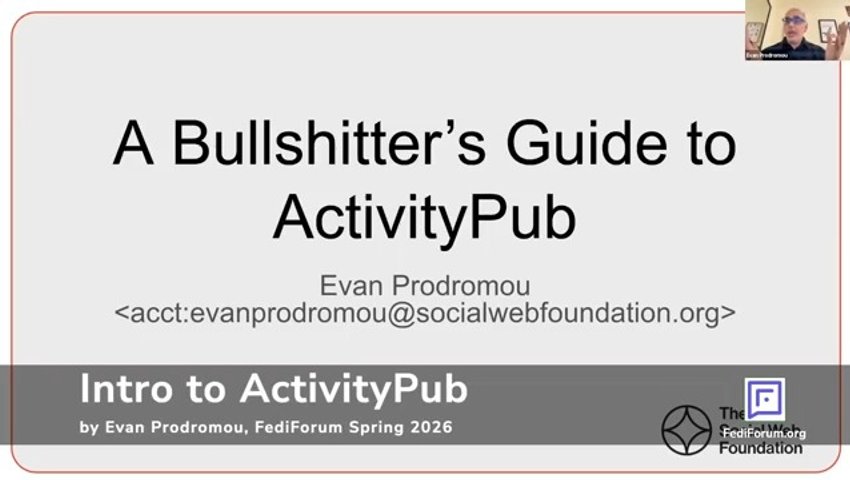
FediForum Talk: How To Bullshit Your Way Through a Conversation about ActivityPub
By Evan Prodromou, Social Web Foundation and editor of the ActivityPub standard. One of the best bluffers in the field of distributed social networks gives you just enough knowledge about ActivityP...
The Fediverse and Content Creation: Monetization
Sure, we have open source, federated replacements for Instagram, Tiktok, and YouTube. How do we get creators to use this stuff? One consideration involves the ability to pay for things.

One thing I left out of my The Everything Account piece was a whole section on Bridgy Fed. Short version: As Bridgy Fed adds more lexicons, it makes the Atmosphere the most versatile and data-owning Fediverse instance in the open social web. Perhaps in a future piece 😉

Anuj Ahooja
I wrote about what I've been calling "The Everything Account" If you're familiar with The Atmosphere, you already know how to get one, and this should hopefully help you explain it to others. For those of you who aren't, you'll be surprised to know you already have one; here's how you use it: