

Fast and Accurate Code Search for Agents. Uses ~98% fewer tokens than grep+read
Fast regex search: indexing text for agent tools · Cursor
How we're building indexes for regular expression search so agents can find text in large monorepos without the 15-second ripgrep waits.

DataLicenses.org
Machine-readable hints for AI agents/crawlers; easy to adopt, rely on compliance.
Meilisearch: Unified Search & AI Retrieval Platform
Build lightning-fast search and AI retrieval with Meilisearch. Open-source, developer-friendly search engine trusted by 20,000+ teams worldwide.
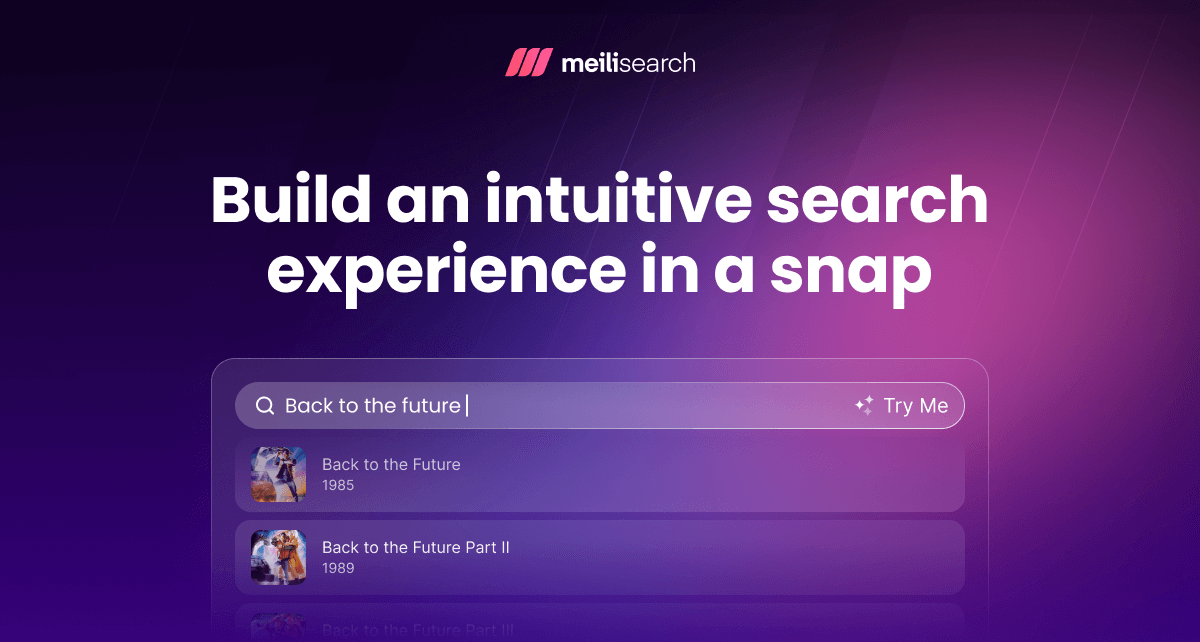
Memory retrieval tuned to your knowledge base | Enzyme
Your users bring content. Enzyme gives your agent their conceptual landscape from the first import. 42,000+ installs. Local CLI and hosted memory workflows.
Cognition | Agent Trace: Capturing the Context Graph of Code
We’re excited to join in Cursor, Cloudflare, Vercel, git-ai, OpenCode and others in support of [Agent Trace](https://agent-trace.dev/). As described in the spec, Agent Trace is an open, vendor-neutral spec for recording AI contributions alongside human authorship in version-controlled codebases.
AI Coding Agent Benchmarks & Leaderboard | Artificial Analysis
We measure real-world performance of coding agents on software engineering tasks, including cost, token usage, and execution time. We compare how performance changes across agents, models, and execution settings.
Agent READMEs: An Empirical Study of Context Files for Agentic Coding
Agentic coding tools receive goals written in natural language, break them down into specific tasks, and write or execute code with minimal human intervention. Central to this process are agent context files (e.g., AGENTS.md and CLAUDE.md) that provide persistent, project-level instructions. In this paper, we conduct the first large-scale empirical study of 2,303 agent context files from 1,925 repositories to characterize their structure, maintenance, and content. We find that these files are not static documentation but complex, difficultto-read artifacts that evolve like configuration code through frequent, small additions. Our content analysis of 16 instruction types shows that developers prioritize functional context, such as test procedures (75.9%), implementation details (70.8%), and architecture (68.1%). We also identify a significant gap: non-functional requirements such as security (14.8%) and performance (14.5%) are rarely specified. These findings indicate that while developers use context files to make agents functional, they provide few guardrails to ensure that agent-written code is secure or performant, highlighting the need for improved tools and practices.

Building a Smarter AI Agent with Neural RAG - Will Bryk, Exa.ai
Open Coding Agents: Fast, accessible coding agents that adapt to any repo | Ai2
SERA is the first in our family of Open Coding Agents, achieving state-of-the-art performance at low cost.
The End of Code Review: Coding Agents Supersede Human Inspection
Code review has been the primary quality gate in software development since Fagan formalised code inspection in 1976. For five decades, having a human examine and comment on a colleague's changes before merge has been a cornerstone practice at organisations of every size. Coding agents are large language model (LLM)-based autonomous systems capable of reading, writing, testing, and repairing software. We argue that coding agents have crossed a threshold of capability at which traditional human code review is no longer a necessary component of a software quality pipeline. Our argument rests on two claims: every stated goal of code review can be served by agents at lower cost and higher throughput; the naive integration in which agents write code and humans remain the mandatory reviewers is a dead end because it neither provides meaningful assurance nor scales with AI-assisted throughput.
Agentic Engineering Patterns - Simon Willison's Weblog
Patterns for getting the best results out of coding agents like Claude Code and OpenAI Codex. See my introduction for more on this project.
AI Code Review | Greptile | Merge 4X Faster, Catch 3X More Bugs
AI Code Reviews that understand your entire codebase. Automate PR reviews, catch bugs faster, improve code quality with AI-driven analysis. Try Greptile free!


User & Agents
@userandagents.org
We are a community focused on shaping the future of user-agent systems. Our goal is to empower people by designing and building software that provides agency, control, and choice in our digital lives. userandagents.org
Coding w/ AI - References/Resources/Tools

📚 AI - Coding, Agents, & Automation
The Case for Software Craftsmanship in the Era of Vibes
One Developer, Two Dozen Agents, Zero Alignment
AI assisted coding (by Ronen Tamari) — Semble

AURI for Developers | AI-Native AppSec Platform | Endor La

We Got Claude to Fine-Tune an Open Source LLM
AI* and coding (by あ) — Semble
Free Tiers/Trials/Credits for Inference (by Bee 🐝) — Semble
Monthly Subscription Coding Plans (by Bee 🐝) — Semble

Best LLM for Coding 2026 | AI Coding Model Rankings & Benchmarks
VibeBench - Track the real-time vibe of AI models
Getting a Gemini API key is an exercise in frustration | Hacker News

[DS] Homepage