

A simple (300 lines of code) reproduction of Computational Life: How Well-formed, Self-replicating Programs Emerge from Simple Interaction
Co-creating with emergent processes ✦ Hijinx World
Existential musings over algorithmic design with creative programming legend Dan Tapper.

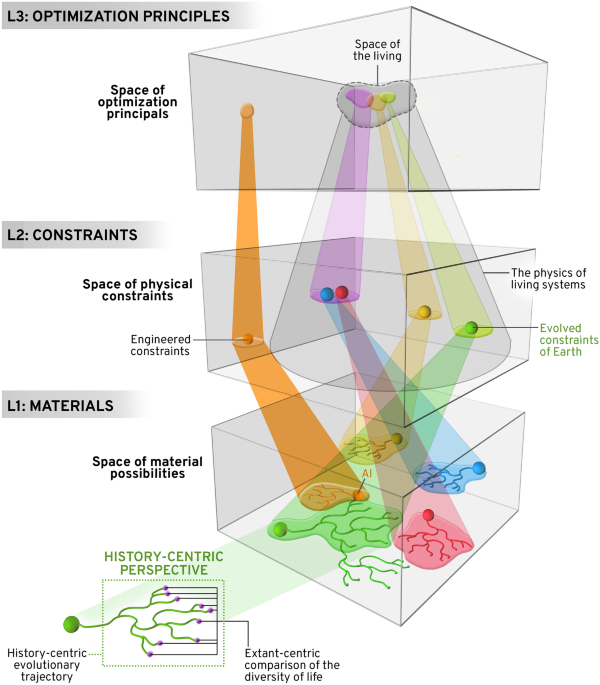
The Multiple Paths to Multiple Life
We argue for multiple forms of life realized through multiple different historical pathways. From this perspective, there have been multiple origins of life on Earth—life is not a universal homology. By broadening the class of originations, we significantly expand the data set for searching for life. Through a computational analogy, the origin of life describes both the origin of hardware (physical substrate) and software (evolved function). Like all information-processing systems, adaptive systems possess a nested hierarchy of levels, a level of function optimization (e.g., fitness maximization), a level of constraints (e.g., energy requirements), and a level of materials (e.g., DNA or RNA genome and cells). The functions essential to life are realized by different substrates with different efficiencies. The functional level allows us to identify multiple origins of life by searching for key principles of optimization in different material form, including the prebiotic origin of proto-cells, the emergence of culture, economic, and legal institutions, and the reproduction of software agents.
The Year of the Software Factory
We are building LifeBuild, a personal operating system for your life where AI agents help you draft projects, prioritize your commitments, and stay on top of what matters—from health to relationships to finances and beyond. This Lab Notebook chronicles our explorations.

Live code with Tidal Cycles | Tidal Cycles
Live coding environment for making algorithmic patterns
Where Did Software Go Wrong? | Jesse Li
Software is broken, but it's not because of NPM, startups, AI, or venture capitalists. A deep dive into how we think about and produce code, and how our software systems reflect the manic state of the modern world.

Keynote: Reproducibility and replicability of computer simulations | Canal U
Since the early days of the reproducibility crisis, much progress has been made in understanding and improving computational reproducibility and replicability (R and R)...

The Next 7000 Programming Languages
Landin’s seminal paper “The next 700 programming languages” considered programming languages prior to 1966 and speculated on the next 700. Half-a-century on, we cast programming languages in a Darwinian ‘tree of life’ and explore languages, their features (genes) and language evolution from the viewpoint of ‘survival of the fittest’.
Growing Graphs
Experimental simulation of emergent complexity through graph-rewriting automata.
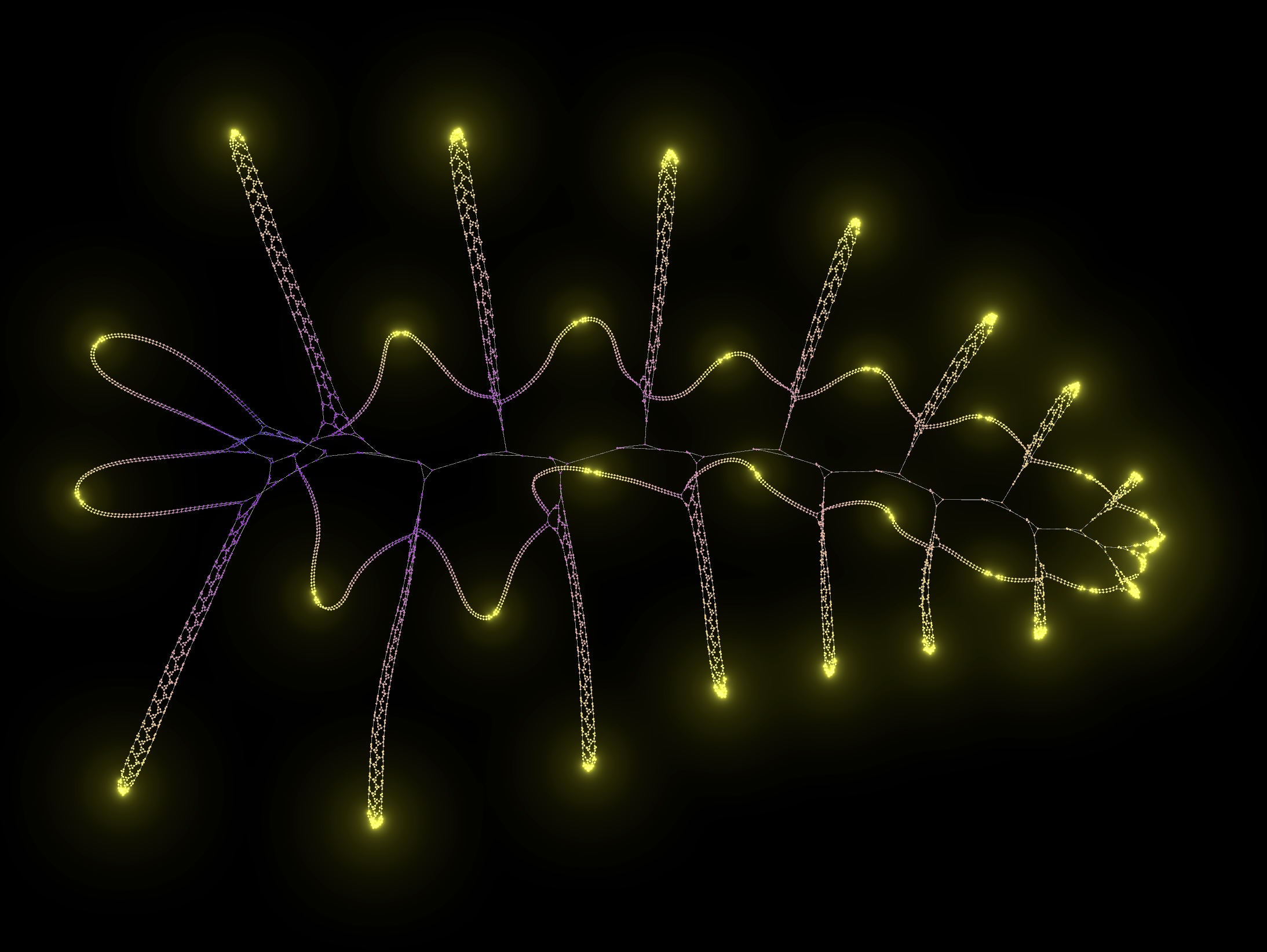
The Evolutionary Ecology of Software: Constraints, Innovation, and the AI Disruption
This chapter investigates the evolutionary ecology of software, focusing on the symbiotic relationship between software and innovation. An interplay between constraints, tinkering, and frequency-dependent selection drives the complex evolutionary trajectories of these socio-technological systems. Our approach integrates agent-based modeling and case studies, drawing on complex network analysis and evolutionary theory to explore how software evolves under the competing forces of novelty generation and imitation. By examining the evolution of programming languages and their impact on developer practices, we illustrate how technological artifacts co-evolve with and shape societal norms, cultural dynamics, and human interactions. This ecological perspective also informs our analysis of the emerging role of AI-driven development tools in software evolution. While large language models (LLMs) provide unprecedented access to information, their widespread adoption introduces new evolutionary pressures that may contribute to cultural stagnation, much like the decline of diversity in past software ecosystems. Understanding the evolutionary pressures introduced by AI-mediated software production is critical for anticipating broader patterns of cultural change, technological adaptation, and the future of software innovation.

The Art of Code - Dylan Beattie
Mote: An Interactive Ecosystem Simulation — Peter Whidden
Apps and programming: two accidental tyrannies
On coding agents, malleable software, and the future of interface invention
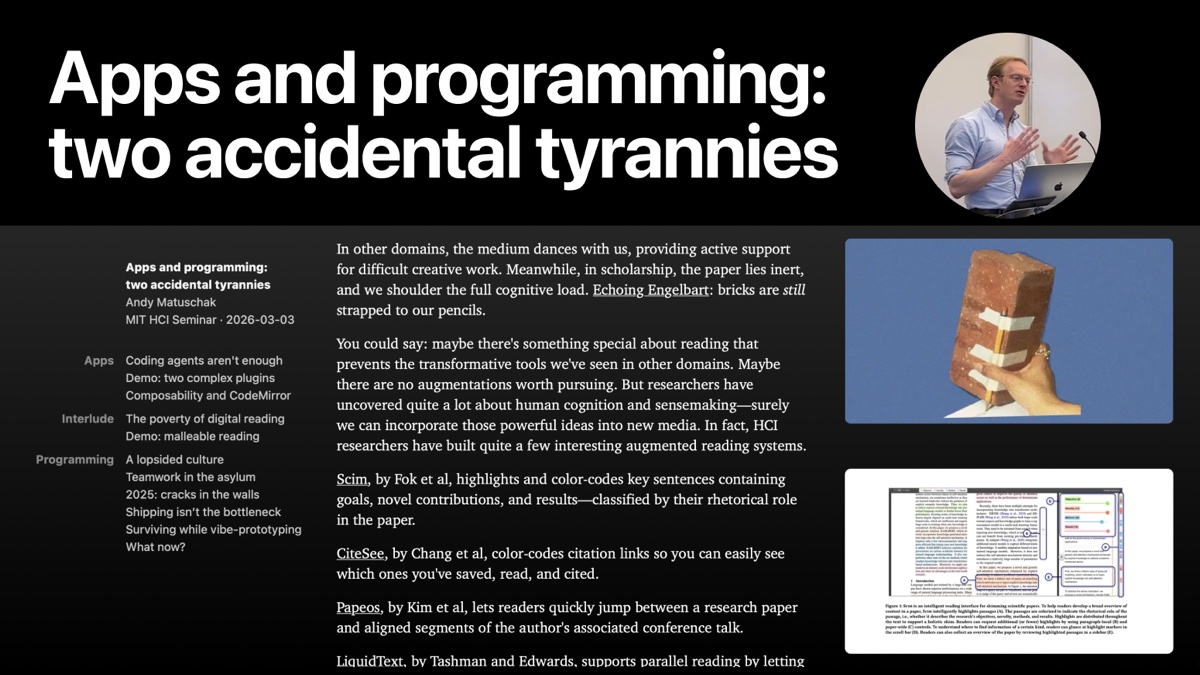
Apps and programming: two accidental tyrannies
On coding agents, malleable software, and the future of interface invention
Post-app computing

Imagining computing beyond siloed, rigid apps

Nobody Wants Your Damn App

Golems, smart objects, and the file metaphor
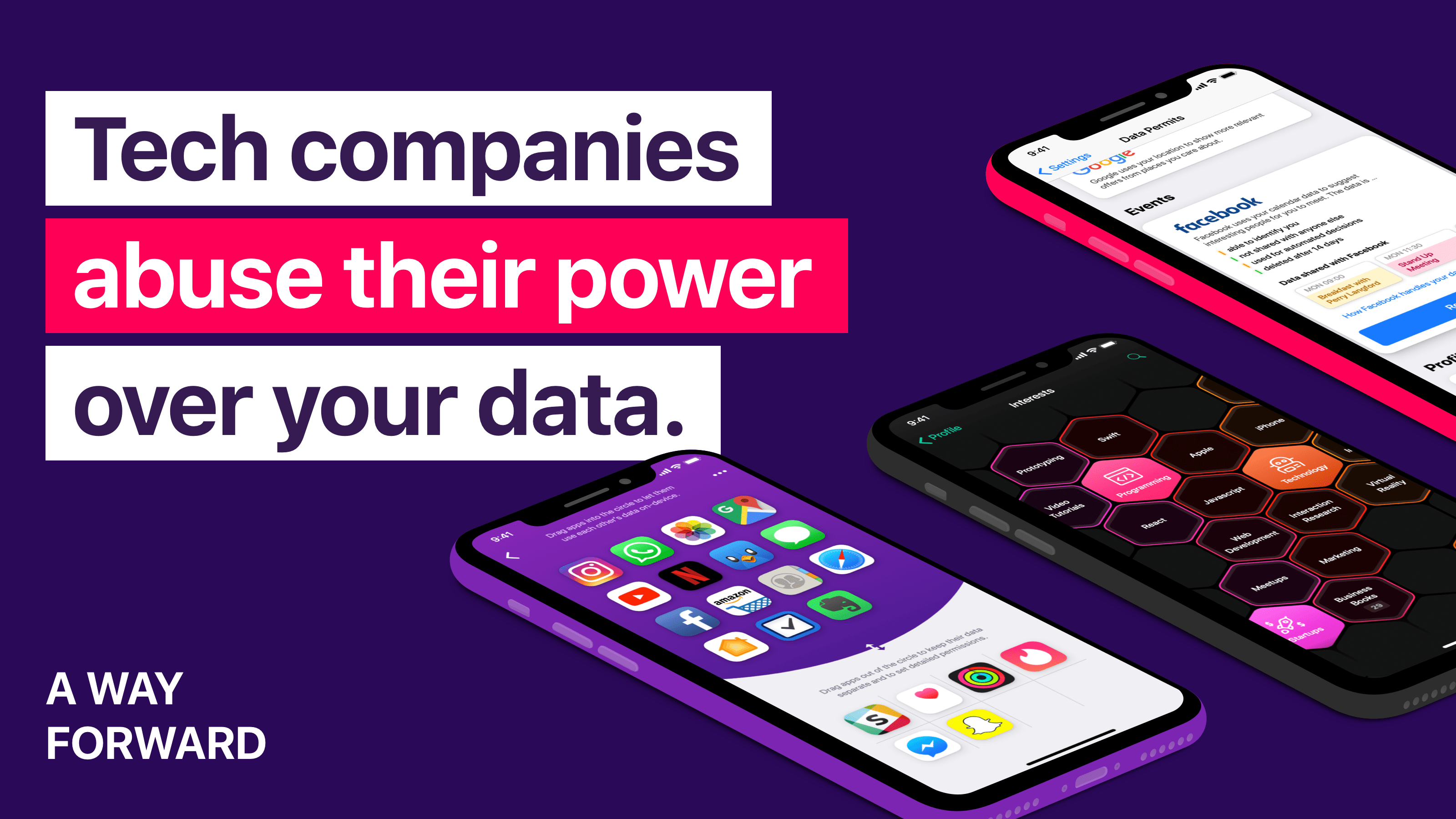
Rethinking how technology uses our personal data
User-tailorable systems: pressing the issues with buttons
everest-pipkin.com

Wesley Finck (@wesleyfinck.org)