

Regular Expressions made Strangely Simple
Regex Crossword
A crossword puzzle game using regular expressions. Earn achievements completing puzzle challenges. Easy tutorials for people new to regular expressions.

regex101: build, test, and debug regex
Regular expression tester with syntax highlighting, explanation, cheat sheet for PHP/PCRE, Python, GO, JavaScript, Java, C#/.NET, Rust.
A DEVELOPER PROVED THE REGEX YOU'VE WRITTEN A THOUSAND TIMES IS SECRETLY A COMPILER AND THAT ALMOST NO ONE WHO USES THEM HAS ANY IDEA WHAT ACTUALLY RUNS 36 minutes from Paul Wankadia, the engineer behind a regex engine that compiles your pattern straight down to raw machine code https://t.co/pMhg9AxYbJ
A DEVELOPER PROVED THE REGEX YOU'VE WRITTEN A THOUSAND TIMES IS SECRETLY A COMPILER AND THAT ALMOST NO ONE WHO USES THEM HAS ANY IDEA WHAT ACTUALLY RUNS36 minutes from Paul Wankadia, the engineer behind a regex engine that compiles your pattern straight down to raw machine code… https://t.co/XgyFxNmImW pic.twitter.com/pMhg9AxYbJ— slash1s (@slash1sol) June 5, 2026
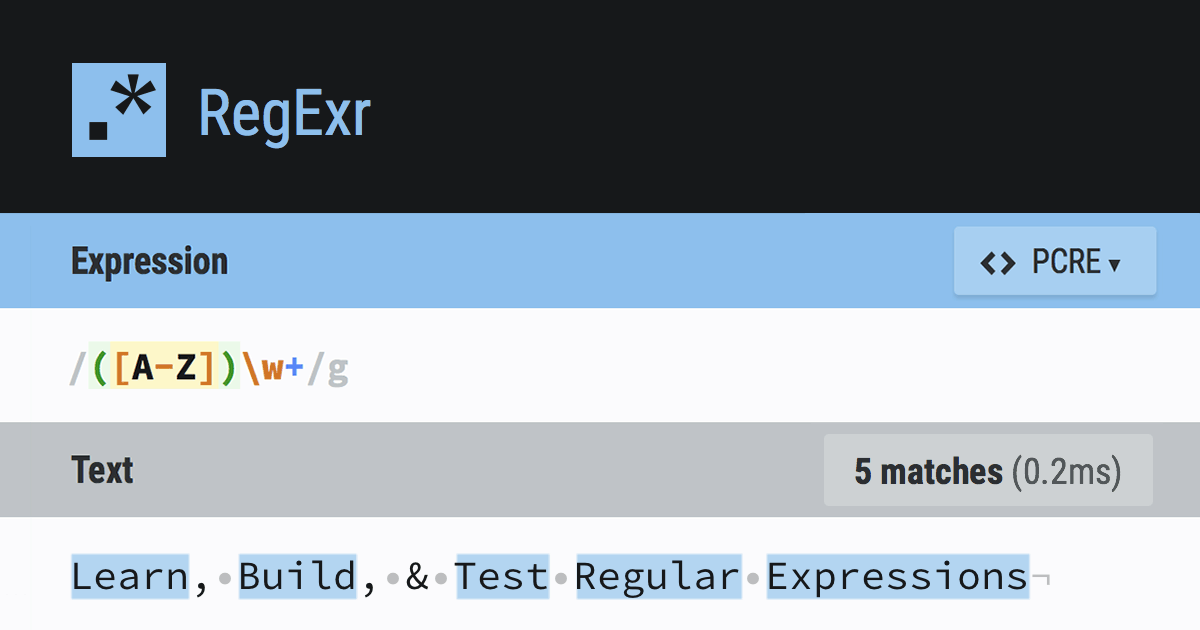
RegExr: Learn, Build, & Test RegEx
RegExr is an online tool to learn, build, & test Regular Expressions (RegEx / RegExp).
Fast regex search: indexing text for agent tools · Cursor
How we're building indexes for regular expression search so agents can find text in large monorepos without the 15-second ripgrep waits.

Warnings for pattern matching
We examine the ML pattern-matching anomalies of useless clauses and non-exhaustive matches. We state the definition of these anomalies, building upon pattern matching semantics, and propose a simple algorithm to detect them. We have integrated the algorithm in the Objective Caml compiler, but we show that the same algorithm is also usable in a non-strict language such as Haskell. Or-patterns are considered for both strict and non-strict languages.
Vim anti-patterns | Arabesque
The benefits of getting to grips with Vim are immense in terms of editing speed and maintaining your “flow” when you’re on a roll, whether writing code, poetry, or prose, but because the learning curve is so steep for a text editor, it’s very easy to retain habits from your time learning the editor that stick with you well into mastery. Because Vim makes you so fast and fluent, it’s especially hard to root these out because you might not even notice them, but it’s worth it. Here I’ll list some of the more common ones.
Packrat parsing: | Proceedings of the seventh ACM SIGPLAN international conference on Functional programming
For decades we have been using Chomsky's generative system of grammars, particularly context-free grammars (CFGs) and regular expressions (REs), to express the syntax of programming languages and protocols. The power of generative grammars to express ...

le0pard/re2js
RE2JS is the JavaScript port of RE2, a regular expression engine that provides linear time matching
BurntSushi/ripgrep
ripgrep recursively searches directories for a regex pattern while respecting your gitignore
An 8 Year Algorithm Nemesis: Analyzing long string trends in a body of text with suffix trees
Tokenization: A Survey for Modern NLP
While modern language models take raw text as their input and produce raw text as output, they do not operate over text directly. Hidden in the very first step of language model pipelines is...
Ten Lines Of Code That Changed My World – Pixelambacht
Front-end antics and typographic mischievousness