

Local natural-language-to-shell command generator. A 941 MB fine-tuned Qwen2.5-Coder-1.5B running on CPU in ~1s.
Qwen on Twitter / X
Qwen3-TTS is officially live. We’ve open-sourced the full family—VoiceDesign, CustomVoice, and Base—bringing high quality to the open community.- 5 models (0.6B & 1.8B)- Free-form voice design & cloning- Support for 10 languages- SOTA 12Hz tokenizer for high compression-… pic.twitter.com/BSWpaYoZWj— Qwen (@Alibaba_Qwen) January 22, 2026

Qwen
Qwen is a family of large language models developed by Alibaba Cloud. Many Qwen models are distributed under the free and open-source Apache 2.0 license, the source-available Qwen License, or the non-commercial Qwen Research License; other proprietary Qwen models are served through Alibaba Cloud.

Recursive Language Models
We study allowing large language models (LLMs) to process arbitrarily long prompts through the lens of inference-time scaling. We propose Recursive Language Models (RLMs), a general inference paradigm that treats long prompts as part of an external environment and allows the LLM to programmatically examine, decompose, and recursively call itself over snippets of the prompt. We find that RLMs can successfully process inputs up to two orders of magnitude beyond model context windows and, even for shorter prompts, dramatically outperform the quality of vanilla frontier LLMs and common long-context and coding scaffolds (e.g., on GPT-5 by a median across the evaluated benchmarks of $26\%$ against compaction, $130\%$ against CodeAct with sub-calls, and $13\%$ against Claude Code) across four diverse long-context tasks while having comparable cost. At a small scale, we post-train the first model around the RLM. Our model, RLM-Qwen3-8B, outperforms the underlying Qwen3-8B model by $28.3\%$ on average and even approaches the quality of vanilla GPT-5 on three long-context tasks. Code is available at https://github.com/alexzhang13/rlm.

RomanSetu: Efficiently unlocking multilingual capabilities of Large Language Models via Romanization
This study addresses the challenge of extending Large Language Models (LLMs) to non-English languages, specifically those using non-Roman scripts. We propose an approach that utilizes the romanized form of text as an interface for LLMs, hypothesizing that its frequent informal use and shared tokens with English enhance cross-lingual alignment. Our approach involve the continual pretraining of a English LLM like Llama 2 on romanized text of non-English, non-Roman script languages, followed by instruction tuning on romanized data. The results indicate that romanized text not only reduces token fertility by 2x-4x but also matches if not outperforms native script representation across various NLU, NLG and MT tasks. Moreover, the embeddings computed on romanized text exhibit closer alignment with their English translations than those from the native script. Our approach presents a promising direction for leveraging the power of English LLMs in languages traditionally underrepresented in NLP research.
A recent experience with ChatGPT 5.5 Pro
We are all having to keep revising upwards our assessments of the mathematical capabilities of large language models. I have just made a fairly large revision as a result of ChatGPT 5.5 Pro, to whi…

Qwen on Twitter / X
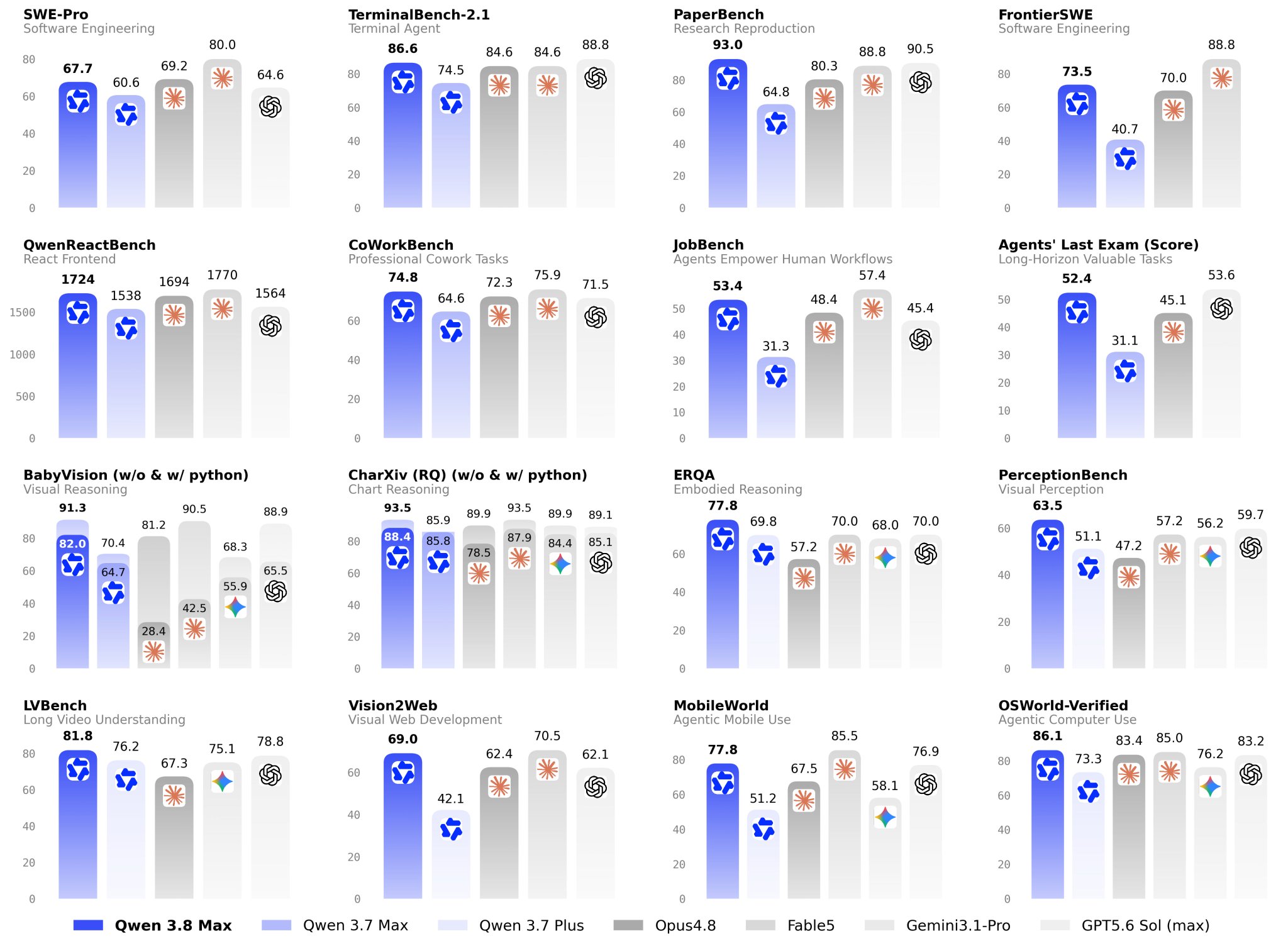
📢Meet Qwen3.8-Max — our most capable model to date. Next week, the open weights of Qwen3.8-Max will be released, and Qwen3.8-27B is also going open-weights to meet you all!🎉Qwen3.8-Max, a new bar for coding and cowork at 2.4T parameters:- Autonomous coding: 10+ days of… pic.twitter.com/e3YFj2hqcT— Qwen (@Alibaba_Qwen) August 3, 2026
atomic.chat on Twitter / X
Google Turbo Quant running Locally in Atomic ChatMacBook Air M4 16 GBModel: QWEN3.5-9BContext window: 50000Summarising 20000 words in just seconds..You can do 3x larger context window, processing 3x faster than before! pic.twitter.com/FRYkXCGjQb— atomic.chat (@atomic_chat_hq) March 27, 2026
GitHub - qwen-code-dev-bot/oh-my-cli at 0ec9cf2a972b55ba1c4448c612e794cdcf114451
A minimal autonomous code-agent CLI built with Qwen Code - qwen-code-dev-bot/oh-my-cli
Installing ZSH
🙃 A delightful community-driven (with 2,500+ contributors) framework for managing your zsh configuration. Includes 300+ optional plugins (rails, git, macOS, hub, docker, homebrew, node, php, pyth...
Please
Please is a cross-language build system with an emphasis on high performance, portability, extensibility and correctness.
Qwen3-Coder: Agentic Coding in the World
GITHUB HUGGING FACE MODELSCOPE DISCORD Today, we’re announcing Qwen3-Coder, our most agentic code model to date. Qwen3-Coder is available in multiple sizes, but we’re excited to introduce its most powerful variant first: Qwen3-Coder-480B-A35B-Instruct — a 480B-parameter Mixture-of-Experts model with 35B active parameters which supports the context length of 256K tokens natively and 1M tokens with extrapolation methods, offering exceptional performance in both coding and agentic tasks. Qwen3-Coder-480B-A35B-Instruct sets new state-of-the-art results among open models on Agentic Coding, Agentic Browser-Use, and Agentic Tool-Use, comparable to Claude Sonnet 4.
qwen3.5:27b
Qwen 3.5 is a family of open-source multimodal models that delivers exceptional utility and performance.

Hey we shipped a new Go code generator for lexicon types. Been in production for a couple weeks now 🥳 Based off of @bnewbold.net's cobalt work and @hypha.coop's go-dasl for DRISL serialization. Copies indigo's echo server stub generation verbatim. 100% compatible with @atproto/lex lockfiles.

GitHub - streamplace/glex: Go code generation for atproto. glex: enter the repo
github.com