

Makes creating footnotes in Obsidian more fun! Contribute to akaalias/obsidian-footnotes development by creating an account on GitHub.
oleeskild/obsidian-digital-garden
Contribute to oleeskild/obsidian-digital-garden development by creating an account on GitHub.
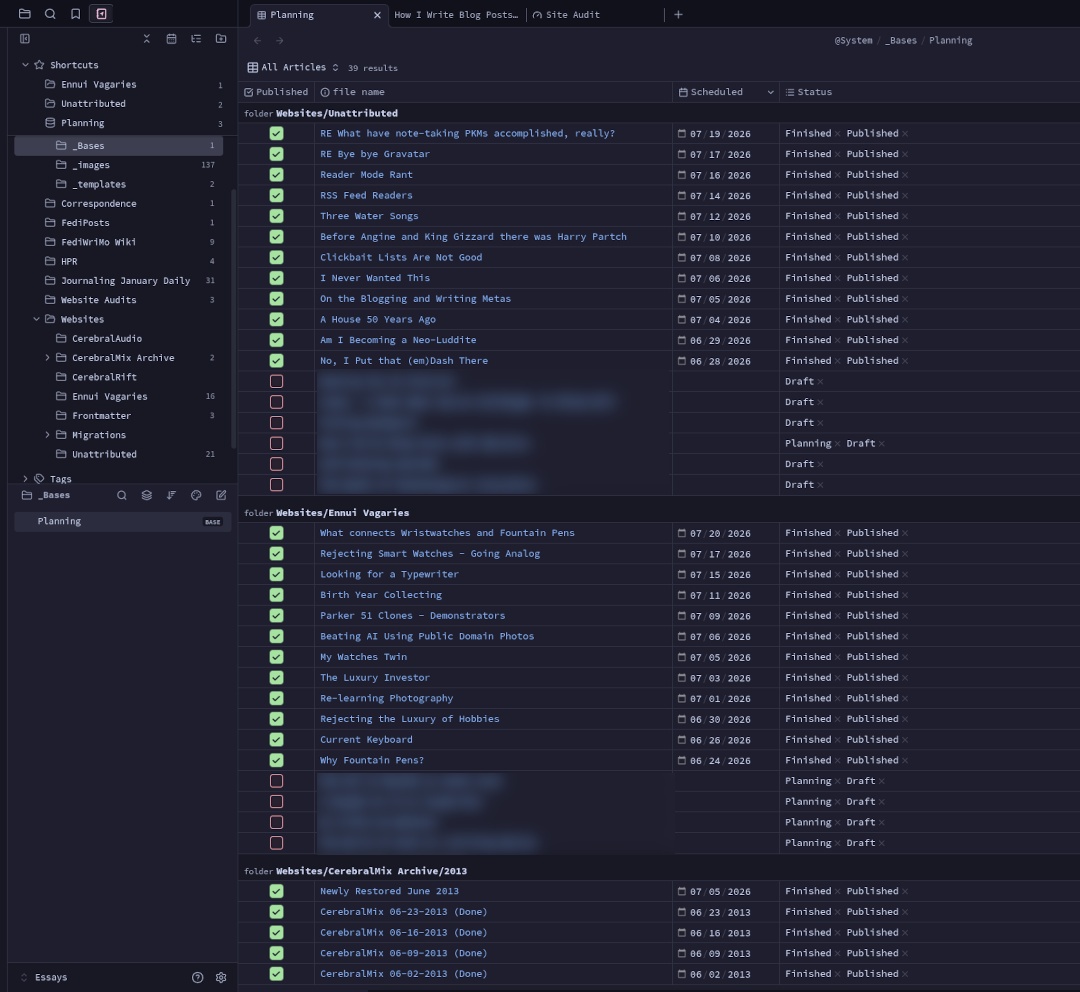
How I Write Blog Posts with Obsidian — Unattributed
You've probably run into some Obsidian evangelist espousing some convoluted system of organizing all their notes, and building some knowl...
Digital Garden - Publish Obsidian Notes For Free
The Obsidian Digital Garden Plugin is a free and open source publishing tool for Obsidian.
jaschaephraim/obsidian-title-generator
Contribute to jaschaephraim/obsidian-title-generator development by creating an account on GitHub.
.github/GOVERNANCE.md at main · co-infra/.github
Contribute to co-infra/.github development by creating an account on GitHub.
GitHub - eharris128/obsidian-bluesky: Post to Bluesky from Obsidian
Post to Bluesky from Obsidian. Contribute to eharris128/obsidian-bluesky development by creating an account on GitHub.
Mustard
A browser extension that lets you annotate any webpage with notes and share them with your Bluesky and/or GitHub followers.

GitHub issues for notes
GitHub issues is almost the best notebook in the world. Free and unlimited, for both public and private notes. Comprehensive Markdown support, including syntax highlighting for almost any language. Plus …
Ditching GitHub
This is going to be some sort of a public service announcement, withside notes. This has been brewing for a long, long time (years), it’sjust that I never se...
Mustard Notes (@mustardnotes.com)
I'm a firefox & chrome browser extension that lets you put notes on any website AND have your bluesky/GitHub followers see them! chrome.mustardnotes.com firefox.mustardnotes.com (still in development and a hobby project so expect some rough edges 🙃)

How I use Obsidian
My personal Obsidian vault template. A bottom-up approach to note-taking and organizing things I am interested in.

GitHub - unxok/obsidian-better-properties: New types and features seamlessly integrated (when possible) with Obsidian's core Properties feature.
New types and features seamlessly integrated (when possible) with Obsidian's core Properties feature. - GitHub - unxok/obsidian-better-properties: New types and features seamlessly integra...
Red Squares — the GitHub outage graph
A satirical contribution graph: red squares track GitHub.com platform outages instead of green squares tracking commits.
Karpathy's LLM Knowledge Base Wiki for Enterprise | Vijoy Pandey posted on the topic | LinkedIn
There's a new kind of computer media in the enterprise: Write once, Read never. The docs are perpetually stale, constantly diverging from reality, and scattered across Confluence, SharePoint, GitHub, Webex (or Slack) threads, Notion, Obsidian - and in my personal life, add Apple Notes, Goodnotes, web clippings, and multiple Google Drives worth of docs and slides that nobody is ever going back to. Karpathy tweeted his LLM knowledge base wiki architecture which went viral last weekend and I decided to give it a run yesterday. Verdict: You *have* to try this out. Prediction: You won’t be able to live without it soon. There were a few mods and decisions I made to the base Karpathy provided. First, the vault / folder structure in Obsidian. I already use Obsidian as a human. Instead of creating separate vaults and dealing with the sync nightmare, I just have folders for Human and Agent, and a Raw folder. (1) The Human/ folder is where I write long form articles and notes independent of the knowledge base wiki. No LLM or agent touches this folder. (2) I do have Arnold Layne, my OpenClaw agent, doing background tasks for me. Raw/ is where both Arnold and I, dump raw snippets. Inclusive of diverse kinds of media. (3) The Agent/ folder is where the LLM (Claude in my case) synthesizes the wiki. No human touches this folder. Second, some customizations to CLAUDE.md for enterprise-like usage - (4) Domain extensions - the agent needs to know that quantum computing and agentic AI have different entity types and different provenance thresholds. (5) Primary source protection, when I drop in my own original work, secondary sources can extend it or raise questions against it, but they cannot overwrite it. It sounds like a small thing but its’s not, especially at enterprise scale where provenance actually matters. Karpathy is upfront that what he’s built is working memory for a single agent, and it’s truly remarkable at that. The jump to Shared Context across teams, reconciling conflicting beliefs at org scale, ontologies that don’t collapse under the weight of a hundred contributors - those are much harder problems and what we are exploring with the Internet of Cognition. PS: The screenshot shows my Obsidian vault after just two runs: one with Karpathy’s original tweet and gist file itself (so meta!) and one with our Internet of Cognition paper. Claude (Sonnet) read it, compiled it into structured summaries, entity pages, concept pages, backlinks, merged all the information cohesively, and keeps it all maintained from there. You just read the Wiki. It’s simply magical.

+ the art of footnotes | Are.na
expanded to include margin annotations and other multi-channel approaches towards text, information and credit.
