

An experimental peer-to-peer Web browser. Contribute to beakerbrowser/beaker development by creating an account on GitHub.
Beaker Browser MVP Review: 0 use cases + 4 years of engineering = 0 users
Beaker Browser is an open-source “peer-to-peer browser for Web hackers” project led by Paul Frazee and Tara Vancil. Here’s the kind of…

Beakr — AI infrastructure for research teams
Beakr connects to your existing tools, builds an institutional memory layer, and automates workflows — helping research teams move faster without losing context, control, or provenance.

Dweb: Serving the Web from the Browser with Beaker – Mozilla Hacks - the Web developer blog
Publishing and sharing is core to the Web’s ethos, yet to publish your own website or even just share a document, you need to know how to run a server, ...
Metagov x Future of Science Seminar - Discourse Graphs with Matt Akamatsu
Building Glass for the Web
How we built a cross-browser glass effect for the web, and how it shapes a family of components.

FeatherReader — read, quietly
Subscriptions, folders, stars, and read-state are written as open-standard community.lexicon.rss.* records in your atproto PDS — portable to any reader that speaks the lexicon. Leaving is as easy as arriving.
National Science Foundation Fostering Interdisciplinary Networks to Develop Emergent and Responsive Solutions Foundry (NSF FINDERS FOUNDRY)
To save a PDF of this solicitation, select Print to PDF in your browser's print options.
National Science Foundation Fostering Interdisciplinary Networks to Develop Emergent and Responsive Solutions Foundry (NSF FINDERS FOUNDRY)
To save a PDF of this solicitation, select Print to PDF in your browser's print options.
Discourse Graphs and the Future of Science | Protocol Labs Research
Interview between Tom Kalil, Chief Innovation Officer of Schmidt Futures, Dr. Evan Miyazono, Research Team Lead at Protocol Labs, and Dr. Matt Akamatsu, Assistant Professor of Biology at the University of Washington.

Open Sourcing Scientific Research with Lab Discourse Graphs
interviews.md at main · sensemaker.computer/home
Sensemaker's home repository for public resources.
NLnet; Nanoarguments
Scientific knowledge is currently scattered across papers, repositories, and disconnected platforms, with no structured way to trace how claims connect to evidence or how arguments develop. Nanoarguments builds a framework and tools for creating, browsing, and contributing to a global, federated graph of scientific discourse and evidence. Researchers and their communities can collaboratively structure claims, evidence chains, and discussion as nanopublications, which are small, cryptographically signed Linked Data snippets with precise provenance and authorship, published to a decentralized peer-to-peer network. The project builds upon the Nanodash interface to help users browse, edit, and aggregate discourse and evidence graphs, and integrates with dokieli to enable in-context authoring of nanopublications as inline annotations while reading or writing a document. A bidirectional ActivityPub connector bridges the nanopublication network and the fediverse, allowing discourse threads to start as social exchanges and crystallize into persistent, machine-readable evidence records. The project will be piloted with early adopter research groups in discourse and evidence modeling. All components will be released as open-source modules that other systems can build upon.
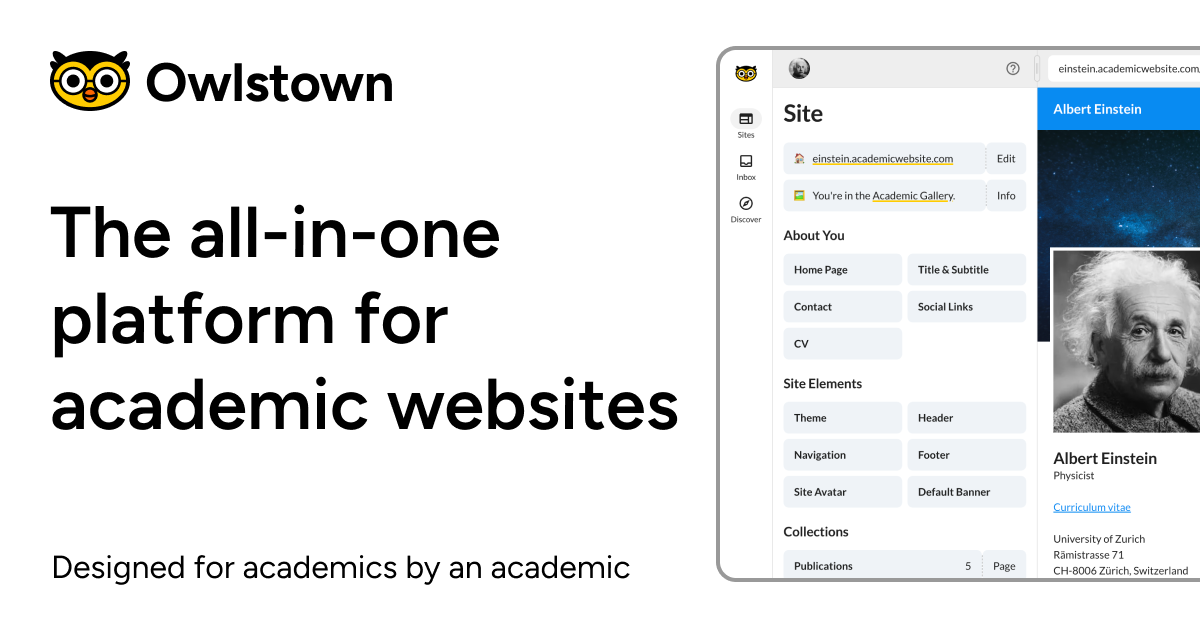
Owlstown: the website builder for academics
Build your academic website and keep it updated easily. Owlstown is designed for all academics, from students to professors to labs.
Super cool! Imagining how something like this could be used for @atproto.science "journal" publishing

Standard Reader
New Feature: Collections on Standard Reader. Curate articles from across the network into magazine editions. Include your editorial intro, notes on each piece, a closing statement and a theme. Publish as a series readers can follow. Tell a story. Check out the first one 👇
Research tools 🔬

Interesting tools that assist with the research process.
atproto tools ⚒️
AT Docs (by Victoria) — Semble
Infonomenon (Beta) — Search the AT Protocol
zzstoatzz.io/find-bufo
pub search
Inlay
panproto | schematic version control

Ronen Tamari (@ronentk.me)

Crossmark - Crossref
Crossmark - Crossref
Plaudit · Open endorsements from the academic community
Introducing the Elicit API - Elicit

Alerts | Elicit: Al for scientific research