Synthetic data curation for post-training and structured data extraction
Designing synthetic datasets for the real world: Mechanism design and reasoning from first principles
Tim R. Davidson, Student Researcher, and Hamza Harkous, Senior Staff Research Scientist, Google

Self-Driving Datasets: From 20 Million Papers to Nuanced Biomedical Knowledge at Scale
Manually curated biomedical repositories -- spanning bioactivity, genomics, and chemistry -- are expensive to maintain, lag behind primary literature, and discard experimental context, obscuring nuances needed to assess data correctness and coverage. We show that PubMed itself can be autonomously and cost-effectively turned into structured datasets that are larger, more nuanced, and more accurate than the curated databases they replace. We present three coupled contributions: (1) an LLM-based entity-tagging pipeline, grounded in nine biomedical ontologies, that tags 4.5B entities across 19 categories in a 22.5M-paper, 2.5T-token PubMed corpus; (2) hybrid sparse-dense retrieval supporting entity-filtered semantic queries over the tagged corpus; and (3) Starling, a multi-agent deep research system that, given only a natural-language task description, designs precision- and recall-targeted retrieval filters, induces an extraction schema, and emits structured records with nuance-rich fields and supporting passages. Across six tasks -- blood-brain barrier permeability, oral bioavailability, acute toxicity (LD50), gene-disease associations, protein subcellular localization, and chemical reactions -- Starling produces ~6.3M records (91K-3M per task); several are, to our knowledge, the largest public datasets for their property. Frontier-model rejection of our extractions is 0.6-7.7% across tasks, far below error rates we measure on widely used curated counterparts (e.g., 16.5% on BBB_Martins, 7.3% on Bioavailability_Ma). Beyond scale and accuracy, the supporting passages carry nuance tabular databases discard -- e.g., oral bioavailability may depend on fed vs. fasted state. Together, the corpus, retrieval, and agent establish a foundation for AI-driven therapeutic design. Code and datasets: https://github.com/starling-labs/starling.

Can Synthetic Training Data Survive Its Own Regulation?
Synthetic training data has recently emerged as the quick fix to two different problems: the lack of high-quality training data, and the need to avoid using personal data in training to stay within the boundaries of privacy legislation. Gartner predicts that by 2026 75% of all enterprises will use generative AI to create synthetic training data, a huge increase from less than 5% in 2023.1 Moreover, Gartner predicts that by 2035, solutions that use synthetic data for training will grab three quarters of all end-user spending on enterprise AI software.2 Training data that only a few years ago was the subject of several research papers is now carrying the weight of huge enterprise systems.

DataRater: Meta-Learned Dataset Curation
The quality of foundation models depends heavily on their training data. Consequently, great efforts have been put into dataset curation. Yet most approaches rely on manual tuning of...
I Wanted to Create “The Most Human Gathering”—and Created a Monster
What my failed attempt at curation says about the next “intelligence explosion” “The word for world is forest“ – Ursula K. Le Guin With everyone now a coder, you’d think this would be a good time for curators like me.

WASA: WAtermark-based Source Attribution for Large Language Model-Generated Data
The impressive performances of Large Language Models (LLMs) and their immense potential for commercialization have given rise to serious concerns over the Intellectual Property (IP) of their training data. In particular, the synthetic texts generated by LLMs may infringe the IP of the data being used to train the LLMs. To this end, it is imperative to be able to perform source attribution by identifying the data provider who contributed to the generation of a synthetic text by an LLM. In this paper, we show that this problem can be tackled by watermarking, i.e., by enabling an LLM to generate synthetic texts with embedded watermarks that contain information about their source(s). We identify the key properties of such watermarking frameworks (e.g., source attribution accuracy, robustness against adversaries), and propose a source attribution framework that satisfies these key properties due to our algorithmic designs. Our framework enables an LLM to learn an accurate mapping from the generated texts to data providers, which sets the foundation for effective source attribution. Extensive empirical evaluations show that our framework achieves effective source attribution.
Synthetic data at scale: a development model to efficiently leverage machine learning in agriculture
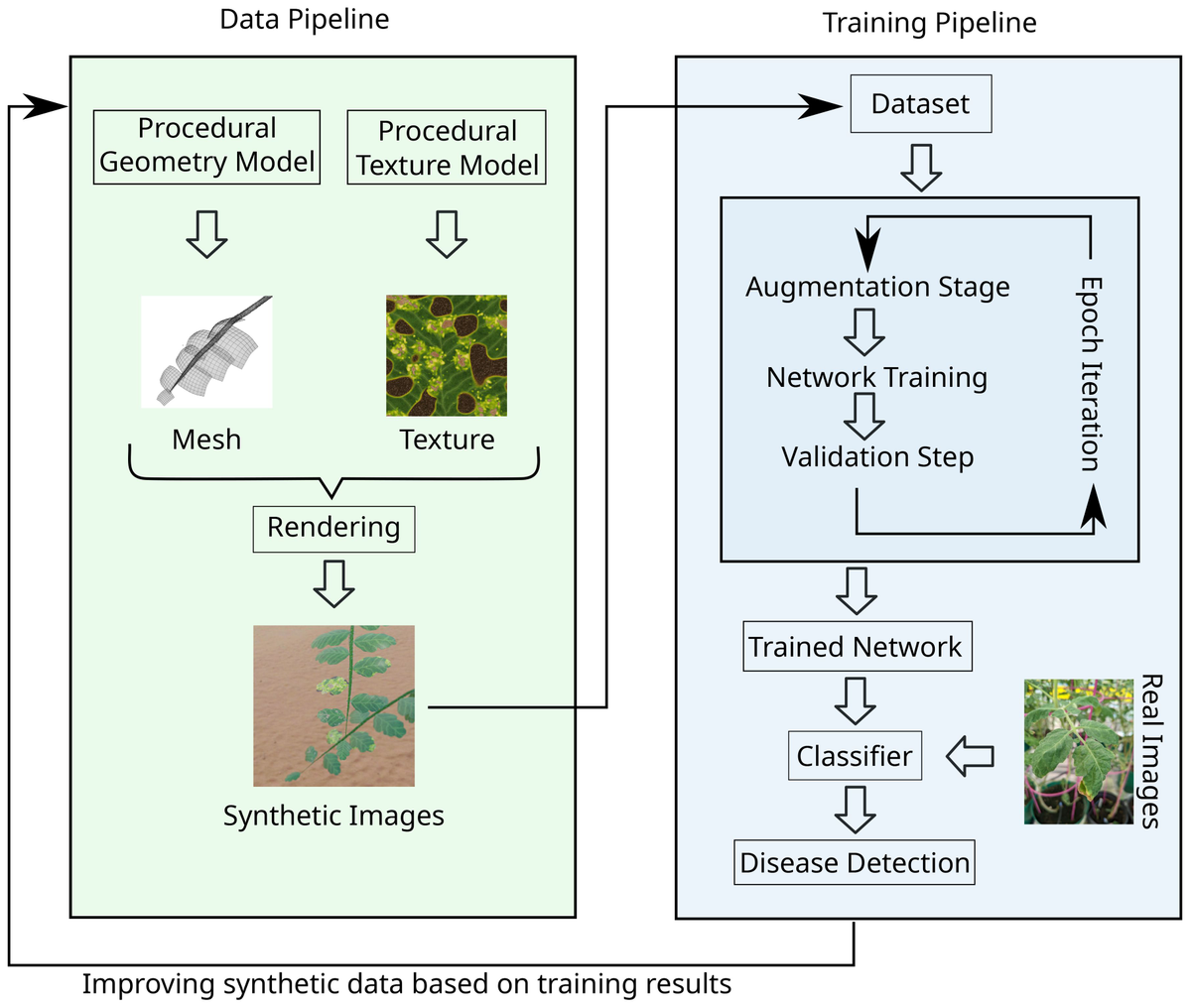
The rise of artificial intelligence (AI) and in particular modern machine learning (ML) algorithms during the last decade has been met with great interest in the agricultural industry. While undisputedly powerful, their main drawback remains the need for sufficient and diverse training data. The collection of real datasets and their annotation are the main cost drivers of ML developments, and while promising results on synthetically generated training data have been shown, their generation is not without difficulties on their own. In this paper, we present a development model for the iterative, cost-efficient generation of synthetic training data. Its application is demonstrated by developing a low-cost early disease detector for tomato plants (Solanum lycopersicum) using synthetic training data. A neural classifier is trained by exclusively using synthetic images, whose generation process is iteratively refined to obtain optimal performance. In contrast to other approaches that rely on a human assessment of similarity between real and synthetic data, we instead introduce a structured, quantitative approach. Our evaluation shows superior generalization results when compared to using non-task-specific real training data and a higher cost efficiency of development compared to traditional synthetic training data.
Distilling Dataset into Neural Field
Utilizing a large-scale dataset is essential for training high-performance deep learning models, but it also comes with substantial computation and storage costs. To overcome these challenges, dataset distillation has emerged as a promising solution by compressing the large-scale dataset into a smaller synthetic dataset that retains the essential information needed for training. This paper proposes a novel parameterization framework for dataset distillation, coined Distilling Dataset into Neural Field (DDiF), which leverages the neural field to store the necessary information of the large-scale dataset. Due to the unique nature of the neural field, which takes coordinates as input and output quantity, DDiF effectively preserves the information and easily generates various shapes of data. We theoretically confirm that DDiF exhibits greater expressiveness than some previous literature when the utilized budget for a single synthetic instance is the same. Through extensive experiments, we demonstrate that DDiF achieves superior performance on several benchmark datasets, extending beyond the image domain to include video, audio, and 3D voxel. We release the code at \url{https://github.com/aailab-kaist/DDiF}.
A large-scale audit of dataset licensing and attribution in AI
The race to train language models on vast, diverse and inconsistently documented datasets raises pressing legal and ethical concerns. To improve data transparency and understanding, we convene a multi-disciplinary effort between legal and machine learning experts to systematically audit and trace more than 1,800 text datasets. We develop tools and standards to trace the lineage of these datasets, including their source, creators, licences and subsequent use. Our landscape analysis highlights sharp divides in the composition and focus of data licenced for commercial use. Important categories including low-resource languages, creative tasks and new synthetic data all tend to be restrictively licenced. We observe frequent miscategorization of licences on popular dataset hosting sites, with licence omission rates of more than 70% and error rates of more than 50%. This highlights a crisis in misattribution and informed use of popular datasets driving many recent breakthroughs. Our analysis of data sources also explains the application of copyright law and fair use to finetuning data. As a contribution to continuing improvements in dataset transparency and responsible use, we release our audit, with an interactive user interface, the Data Provenance Explorer, to enable practitioners to trace and filter on data provenance for the most popular finetuning data collections: www.dataprovenance.org.

Documenting Large Webtext Corpora: A Case Study on the Colossal Clean Crawled Corpus
Large language models have led to remarkable progress on many NLP tasks, and researchers are turning to ever-larger text corpora to train them. Some of the largest corpora available are made by scraping significant portions of the internet, and are frequently introduced with only minimal documentation. In this work we provide some of the first documentation for the Colossal Clean Crawled Corpus (C4; Raffel et al., 2020), a dataset created by applying a set of filters to a single snapshot of Common Crawl. We begin by investigating where the data came from, and find a significant amount of text from unexpected sources like patents and US military websites. Then we explore the content of the text itself, and find machine-generated text (e.g., from machine translation systems) and evaluation examples from other benchmark NLP datasets. To understand the impact of the filters applied to create this dataset, we evaluate the text that was removed, and show that blocklist filtering disproportionately removes text from and about minority individuals. Finally, we conclude with some recommendations for how to created and document web-scale datasets from a scrape of the internet.
Scalable watermarking for identifying large language model outputs
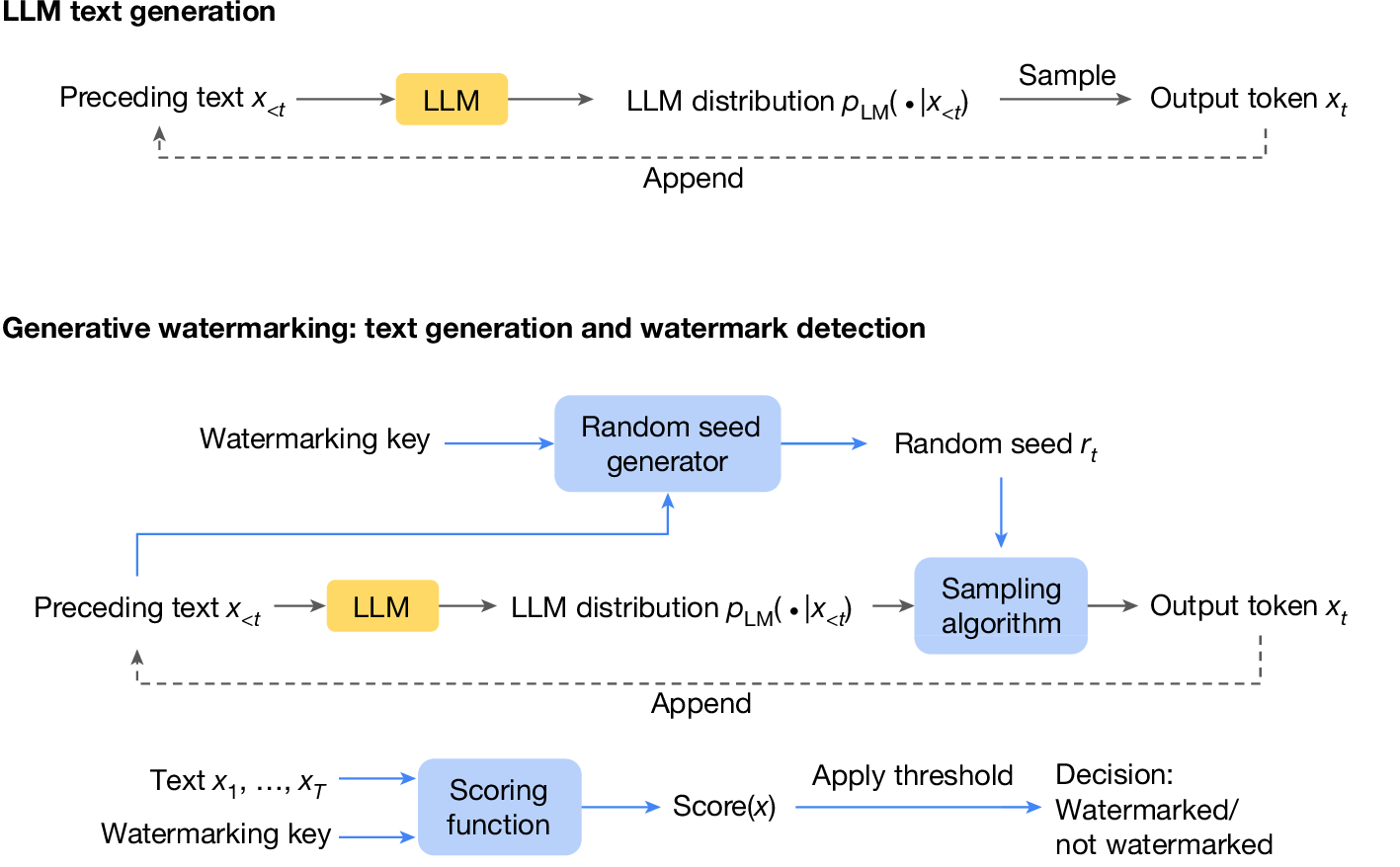
Large language models (LLMs) have enabled the generation of high-quality synthetic text, often indistinguishable from human-written content, at a scale that can markedly affect the nature of the information ecosystem1–3. Watermarking can help identify synthetic text and limit accidental or deliberate misuse4, but has not been adopted in production systems owing to stringent quality, detectability and computational efficiency requirements. Here we describe SynthID-Text, a production-ready text watermarking scheme that preserves text quality and enables high detection accuracy, with minimal latency overhead. SynthID-Text does not affect LLM training and modifies only the sampling procedure; watermark detection is computationally efficient, without using the underlying LLM. To enable watermarking at scale, we develop an algorithm integrating watermarking with speculative sampling, an efficiency technique frequently used in production systems5. Evaluations across multiple LLMs empirically show that SynthID-Text provides improved detectability over comparable methods, and standard benchmarks and human side-by-side ratings indicate no change in LLM capabilities. To demonstrate the feasibility of watermarking in large-scale-production systems, we conducted a live experiment that assessed feedback from nearly 20 million Gemini6 responses, again confirming the preservation of text quality. We hope that the availability of SynthID-Text7 will facilitate further development of watermarking and responsible use of LLM systems.
Unmasking Synthetic Realities in Generative AI: A Comprehensive...
The rapid advancement of Generative Artificial Intelligence has fueled deepfake proliferation-synthetic media encompassing fully generated content and subtly edited authentic material-posing...
Data preprocessing techniques for classification without discrimination
Recently, the following Discrimination-Aware Classification Problem was introduced: Suppose we are given training data that exhibit unlawful discrimination; e.g., toward sensitive attributes such as gender or ethnicity. The task is to learn a classifier that optimizes accuracy, but does not have this discrimination in its predictions on test data. This problem is relevant in many settings, such as when the data are generated by a biased decision process or when the sensitive attribute serves as a proxy for unobserved features. In this paper, we concentrate on the case with only one binary sensitive attribute and a two-class classification problem. We first study the theoretically optimal trade-off between accuracy and non-discrimination for pure classifiers. Then, we look at algorithmic solutions that preprocess the data to remove discrimination before a classifier is learned. We survey and extend our existing data preprocessing techniques, being suppression of the sensitive attribute, massaging the dataset by changing class labels, and reweighing or resampling the data to remove discrimination without relabeling instances. These preprocessing techniques have been implemented in a modified version of Weka and we present the results of experiments on real-life data.