

Wolfram LLM Benchmarking Project
Results from Wolfram's ongoing tracking of LLM performance. The benchmark is based on a Wolfram Language code generation task.

The Return of Language-Oriented Programming | Middle of Nowhere
I’ve been wondering what LLMs mean for language design and implementation. Some believe that, because language models are obviously trained on existing content, they are inherently less capable of assisting users with new programming languages. Intuitively this makes sense. However:
Best LLM for Coding 2026 | AI Coding Model Rankings & Benchmarks
Which AI model writes the best code? We rank every major LLM — open and closed source — across SWE-bench, HumanEval, LiveCodeBench, and Terminal-Bench coding benchmarks. Compare the best LLMs for coding, software engineering, and programming.

Wikipedia:LLM-assisted translation
This guideline applies to machine translation tools that include a large language model ("LLM"). Assume that it applies to any online translation tool unless you have confirmed there is no LLM element.
Mitigating Cross-Lingual Cultural Inconsistencies in LLMs via...
Despite their impressive capabilities, multilingual large language models (MLLMs) frequently exhibit inconsistent behaviour when the prompt's language changes. While such adaptation is generally...

Introducing any-llm: A unified API to access any LLM provider
When it comes to using LLMs, it’s not always a question of which model to use: it’s also a matter of choosing who provides the LLM and where it is deployed. Today, we announce the release of any-llm, a Python library that provides a simple unified interface to access the most popular providers.

Large language model
A large language model (LLM) is a neural network trained on a vast amount of text for natural language processing tasks, especially language generation. LLMs can typically generate, summarize, translate, and analyze text in many contexts, and are a foundational technology behind modern chatbots.[1] Biased or inaccurate training data can make an LLM's output less reliable.[2]
A Complete Guide to LLVM for Programming Language Creators
We'll explain the concepts underlying LLVM IR, and how you can use the LLVM C++ API in your programming language's compiler.
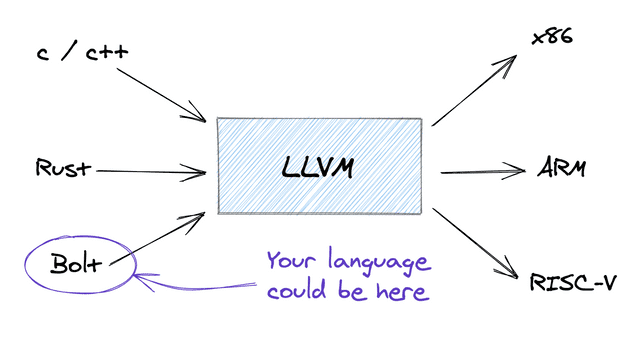
The /llms.txt file – llms-txt
A proposal to standardise on using an /llms.txt file to provide information to help LLMs use a website at inference time.
Defeating Nondeterminism in LLM Inference
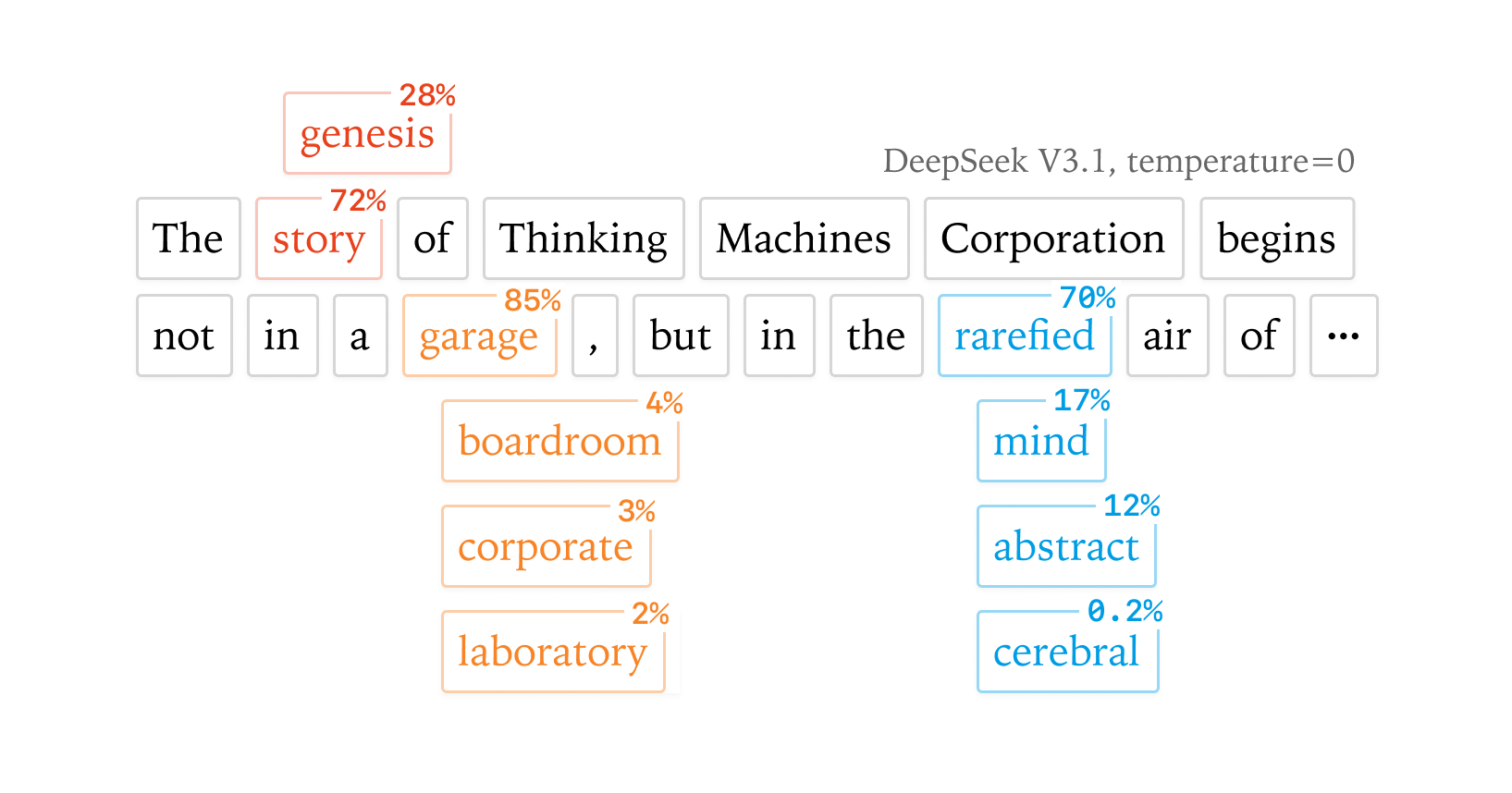
Reproducibility is a bedrock of scientific progress. However, it’s remarkably difficult to get reproducible results out of large language models. For example, you might observe that asking ChatGPT the same question multiple times provides different results. This by itself is not surprising, since getting a result from a language model involves “sampling”, a process that converts the language model’s output into a probability distribution and probabilistically selects a token. What might be more surprising is that even when we adjust the temperature down to 0This means that the LLM always chooses the highest probability token, which is called greedy sampling. (thus making the sampling theoretically deterministic), LLM APIs are still not deterministic in practice (see past discussions here, here, or here). Even when running inference on your own hardware with an OSS inference library like vLLM or SGLang, sampling still isn’t deterministic (see here or here).
The Myth of Deterministic Software
How I've come to terms with LLM non-determinism in software and abandoned the comforting lies we've been telling ourselves about traditional software.

I just came across this paper arxiv.org/abs/2509.22908 which coins the term "vericoding" for using LLMs to generate formally verified code, and presents benchmark results for several languages

A benchmark for vericoding: formally verified program synthesis
arxiv.org
Martin Kleppmann
New blog post! ✨ I argue that AI will make formal verification go mainstream. martin.kleppmann.com/2025/12/08/ai-formal-verifica… Three reasons for this: 1. LLMs are getting increasingly good at writing proofs using proof assistants. This will make formal verification vastly cheaper than it's been to date.
What programming language do LLMs default to when you don't tell them? A small benchmark. - chad/whichlang
