

Generate terminal commands with natural language
Reverse-engineering Claude's generative UI - then building it for the terminal
Extracting Anthropic's design system from a conversation export and rebuilding generative UI for the terminal.

darrenburns/elia
A snappy, keyboard-centric terminal user interface for interacting with large language models. Chat with ChatGPT, Claude, Llama 3, Phi 3, Mistral, Gemma and more.
SwarmChat: An LLM-Based, Context-Aware Multimodal Interaction System for Robotic Swarms
Traditional Human-Swarm Interaction (HSI) methods often lack intuitive real-time adaptive interfaces, making decision making slower and increasing cognitive load while limiting command flexibility. To solve this, we present SwarmChat, a context-aware, multimodal interaction system powered by Large Language Models (LLMs). SwarmChat enables users to issue natural language commands to robotic swarms using multiple modalities, such as text, voice, or teleoperation. The system integrates four LLM-based modules: Context Generator, Intent Recognition, Task Planner, and Modality Selector. These modules collaboratively generate context from keywords, detect user intent, adapt commands based on real-time robot state, and suggest optimal communication modalities. Its three-layer architecture offers a dynamic interface with both fixed and customizable command options, supporting flexible control while optimizing cognitive effort. The preliminary evaluation also shows that the SwarmChat's LLM modules provide accurate context interpretation, relevant intent recognition, and effective command delivery, achieving high user satisfaction.

brevity1swos/rgx
regex101 for the terminal — real-time matching, 3 engines, capture groups, replace mode, syntax highlighting, plain-English explanations, undo/redo, mouse support. Written in Rust.
GitHub - denisidoro/navi: An interactive cheatsheet tool for the command-line
An interactive cheatsheet tool for the command-line - denisidoro/navi
ui.sh — Turn your terminal into a design engineer
A toolkit for coding assistants like Claude Code, Cursor, and Codex to help you build UIs that don't suck.
Recursive Language Models: the paradigm of 2026
How we plan to manage extremely long contexts
.png?v=c8c07d4bf43b)

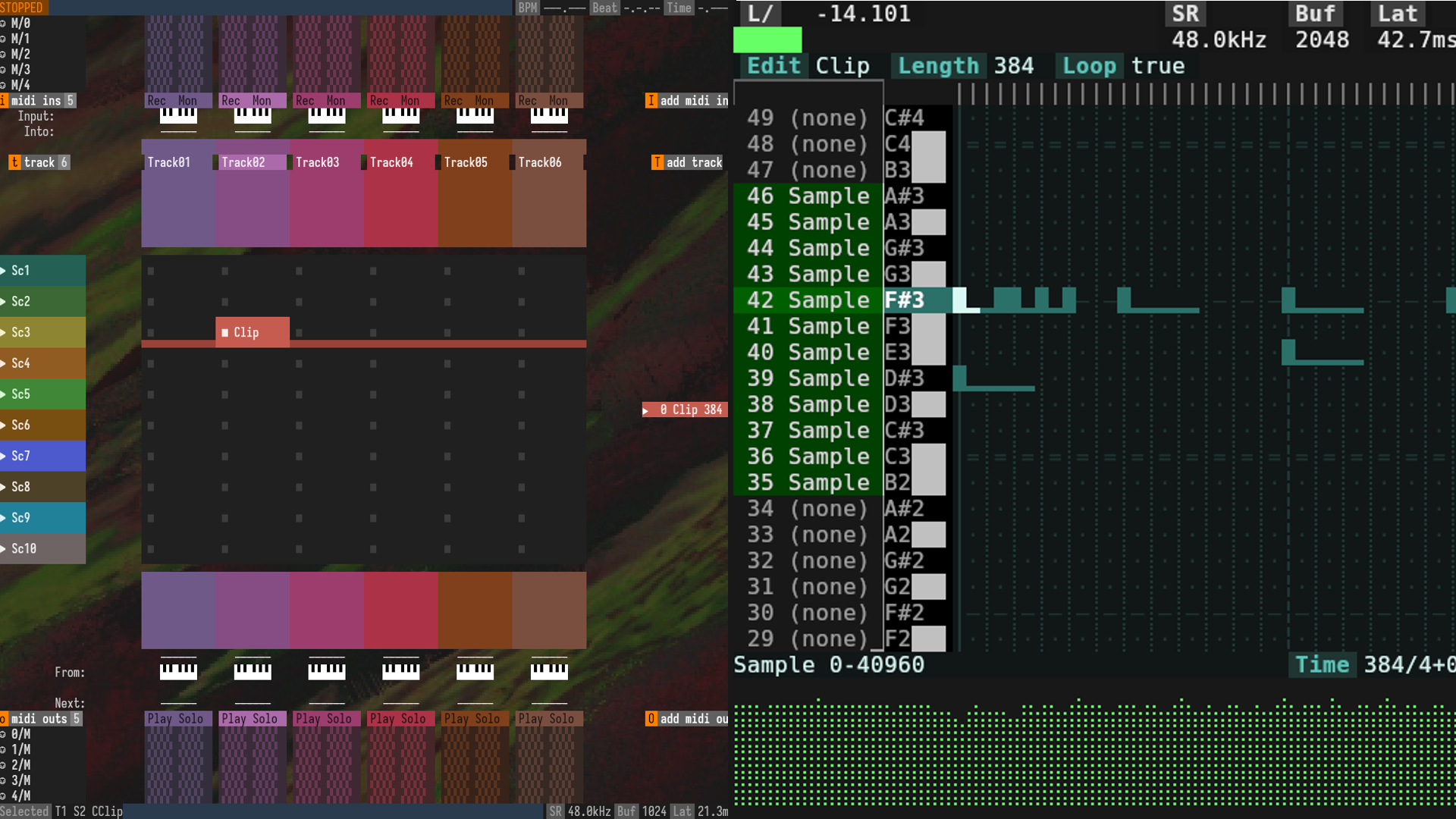
Terminal DAW Does It In Style
As any Linux chat room or forum will tell you, the most powerful tool to any Linux user is a terminal emulator. Just about every program under the sun has a command line alternative, be it CAD, not…
Stanford CS336 | Language Modeling from Scratch (Spring 2025 Archive)
Archived course website for Stanford CS336: Language Modeling from Scratch (Spring 2025), including schedule, assignments, logistics, and materials.

Stop Making TUIs
Our field has a weird relationship with terminal and command line interfaces. The time has come to re-evaluate it.
Self-Instruct: Aligning Language Models with Self-Generated Instructions
Large "instruction-tuned" language models (i.e., finetuned to respond to instructions) have demonstrated a remarkable ability to generalize zero-shot to new tasks. Nevertheless, they depend heavily on human-written instruction data that is often limited in quantity, diversity, and creativity, therefore hindering the generality of the tuned model. We introduce Self-Instruct, a framework for improving the instruction-following capabilities of pretrained language models by bootstrapping off their own generations. Our pipeline generates instructions, input, and output samples from a language model, then filters invalid or similar ones before using them to finetune the original model. Applying our method to the vanilla GPT3, we demonstrate a 33% absolute improvement over the original model on Super-NaturalInstructions, on par with the performance of InstructGPT-001, which was trained with private user data and human annotations. For further evaluation, we curate a set of expert-written instructions for novel tasks, and show through human evaluation that tuning GPT3 with Self-Instruct outperforms using existing public instruction datasets by a large margin, leaving only a 5% absolute gap behind InstructGPT-001. Self-Instruct provides an almost annotation-free method for aligning pre-trained language models with instructions, and we release our large synthetic dataset to facilitate future studies on instruction tuning. Our code and data are available at https://github.com/yizhongw/self-instruct.
Learn Go by Building a Command Line Todo App | Barbarian Meets Coding
Learn the Go programming language by building a test-driven command line todo application

Designing a Language by Asking the Language Models — using an LLM panel as a syntax usability lab (from the kaish project)
Designing a Language by Asking the Language Models — using an LLM panel as a syntax usability lab (from the kaish project) · GitHub
Terminal toolbox

A collection of terminal tools and resources for Linux that I’ve found useful/fun or are my favourites!
am2rican5/sigye
beeb/swpui
jdefrancesco/dskDitto
Elsa002/queercat
GitHub - InputUsername/rescrobbled: MPRIS music scrobbler daemon
jj-vcs/jj