

A Programming Paradigm for Spatiotemporal Composability - cordiverse/paper
Paper Plane — A modern communication platform
Real-time communication with servers, channels, voice, and video. Built for reliability. Translation native. Open-source. Self-hostable.
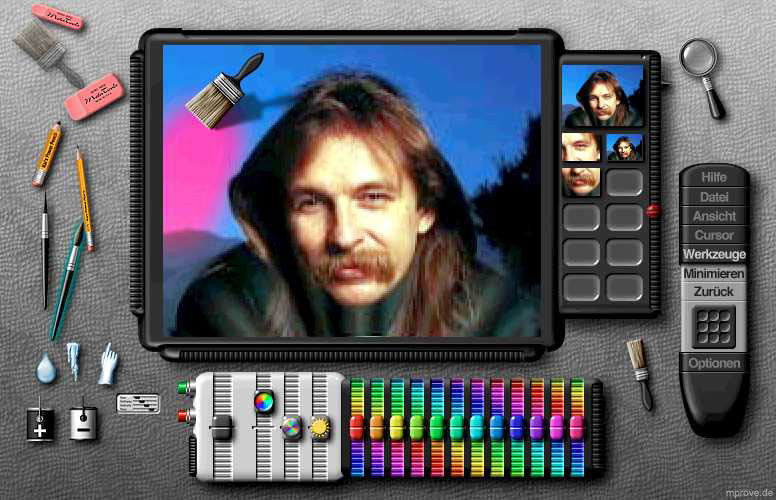
The Interface of Kai Krause's Software @mprove
Matthias Müller-Prove, Innovative Benutzungsschnittstellen, 1998/99, University of Hamburg
<i>Webstrates</i>: Shareable Dynamic Media
Shareable Dynamic Media is our vision for an interactive computing environment that blurs the distinction between documents and applications, characterized by three key properties: malleability, so that users can appropriate and repurpose media in ...

Claude and Paper - Peter Van Dijck's homepage
I've always done a lot of engineering work on paper, figuring out relationships, page layouts, models, UX etc.
Bidirectionalization for free! (Pearl) | Proceedings of the 36th annual ACM SIGPLAN-SIGACT symposium on Principles of programming languages
A bidirectional transformation consists of a function get that takes a source (document or value) to a view and a function put that takes an updated view and the original source back to an updated source, governed by certain consistency conditions ...

Is paper safer? The role of paper flight strips in air traffic control
Air traffic control is a complex, safety-critical activity, with well-established and successful work practices. Yet many attempts to automate the existing system have failed because controllers remain attached to a key work artifact: the paper flight strip. This article describes a four-month intensive study of a team of Paris en-route controllers in order to understand their use of paper flight strips. The article also describes a comparison study of eight different control rooms in France and the Netherlands. Our observations have convinced us that we do not know enough to simply get rid of paper strips, nor can we easily replace the physical interaction between controllers and paper strips.These observationshighlight the benefits of strips, including qualities difficult to quantify and replicate in new computer systems. Current thinking offers two basic alternatives: maintaining the existing strips without computer support and bearing the financial cost of limiting the air traffic, or replacing the strips with automated versions, which offer potential benefits in terms of increased efficiency through automation, but unknown risks through radical change of work practices. We conclude with a suggestion for a third alternative: to maintain the physical strips, but turn them into the interface to the computer. This would allow controllers to build directly upon their existing, safe work practices with paper strips, while offering them a gradual path for incorporating new computer-based functions. Augmented paper flight strips allow us to take advantage of uniquely human skills in the physical world, and allows us to leave the user interface and its subsequent evolution in the hands of the people most responsible, the air traffic controllers themselves.


The Glimmer — thefugue.space
A brief history of my attempts to bring Spatial Computing to the wider audience..

Design for a Living Planet: Settlement, Science, & the Human Future
In this brief, accessible volume, the authors — an urban philosopher and a mathematician-physicist — explain the surprising new findings from the sciences that are beginning to transform environmental design in the modern era. Authors Michael Mehaffy and Nikos Salingaros explore fractals, networks, self-organization, dynamical systems and other revolutionary ideas, describing them to non-science readers in a direct and engaging way. The book also examines fascinating new topics of design, including Agile, Wiki, Design Patterns and other “open-source” approaches from the software world. The authors conclude that a profound transformation is under way in modern design — and today’s students and practitioners will need to be aware of its implications for our future.“Lucidly describes what’s coming in the world of design — and what needs to come.” — Ward Cunningham, Inventor of wiki, and pioneer of Pattern Languages of Programming, Agile, and Scrum“Essential reading for all urban designers.” — Jeff Speck, Author of Walkable City“Brilliant.” — Charles Montgomery, Author of Happy City“Inspired, compelling and fascinating… Recognizes that a true architecture can be dug from the facts, insights, and theories, that occur with a broadening of science to include the human being.” — Christopher Alexander, Author of A Pattern Language and Notes on the Synthesis of FormSome comments on the individual chapters:“Packed with detail and beautiful in presentation.” — Gil Friend“Human society must find a path of retreat. Salingaros and Mehaffy point the way.” — David Brussat, Providence Journal“Michael Mehaffy and Nikos Salingaros have written some brilliant articles on how we can co-create cities which are truly resilient, rather than being ‘engineered resilient’.” — Smallworld Urbanism“For me, this essay was like a flash of insight, and I suddenly saw the world in a new light.” — Oeyvind Holmstad, Permaliv“We’ve just come across a very thoughtful article by Michael Mehaffy and Nikos Salingaros… [who] draw a number of lessons from biological systems and use them to draw conclusions about how resilient human systems must be designed.” — Resilient Design Institute“Salingaros and Mehaffy take us from the configuration of city spaces to the order of cells in living beings.” — Jaap Dawson, Delft Institute of Technology“If you wanted to know where the cutting edge was in urban design, it is here.” — Patrick J. Kennedy, CarFreeInBigD“This is the single most intelligent and illuminating article I’ve seen on Archdaily in 3 years.” — Nìming Pínglùn Zhě, ChinaMichael Mehaffy is an urbanist and design theorist, and a periodic visiting professor or adjunct in five graduate universities in four countries and three disciplines (architecture, urban planning and philosophy) including the University of Oregon (US) and the University of Strathclyde (UK). He has been a close associate of the architect and software pioneer Christopher Alexander, and a Research Associate with the Center for Environmental Structure, Alexander’s research center founded in 1967. He is currently executive director of Portland, Oregon based Sustasis Foundation, and editor of Sustasis Press.Nikos A. Salingaros is a mathematician and polymath known for his work on urban theory, architectural theory, complexity theory, and design philosophy. He has been a close collaborator of the architect and computer software pioneer Christopher Alexander. Salingaros published substantive research on Algebras, Mathematical Physics, Electromagnetic Fields, and Thermonuclear Fusion before turning his attention to Architecture and Urbanism. He is Professor of Mathematics at the University of Texas at San Antonio and has been on the Architecture faculties of universities in Italy, Mexico, and The Netherlands.
Paper – design, share, ship
Paper is a modern and powerful design tool that helps you create, share, and ship your best work.

Microsoft 365 Copilot | Copilot Pages
Exploring interoperability & composability for local-first software | grjte
Check out the project at https://github.com/grjte/groundmist-syncCross-posted to https://baincapitalcrypto.com/atproto-for-local-first-interoperability/ This is the third exploration connecting local-first software with the AT Protocol (atproto). Previously, I explored how atproto can enable new fu...

Addressable Space Web - Summer of Protocols
Addressable Space Chenoe Hart 1. Hidden Floors You may not notice in everyday life when a building you walk into is constructed of words and numbers in addition to bricks and mortar. Consider the composition of One Burrard Place, a condominium in Vancouver. It was described as

Tiles: Own your AI with local models and open protocols
Tiles: Own your AI with local models and open protocols is a Lightning Talk proposal for PuneFOSS 4.0. As AI becomes central to how we work and communicate, I believe we’re seeing a new form of technological feudalism, where a handful of platforms [...]
Smart Disorganized Individuals: SpimeScript
These days, I'm thinking a lot about 3D printers, desktop manufacturing and software to create physical things. Last year I did some art...