

Automated Training Interface : standard endpoint layer for computer-led training and inference parameters
Georgi Gerganov on Twitter / X
gpt-oss is a great modelIMO OpenAI showed us the blueprint for winning local AI:- Interleaved SWA- Small head sizes in the attention- Attention sinks- Mixture of Experts FFN- 4-bit trainingAll of these parts combined together result in the best architecture suitable for…— Georgi Gerganov (@ggerganov) August 28, 2025
Stanford CS231N Deep Learning for Computer Vision | Spring 2025 | Lecture 1: Introduction
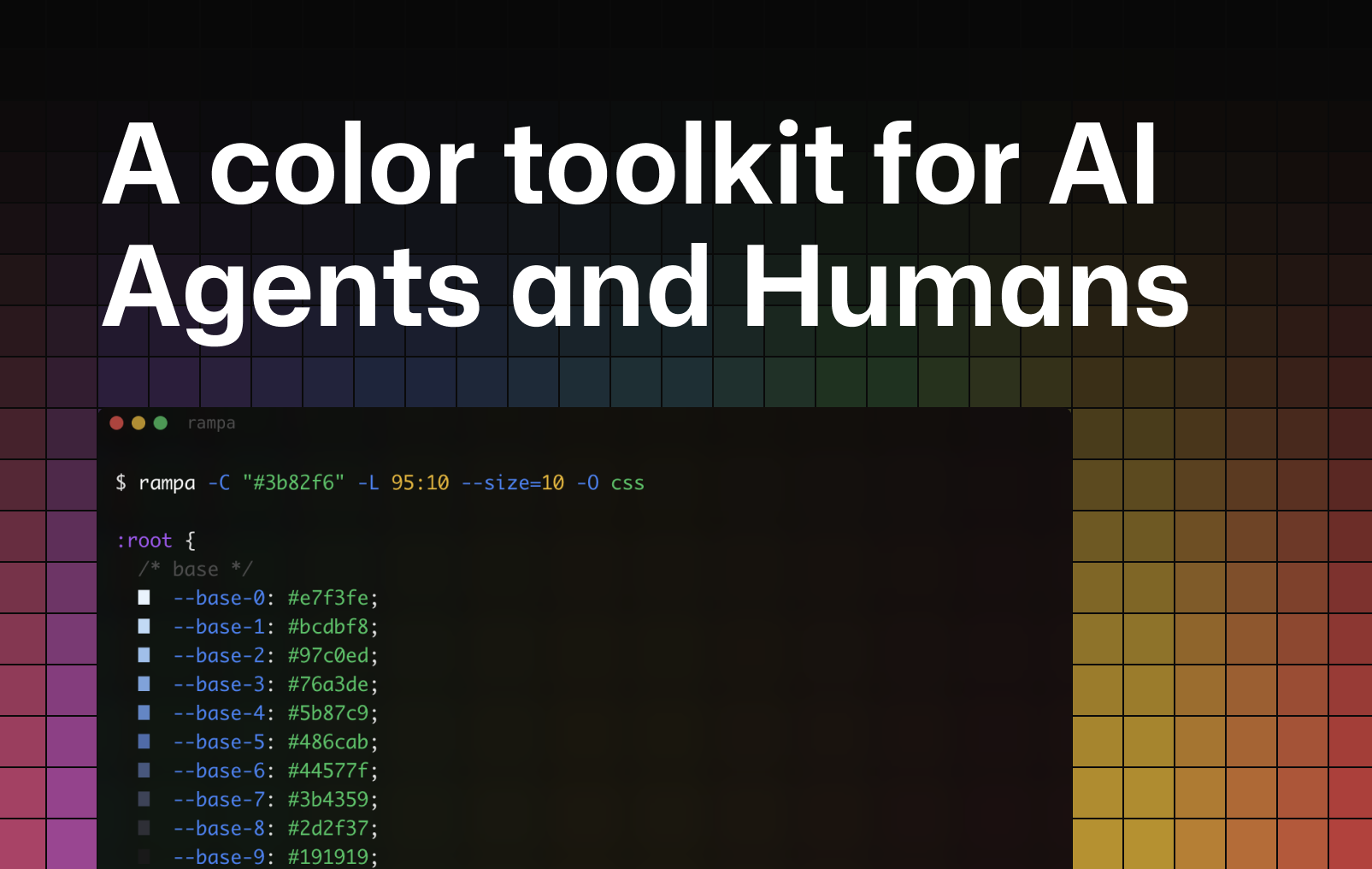
Rampa — A color toolkit for AI agents and humans
One tool generates palettes, analyzes contrast, mixes colors, and exports to any format. No plugins, no dependencies.
Open Source AI Inference Benchmark | InferenceX
Compare AI inference performance across GPUs and frameworks. Real benchmarks on NVIDIA GB200, B200, AMD MI355X, and more. Free, open-source, continuously updated.
OpenAI and Broadcom unveil LLM-optimized inference chip
OpenAI and Broadcom introduce Jalapeño, a custom AI chip built for LLM inference to improve performance, efficiency, and scale across AI systems.
A Controlled Study of Attention-Only Transformers
Feed-forward networks hold two thirds of a transformer's non-embedding parameters, yet the architecture has not received a necessity test that controls parameters, compute, and depth at once. We pretrain attention-only decoder transformers (Simple Attention Networks, SANs) against standard transformers matched separately for parameter count, training FLOPs, and depth (2 to 48 layers), for up to 105B tokens at 6M to 87M parameters. Deleting feed-forward layers in place is costly: the standard transformer leads by 0.47 nats at matched depth and 0.26 nats at matched FLOPs. Reallocating the freed budget into attention depth closes the gap: at matched parameters the difference is 0.006 nats (0.27 percent of loss), reproducible to one part in ten thousand across seed pairs, shrinking across 5B, 30B, and 105B budgets, and holding near 0.02 nats across a 29x size range. Three measurements localize the remaining gap to parametric recall: attention-only models are better on context-grounded answers and worse where knowledge must come from weights. Weight spectra show why: routing matrices (Q/K) crystallize early, content matrices accumulate rank slowly, and removing feed-forward layers relocates this accumulation to the attention output projection. QK-normalization, not feed-forward layers or residual gating, keeps 48-layer attention-only stacks trainable. The deficit concentrates on low-context query prediction and localizes there entirely by the largest budget. A pre-registered test confirms the account: it predicts a 0.02 to 0.05 nat gap on knowledge-dense web text; a matched pair trained on fineweb-edu measures 0.040. Within the tested regime, attention does the rest.

Set Lighting Technician's Handbook : Film Lighting Equipment, Practice, and Electrical Distribution
A friendly, hands-on training manual and reference for lighting technicians in motion picture and television production, this handbook is the most comprehensive guide to set lighting available. It provides a unique combination of practical detail with a big-picture understanding of lighting, technology, safety, and professionalism, essential to anyone doing motion picture lighting. The fifth edition delves into every aspect of lighting and features vastly expanded sections on controlling LED lights, color science, lighting control systems, wireless systems, Ethernet-based control systems, battery power, and modern set protocol for productions small and large. With a generous number of original images, the book illustrates the use of soft light, the effect of lighting angles, and how the gaffer and DP build an effective lighting plan around the blocking of the actors. This encyclopedic volume of technical knowhow is tempered with years of practical experience and a much-needed sense of humor.This is the ideal text for professional lighting technicians across film and television including lighting directors, gaffers, DOPs, and rigging crews, as well as film and television production students studying lighting, camera techniques, film production, and cinematography.It includes a revamped companion website with supplementary resources, forms, checklists, and images.

unslothai/unsloth
Unified web UI for training and running open models like Qwen, DeepSeek, gpt-oss and Gemma locally.
Benchmarking Subquadratic’s latest model & SSA Kernel | Appen
56× faster than FlashAttention-2 at 1M tokens. Independent efficiency, retrieval, and SWE-Bench benchmark of sparse self-attention. Download the full report.
Patternflow — An LED synthesizer
Patternflow is an open-source LED synthesizer. Play light with your fingertips.
Inside the World's Smartest Robot Brain [VLA]
On-device intelligence for every product
We're building a frontier lab for on-device AI. Small, specialized models for audio, vision, and text, faster than the cloud and free.
Frontier Pre-training at Microsoft AI | Microsoft AI
In June, we announced MAI-Thinking-1, a general-purpose foundation model post-trained on top of MAI-Base-1 with strong reasoning performance. We’ve recently completed pre-training our new state-of-the-art model, MAI-Base-2, an MoE foundation model with 80 billion active and 2.8 trillion total parameters.
karpathy/minGPT
A minimal PyTorch re-implementation of the OpenAI GPT (Generative Pretrained Transformer) training