DeepInfer: High-performance, large-scale inference framework for DeepSeek models
DeepSeek-V4: Towards Highly Efficient Million-Token Context Intelligence
We present a preview version of DeepSeek-V4 series, including two strong Mixture-of-Experts (MoE) language models -- DeepSeek-V4-Pro with 1.6T parameters (49B activated) and DeepSeek-V4-Flash with 284B parameters (13B activated) -- both supporting a context length of one million tokens. DeepSeek-V4 series incorporate several key upgrades in architecture and optimization: (1) a hybrid attention architecture that combines Compressed Sparse Attention (CSA) and Heavily Compressed Attention (HCA) to improve long-context efficiency; (2) Manifold-Constrained Hyper-Connections (mHC) that enhance conventional residual connections; (3) and the Muon optimizer for faster convergence and greater training stability. We pre-train both models on more than 32T diverse and high-quality tokens, followed by a comprehensive post-training pipeline that unlocks and further enhances their capabilities. DeepSeek-V4-Pro-Max, the maximum reasoning effort mode of DeepSeek-V4-Pro, redefines the state-of-the-art for open models, outperforming its predecessors in core tasks. Meanwhile, DeepSeek-V4 series are highly efficient in long-context scenarios. In the one-million-token context setting, DeepSeek-V4-Pro requires only 27% of single-token inference FLOPs and 10% of KV cache compared with DeepSeek-V3.2. This enables us to routinely support one-million-token contexts, thereby making long-horizon tasks and further test-time scaling more feasible. The model checkpoints are available at https://huggingface.co/collections/deepseek-ai/deepseek-v4.

DeepSeek_V4.pdf · deepseek-ai/DeepSeek-V4-Pro at main
We’re on a journey to advance and democratize artificial intelligence through open source and open science.
Distilling Dataset into Neural Field
Utilizing a large-scale dataset is essential for training high-performance deep learning models, but it also comes with substantial computation and storage costs. To overcome these challenges, dataset distillation has emerged as a promising solution by compressing the large-scale dataset into a smaller synthetic dataset that retains the essential information needed for training. This paper proposes a novel parameterization framework for dataset distillation, coined Distilling Dataset into Neural Field (DDiF), which leverages the neural field to store the necessary information of the large-scale dataset. Due to the unique nature of the neural field, which takes coordinates as input and output quantity, DDiF effectively preserves the information and easily generates various shapes of data. We theoretically confirm that DDiF exhibits greater expressiveness than some previous literature when the utilized budget for a single synthetic instance is the same. Through extensive experiments, we demonstrate that DDiF achieves superior performance on several benchmark datasets, extending beyond the image domain to include video, audio, and 3D voxel. We release the code at \url{https://github.com/aailab-kaist/DDiF}.
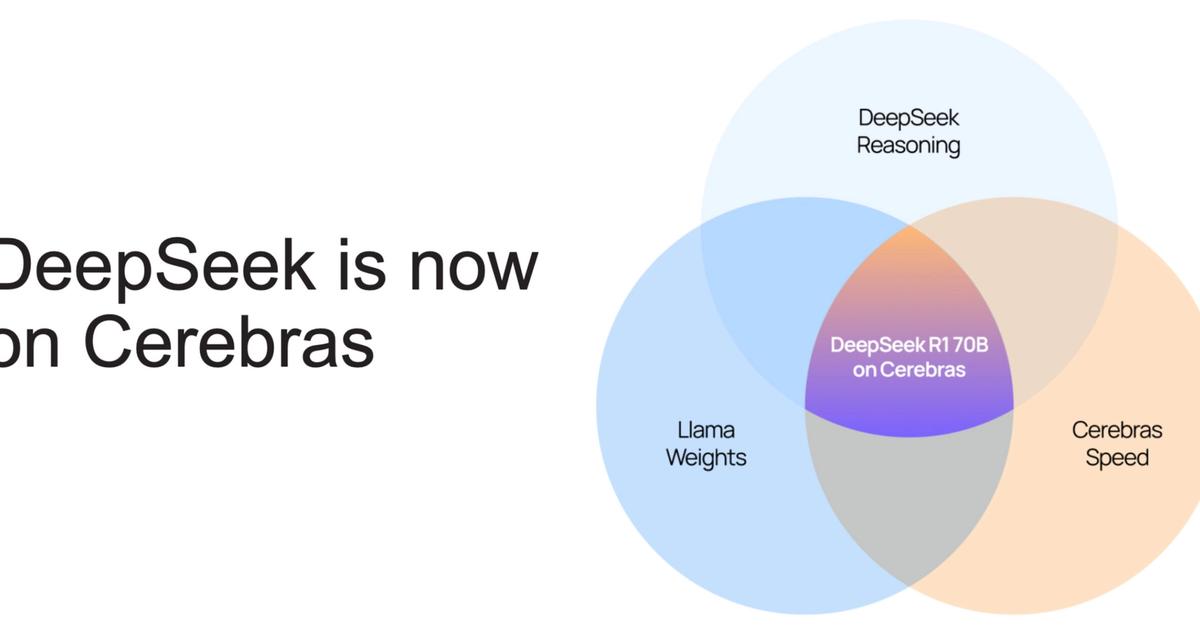
Cerebras Launches World Fastest DeepSeek R1 Llama-70B Inference - Cerebras
Cerebras launches fastest DeepSeek
Wafer - Ship the fastest inference in the world
Autonomous AI agents that profile, diagnose, and optimize GPU inference across your entire stack — from kernels to models to production pipelines.

Deep Learning Scaling is Predictable, Empirically
Deep learning (DL) creates impactful advances following a virtuous recipe: model architecture search, creating large training data sets, and scaling computation. It is widely believed that growing training sets and models should improve accuracy and result in better products. As DL application domains grow, we would like a deeper understanding of the relationships between training set size, computational scale, and model accuracy improvements to advance the state-of-the-art. This paper presents a large scale empirical characterization of generalization error and model size growth as training sets grow. We introduce a methodology for this measurement and test four machine learning domains: machine translation, language modeling, image processing, and speech recognition. Our empirical results show power-law generalization error scaling across a breadth of factors, resulting in power-law exponents---the "steepness" of the learning curve---yet to be explained by theoretical work. Further, model improvements only shift the error but do not appear to affect the power-law exponent. We also show that model size scales sublinearly with data size. These scaling relationships have significant implications on deep learning research, practice, and systems. They can assist model debugging, setting accuracy targets, and decisions about data set growth. They can also guide computing system design and underscore the importance of continued computational scaling.
SYNTHETIC-1: Scaling Distributed Synthetic Data Generation for Verified Reasoning
Introducing SYNTHETIC-1, a collaborative effort to create the largest open-source dataset of verified reasoning traces for math, coding and science, leveraging DeepSeek-R1.

deepseek-ai/DeepSeek-V4-Flash-0731 at 9e165c30e2704aec5d9d593cce3eebd58bbef1cb
We’re on a journey to advance and democratize artificial intelligence through open source and open science.

Dataset Condensation with Distribution Matching
Computational cost to train state-of-the-art deep models in many learning problems is rapidly increasing due to more sophisticated models and larger datasets. A recent promising direction to reduce training time is dataset condensation that aims to replace the original large training set with a significantly smaller learned synthetic set while preserving its information. While training deep models on the small set of condensed images can be extremely fast, their synthesis remains computationally expensive due to the complex bi-level optimization and second-order derivative computation. In this work, we propose a simple yet effective dataset condensation technique that requires significantly lower training cost with comparable performance by matching feature distributions of the synthetic and original training images in sampled embedding spaces. Thanks to its efficiency, we apply our method to more realistic and larger datasets with sophisticated neural architectures and achieve a significant performance boost while using larger synthetic training set. We also show various practical benefits of our method in continual learning and neural architecture search.
deepseek-ai/DeepSeek-OCR-2 · Hugging Face
We’re on a journey to advance and democratize artificial intelligence through open source and open science.

Deep Learning on a Data Diet: Finding Important Examples Early in Training
Recent success in deep learning has partially been driven by training increasingly overparametrized networks on ever larger datasets. It is therefore natural to ask: how much of the data is superfluous, which examples are important for generalization, and how do we find them? In this work, we make the striking observation that, in standard vision datasets, simple scores averaged over several weight initializations can be used to identify important examples very early in training. We propose two such scores—the Gradient Normed (GraNd) and the Error L2-Norm (EL2N) scores—and demonstrate their efficacy on a range of architectures and datasets by pruning significant fractions of training data without sacrificing test accuracy. In fact, using EL2N scores calculated a few epochs into training, we can prune half of the CIFAR10 training set while slightly improving test accuracy. Furthermore, for a given dataset, EL2N scores from one architecture or hyperparameter configuration generalize to other configurations. Compared to recent work that prunes data by discarding examples that are rarely forgotten over the course of training, our scores use only local information early in training. We also use our scores to detect noisy examples and study training dynamics through the lens of important examples—we investigate how the data distribution shapes the loss surface and identify subspaces of the model’s data representation that are relatively stable over training.
TRAK: Attributing Model Behavior at Scale
The goal of data attribution is to trace model predictions back to training data. Despite a long line of work towards this goal, existing approaches to data attribution tend to force users to choose between computational tractability and efficacy. That is, computationally tractable methods can struggle with accurately attributing model predictions in non-convex settings (e.g., in the context of deep neural networks), while methods that are effective in such regimes require training thousands of models, which makes them impractical for large models or datasets. In this work, we introduce TRAK (Tracing with the Randomly-projected After Kernel), a data attribution method that is both effective and computationally tractable for large-scale, differentiable models. In particular, by leveraging only a handful of trained models, TRAK can match the performance of attribution methods that require training thousands of models. We demonstrate the utility of TRAK across various modalities and scales: image classifiers trained on ImageNet, vision-language models (CLIP), and language models (BERT and mT5). We provide code for using TRAK (and reproducing our work) at https://github.com/MadryLab/trak .
SambaNova | The Fastest AI Inference Platform
Discover SambaNova - the complete AI platform delivering the fastest AI inference, fine-tuning, and scalable solutions for agentic AI easily integrated into existing data center infrastructures.