

The Digital Objects Network is a decentralized network that facilitates the creation, execution, and exchange of Digital Objects.
(PDF) The Comparative Anatomy of Nanopublications and FAIR Digital Objects
PDF | Beginning in 1995, early Internet pioneers proposed Digital Objects as encapsulations of data and metadata made accessible through persistent... | Find, read and cite all the research you need on ResearchGate

Network of shared purpose · Issue #369 · muni-town/roomy
Excerpted from Weird Web Pages. The Network is effectively a global jobs board, but for mutual collaborations rather than work-for-hire. Easiest way to prototype this might be with GitHub issues/di...
DIDComm: The Future of Secure and Decentralized Communication
How the W3C-Defined DIDComm Protocol is Revolutionizing Digital Messaging
Whanau | Proceedings of the 7th USENIX conference on Networked systems design and implementation
Pastry is a popular DHT overlay for its capability to facilitate storage and retrieval of data/ file among large number of nodes, efficiently without any centralized server. Performance is one of the major concerns in such networks. This work, frames a ...
Omidyar Network
Omidyar Network is a philanthropy whose mission is to bend the arc of the digital revolution toward shared power, prosperity, and possibility.
DAWO.community
DAWO.community, working together on a digitally autonomous workplace for the Dutch government.
DigitaltMuseum
DigitaltMuseum is a common database for Norwegian and Swedish museums and collections. It provides access to more than four million photographs, objects, works of art and buildings.


gioblu/PJON
PJON (Padded Jittering Operative Network) is an experimental, arduino-compatible, multi-master, multi-media network protocol.
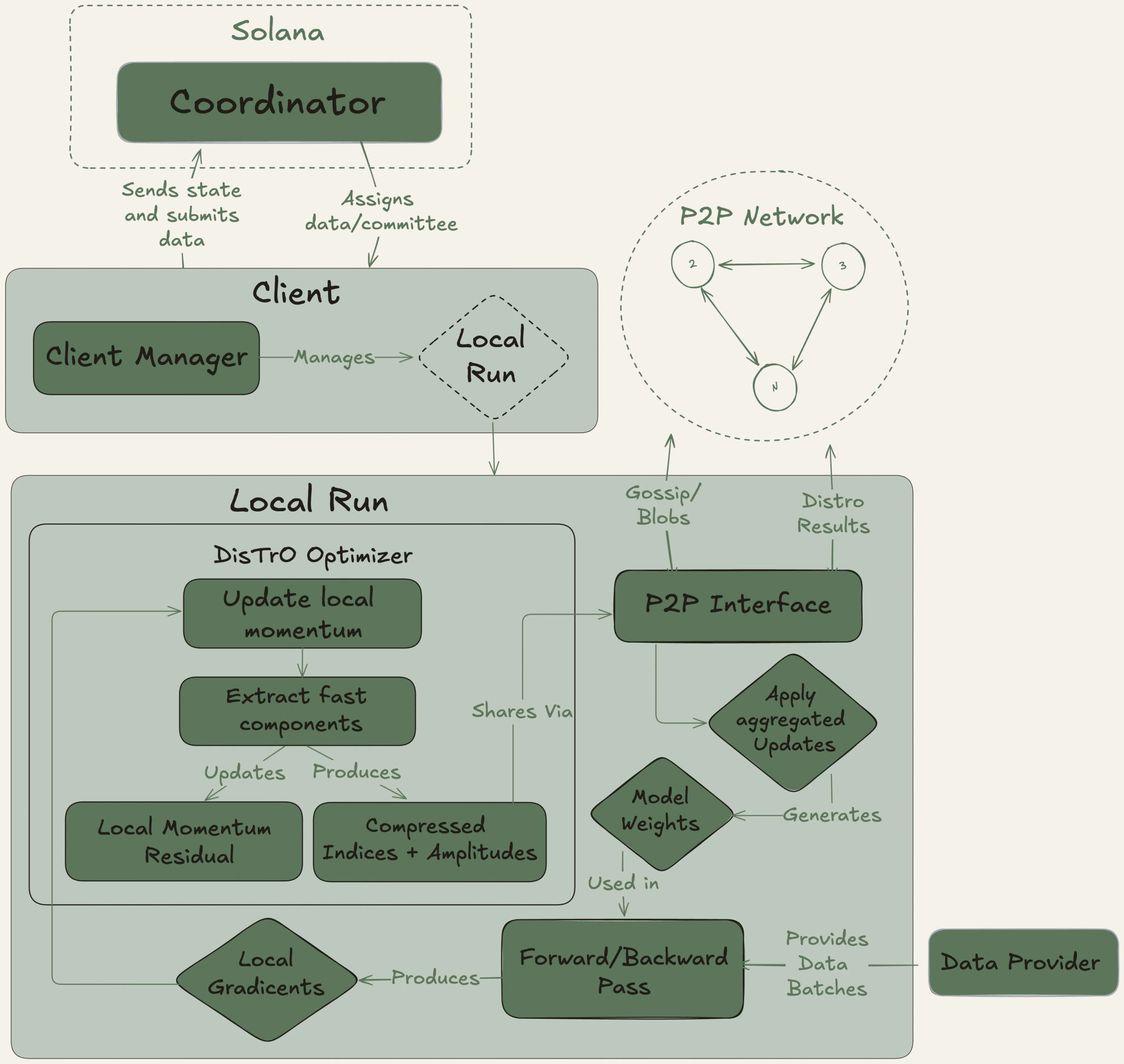
Democratizing AI: The Psyche Network Architecture - NOUS RESEARCH
Psyche is an open infrastructure that democratizes AI development by decentralizing training across underutilized hardware. Building on DisTrO and its predecessor DeMo, Psyche reduces data transfer by several orders of magnitude, making distributed training practical. Coordination happens on the Solana blockchain, ensuring a fault-tolerant and censorship-resistant network.
DIDComm
DIDComm lets people and software use DIDs to communicate securely and privately over many channels: the web, email, mobile push notifications, QR codes, Bluetooth, message queues, sneakernet, and more.
An Explanation of DAOstack in Fairly Simple Terms
DAOstack is an open-source software stack designed to support a global collaborative network.
KOI-net Protocol Specification Draft v1.0
The KOI-net protocol defines the standard communication patterns and coordination norms needed to establish and maintain Knowledge Organization Infrastructure (KOI) networks. KOI networks are heterogeneous compositions of KOI nodes, each of which is capable of autonomously inputting, processing, and outputting knowledge. The behavior of each node and configuration of each network can vary greatly; therefore, the protocol is designed to be a simple, flexible, and interoperable foundation for future projects to build on. The protocol only governs communication between nodes, not how they operate internally. As a result we consider KOI-nets to be fractal-like, in that a network of nodes may act like a single node when viewed from outside.
From ZK-first to AT Protocol — our path to DDS | Agora Citizen Network
We've been building Agora — a platform for public deliberation using Polis-style clustering — for a while now. Along the way, we've written about what we think about Nostr, AT Protocol, Polis, Community Notes, and protocol interoperability. Those posts are somewhat outdated now. This one describes w...

