

Par (⅋) is an experimental concurrent programming language. It's an attempt to bring the expressive power of linear logic into practice.
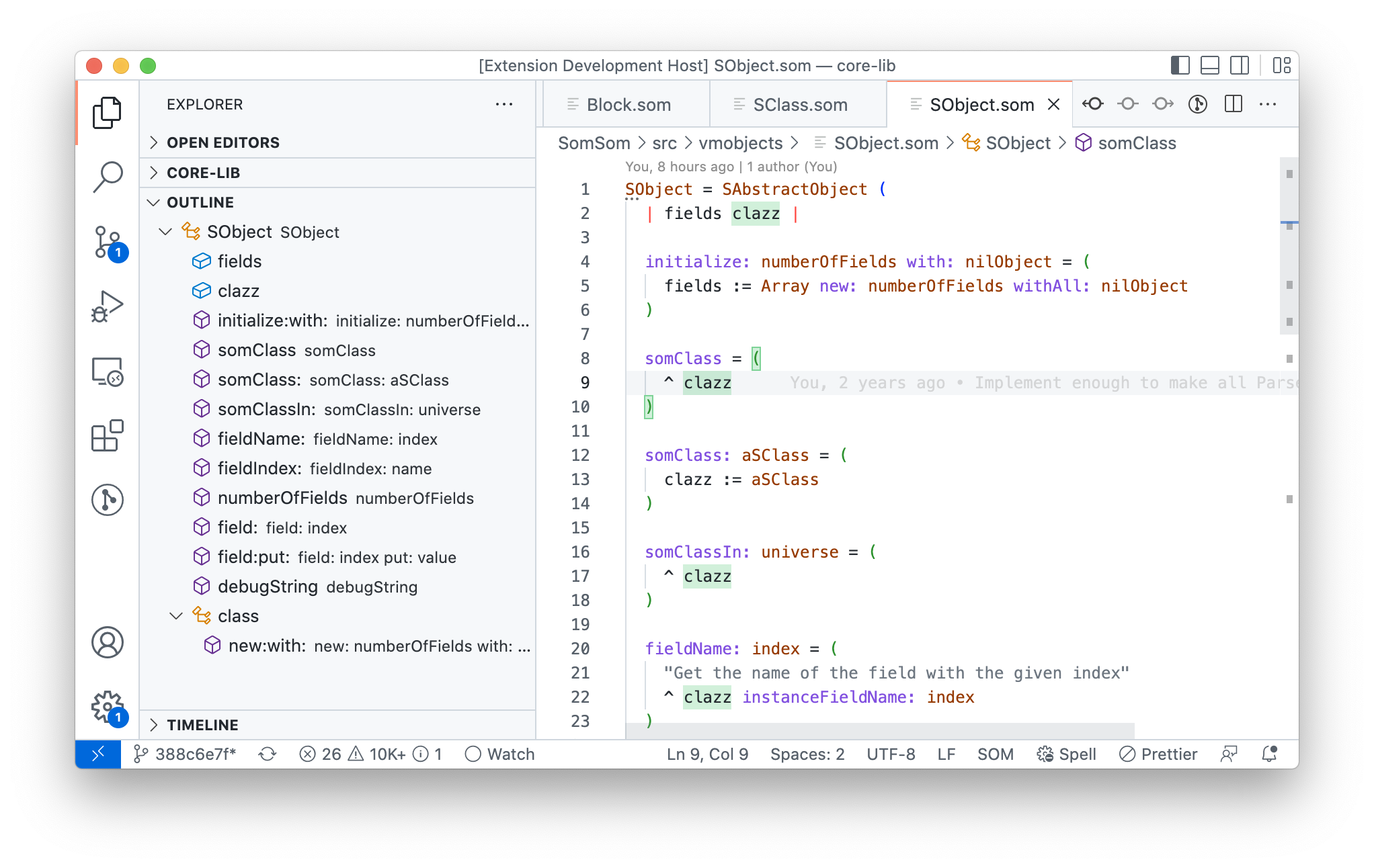
Execution vs Parse-based Language Servers: Tradeoffs and Opportunities for Language-Agnostic Tooling for Dynamic Languages
Paper on low-effort language server implementations, comparing an execution-based approach with one that requires a little more effort by extracting information during parsing. Presented at the Dynamic Language Symposium, Auckland, New Zealand, December 7, 2022
What Kind of Programming is Natural Language Programming?
In previous posts I’ve written about Natural Language Programming, Dijkstra’s Ghost – the End of The Symbolic Supremacy and Ephemeral Editable Specifications (aka Extract, Edit, A…

Kaitai Struct: declarative binary format parsing language
Kaitai Struct is a formal language for binary format specification that can be compiled into parser code
Syntax Club
Share your syntax. Spread knowledge. A place to share, save, and discover code snippets on the AT Protocol.

Resugaring | Proceedings of the 35th ACM SIGPLAN Conference on Programming Language Design and Implementation
Syntactic sugar plays a crucial role in engineering programming languages. It offers convenient syntax and higher-level of abstractions, as witnessed by its pervasive use in both general-purpose and domain-specific contexts. Unfortunately, the ...

candy-lang/candy
🍭 A sweet, functional programming language that is robust, minimalistic, and expressive.
Unison | A friendly, statically-typed, functional programming language from the future · Unison programming language
A friendly programming language from the future.

Unison | A friendly, statically-typed, functional programming language from the future · Unison programming language
A friendly programming language from the future.
quint-co/quint
An executable specification language with delightful tooling based on the temporal logic of actions (TLA)
Packrat parsing: | Proceedings of the seventh ACM SIGPLAN international conference on Functional programming
For decades we have been using Chomsky's generative system of grammars, particularly context-free grammars (CFGs) and regular expressions (REs), to express the syntax of programming languages and protocols. The power of generative grammars to express ...

Combinatory Logic
Explore combinatory logic, combinator birds, and tacit programming across different languages like BQN, J, APL, and Haskell.
Tree-sitter - a new parsing system for programming tools - Strange Loop
Strange Loop is a conference for software developers covering programming langs, databases, distributed systems, security, machine learning, creativity, and more!

Engineering High-Performance Parsers with Data-Oriented Design
Notes from building Yuku: the AST is flat arrays of u32 indices instead of a pointer tree, and memory layout, allocation, strings, unicode, and serialization all follow from that one decision.
Rusty thoughts on "Parse, don't validate" - Eli Bendersky's website
Like many programmers, I find Alexis King's Parse, don't validate article fascinating, because it gives a name to an idiom that seems familiar and important - one I've observed and used in the past without naming it explicitly. This post is a review of the "Parse, don't validate" pattern applied to the Rust programming language (the original post uses Haskell). I was particularly interested in finding educational examples of this pattern in the Rust standard library and other well-known projects.
Factor programming language
The Factor programming language is a concatenative, stack-based programming language with high-level features including dynamic types, extensible syntax, macros, and garbage collection. On a practical side, Factor has a full-featured library, supports many different platforms, and has been extensively documented.