

A reactions plugin for Discourse. Contribute to gdpelican/retort development by creating an account on GitHub.
Getting started - Docs
Discourse Graphs are a tool and ecosystem for collaborative knowledge synthesis, enabling researchers to map ideas and arguments in a modular, composable graph format.
Generative AI for Pro-Democracy Platforms · From Novel Chemicals to Opera
Online discourse faces challenges in facilitating substantive and productive political conversations. Recent technologies have explored the potential of generative AI to promote civil discourse, encourage the development of mutual understanding in a discussion, produce . . .

NLnet; Nanoarguments
Scientific knowledge is currently scattered across papers, repositories, and disconnected platforms, with no structured way to trace how claims connect to evidence or how arguments develop. Nanoarguments builds a framework and tools for creating, browsing, and contributing to a global, federated graph of scientific discourse and evidence. Researchers and their communities can collaboratively structure claims, evidence chains, and discussion as nanopublications, which are small, cryptographically signed Linked Data snippets with precise provenance and authorship, published to a decentralized peer-to-peer network. The project builds upon the Nanodash interface to help users browse, edit, and aggregate discourse and evidence graphs, and integrates with dokieli to enable in-context authoring of nanopublications as inline annotations while reading or writing a document. A bidirectional ActivityPub connector bridges the nanopublication network and the fediverse, allowing discourse threads to start as social exchanges and crystallize into persistent, machine-readable evidence records. The project will be piloted with early adopter research groups in discourse and evidence modeling. All components will be released as open-source modules that other systems can build upon.
Red Squares — the GitHub outage graph
A satirical contribution graph: red squares track GitHub.com platform outages instead of green squares tracking commits.
Latest ChatGPT model uses Elon Musk’s Grokipedia as source, tests reveal
Guardian found OpenAI’s platform cited Grokipedia on topics including Iran and Holocaust deniers

Steps Towards an Infrastructure for Scholarly Synthesis
Sharing, reusing, and synthesizing knowledge is central to the research process, both individually, and with others. These core functions are not supported by our formal scholarly publishing infrastructure: instead of the smooth functioning of functional infrastructure, researchers resort to laborious ”hacks” and workarounds to ”mine” publications for what they need, and struggle to efficiently share the resulting information with others. Information scientists have proposed an alternative infrastructure based on the more appropriately granular model of a discourse graph of claims, and evidence, along with key rhetorical relationships between them. However, despite significant technical progress on standards and platforms, the predominant infrastructure remains steadfastly document-based. Drawing from infrastructure studies, we locate the current infrastructural bottlenecks in the lack of local systems that integrate discourse-centric models to augment synthesis work, from which an infrastructure for synthesis can be grown. Through 3 years of research through design and field deployment in a distributed community of hypertext notebook users, we elaborate a design vision of what can and should be built in order to grow a discourse-centric synthesis infrastructure: a thriving “installed base” of researchers authoring local, shareable discourse graphs to improve synthesis work, enhance primary research and research training, and augment collaborative research. We discuss how this design vision — and our empirical work — contributes steps towards a new infrastructure for synthesis, and increases HCI’s capacity to advance collective intelligence and solve infrastructure-level problems.
Integrate Bluesky replies as your blog's comment section
Integrate Bluesky replies as your blog's comment section · GitHub

Steps Towards an Infrastructure for Scholarly Synthesis
Sharing, reusing, and synthesizing knowledge is central to the research process, both individually, and with others. These core functions are not supported by our formal scholarly publishing infrastructure: instead of the smooth functioning of functional infrastructure, researchers resort to laborious "hacks" and workarounds to "mine" publications for what they need, and struggle to efficiently share the resulting information with others. Information scientists have proposed an alternative infrastructure based on the more appropriately granular model of a discourse graph of claims, and evidence, along with key rhetorical relationships between them. However, despite significant technical progress on standards and platforms, the predominant infrastructure remains steadfastly document-based. Drawing from infrastructure studies, we locate the current infrastructural bottlenecks in the lack of local systems that integrate discourse-centric models to augment synthesis work, from which an infrastructure for synthesis can be grown. Through 3 years of research through design and field deployment in a distributed community of hypertext notebook users, we elaborate a design vision of what can and should be built in order to grow a discourse-centric synthesis infrastructure: a thriving "installed base" of researchers authoring local, shareable discourse graphs to improve synthesis work, enhance primary research and research training, and augment collaborative research. We discuss how this design vision -- and our empirical work -- contributes steps towards a new infrastructure for synthesis, and increases HCI's capacity to advance collective intelligence and solve infrastructure-level problems.

Embracing ATProto, part 2: Tangled Knots and social coding
You thought Github was a social coding platform? Think again, and get ready to tangle! Built on atproto, tangled allows you to use your Bluesky/atproto identity on a (not quite yet) fully feldged git platform!


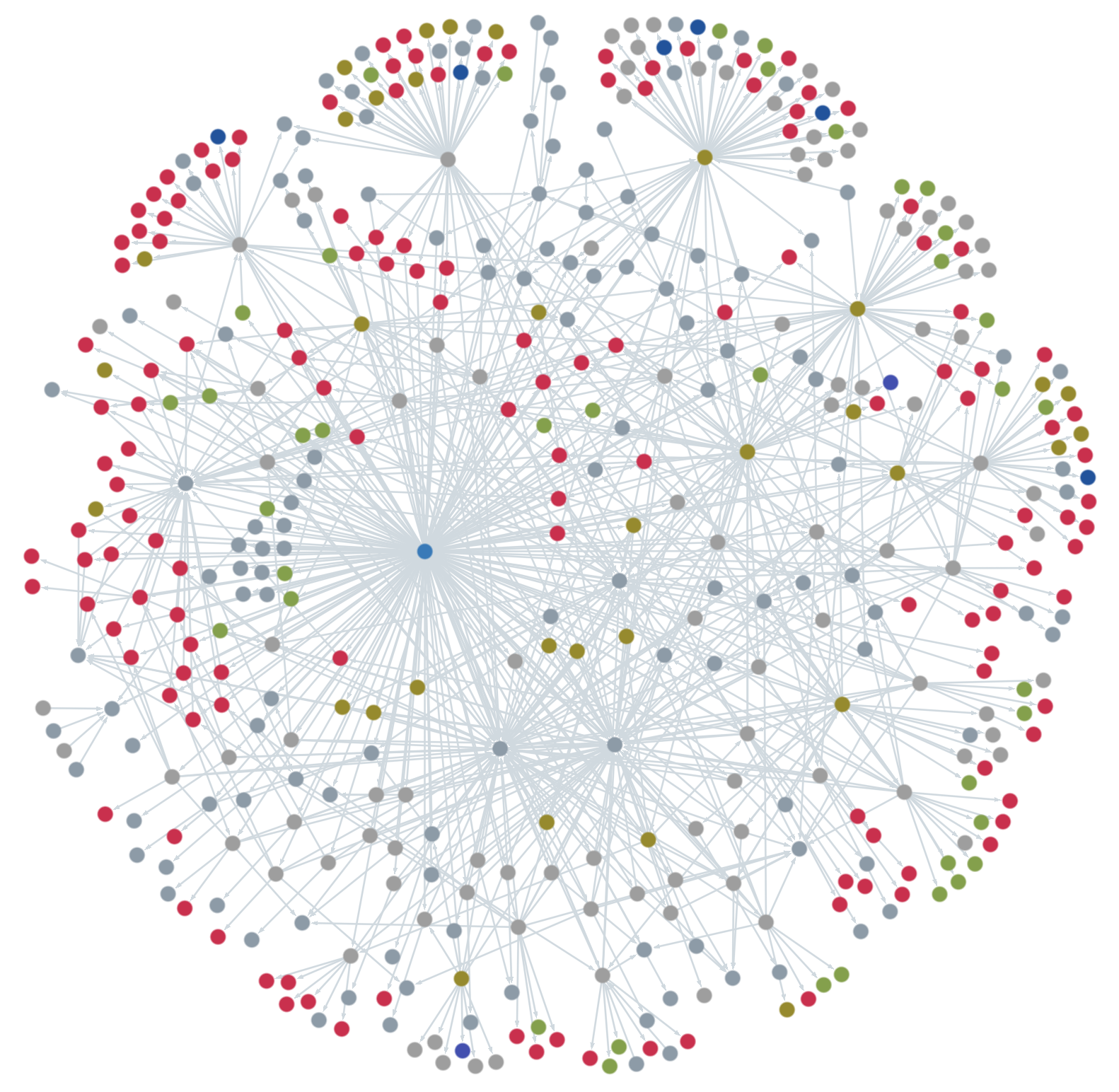
Metagov x Future of Science Seminar - Discourse Graphs with Matt Akamatsu
this is an effective method of delivering hand-tailored propaganda to a billion people every day

Daphne Keller
Oh look. It's that thing @corbinkbarthold.bsky.social warned us about. nytimes.com/2026/05/04/technology/trump-a…

