

Unsupervised text tokenizer for Neural Network-based text generation.
Tokenization: A Survey for Modern NLP
While modern language models take raw text as their input and produce raw text as output, they do not operate over text directly. Hidden in the very first step of language model pipelines is...
Your LLM Knows the Future: Uncovering Its Multi-Token Prediction Potential
Autoregressive language models are constrained by their inherently sequential nature, generating one token at a time. This paradigm limits inference speed and parallelism, especially during later stages of generation when the direction and semantics of text are relatively certain. In this work, we propose a novel framework that leverages the inherent knowledge of vanilla autoregressive language models about future tokens, combining techniques to realize this potential and enable simultaneous prediction of multiple subsequent tokens. Our approach introduces several key innovations: (1) a masked-input formulation where multiple future tokens are jointly predicted from a common prefix; (2) a gated LoRA formulation that preserves the original LLM's functionality, while equipping it for multi-token prediction; (3) a lightweight, learnable sampler module that generates coherent sequences from the predicted future tokens; (4) a set of auxiliary training losses, including a consistency loss, to enhance the coherence and accuracy of jointly generated tokens; and (5) a speculative generation strategy that expands tokens quadratically in the future while maintaining high fidelity. Our method achieves significant speedups through supervised fine-tuning on pretrained models. For example, it generates code and math nearly 5x faster, and improves general chat and knowledge tasks by almost 2.5x. These gains come without any loss in quality.

make ai speak computer by dottxt @ Nouscon 2024
Technical Report on the Pangram AI-Generated Text Classifier
We present Pangram Text, a transformer-based neural network trained to distinguish text written by large language models from text written by humans. Pangram Text outperforms zero-shot methods...
The Impact of AI-Generated Text on the Internet
The proliferation of AI-generated and AI-assisted text on the internet is feared to contribute to a degradation in semantic and stylistic diversity, factual accuracy, and other negative...
The Impact of AI-Generated Text on the Internet
The proliferation of AI-generated and AI-assisted text on the internet is feared to contribute to a degradation in semantic and stylistic diversity, factual accuracy, and other negative...
Natural Language Autoencoders Produce Unsupervised Explanations of LLM Activations
We introduce Natural Language Autoencoders (NLAs), an unsupervised method for generating natural language explanations of LLM activations. An NLA consists of two LLM modules: an activation verbalizer (AV) that maps an activation to a text description and an activation reconstructor (AR) that maps the description back to an activation. We jointly train the AV and AR with reinforcement learning to reconstruct residual stream activations. Although we optimize for activation reconstruction, the resulting NLA explanations read as plausible interpretations of model internals that, according to our quantitative evaluations, grow more informative over training.
Attention Is All You Need
The dominant sequence transduction models are based on complex recurrent or convolutional neural networks in an encoder-decoder configuration. The best performing models also connect the encoder and decoder through an attention mechanism. We propose a new simple network architecture, the Transformer, based solely on attention mechanisms, dispensing with recurrence and convolutions entirely. Experiments on two machine translation tasks show these models to be superior in quality while being more parallelizable and requiring significantly less time to train. Our model achieves 28.4 BLEU on the WMT 2014 English-to-German translation task, improving over the existing best results, including ensembles by over 2 BLEU. On the WMT 2014 English-to-French translation task, our model establishes a new single-model state-of-the-art BLEU score of 41.8 after training for 3.5 days on eight GPUs, a small fraction of the training costs of the best models from the literature. We show that the Transformer generalizes well to other tasks by applying it successfully to English constituency parsing both with large and limited training data.
Differences in Text Generated by Diffusion and Autoregressive Language Models
Diffusion language models (DLMs) are promising alternatives to autoregressive language models (ARMs), yet the intrinsic differences in their generated text remain underexplored. We first find empirically that off-the-shelf DLMs exhibit lower $n$-gram entropy, higher semantic coherence, and higher semantic diversity. To understand the cause, we conduct controlled experiments that decouple the effects of training objectives and decoding algorithms. Results suggest that the DLM training objective contributes to the increases in semantic coherence and semantic diversity, but has a minor influence on entropy. These differences are primarily driven by the bidirectional context; other components in the training objective, such as input masking, label masking, and the weighting function, have a much weaker influence. Further, our experiments demonstrate that the reduction in entropy stems from DLMs' decoding algorithms, particularly confidence-based remasking strategies. We provide a theoretical understanding for this entropy reduction phenomenon. Together, our work uncovers key mechanisms underlying the differences between DLMs and ARMs in text generation, and informs future design of training objectives and decoding algorithms in DLMs.
Overcoming Vocabulary Constraints with Pixel-level Fallback
Subword tokenization requires balancing computational efficiency and vocabulary coverage, which often leads to suboptimal performance on languages and scripts not prioritized during training. We propose to augment pretrained language models with a vocabulary-free encoder that generates input embeddings from text rendered as pixels. Through experiments on English-centric language models, we demonstrate that our approach substantially improves machine translation performance and facilitates effective cross-lingual transfer, outperforming tokenizer-based methods. Furthermore, we find that pixel-based representations outperform byte-level approaches and standard vocabulary expansion. Our approach enhances the multilingual capabilities of monolingual language models without extensive retraining and reduces decoding latency via input compression.
AI models collapse when trained on recursively generated data
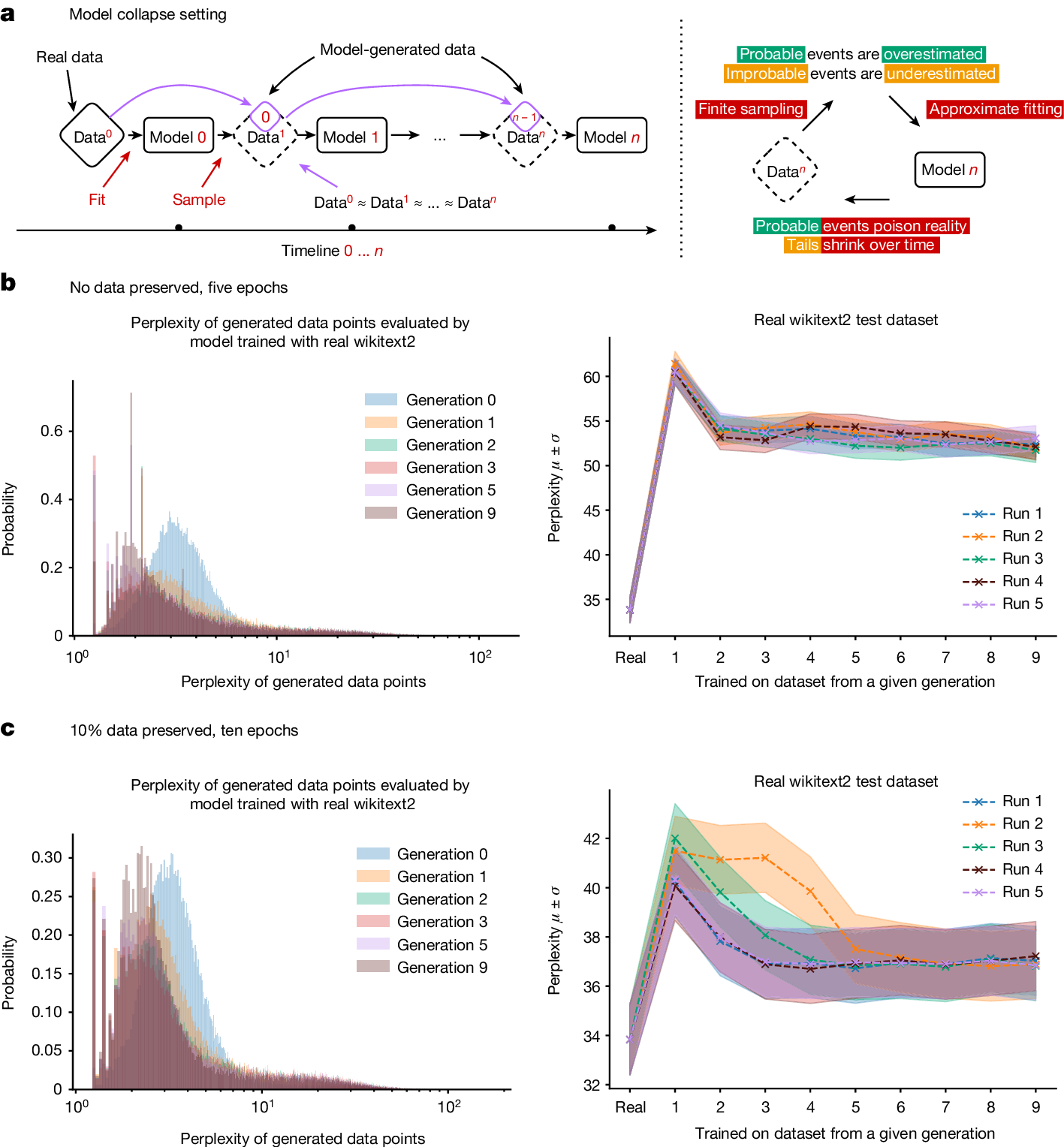
Stable diffusion revolutionized image creation from descriptive text. GPT-2 (ref. 1), GPT-3(.5) (ref. 2) and GPT-4 (ref. 3) demonstrated high performance across a variety of language tasks. ChatGPT introduced such language models to the public. It is now clear that generative artificial intelligence (AI) such as large language models (LLMs) is here to stay and will substantially change the ecosystem of online text and images. Here we consider what may happen to GPT-{n} once LLMs contribute much of the text found online. We find that indiscriminate use of model-generated content in training causes irreversible defects in the resulting models, in which tails of the original content distribution disappear. We refer to this effect as ‘model collapse’ and show that it can occur in LLMs as well as in variational autoencoders (VAEs) and Gaussian mixture models (GMMs). We build theoretical intuition behind the phenomenon and portray its ubiquity among all learned generative models. We demonstrate that it must be taken seriously if we are to sustain the benefits of training from large-scale data scraped from the web. Indeed, the value of data collected about genuine human interactions with systems will be increasingly valuable in the presence of LLM-generated content in data crawled from the Internet.
AI models collapse when trained on recursively generated data
Stable diffusion revolutionized image creation from descriptive text. GPT-2 (ref. 1), GPT-3(.5) (ref. 2) and GPT-4 (ref. 3) demonstrated high performance across a variety of language tasks. ChatGPT introduced such language models to the public. It is now clear that generative artificial intelligence (AI) such as large language models (LLMs) is here to stay and will substantially change the ecosystem of online text and images. Here we consider what may happen to GPT-{n} once LLMs contribute much of the text found online. We find that indiscriminate use of model-generated content in training causes irreversible defects in the resulting models, in which tails of the original content distribution disappear. We refer to this effect as ‘model collapse’ and show that it can occur in LLMs as well as in variational autoencoders (VAEs) and Gaussian mixture models (GMMs). We build theoretical intuition behind the phenomenon and portray its ubiquity among all learned generative models. We demonstrate that it must be taken seriously if we are to sustain the benefits of training from large-scale data scraped from the web. Indeed, the value of data collected about genuine human interactions with systems will be increasingly valuable in the presence of LLM-generated content in data crawled from the Internet.
Attention is All you Need
The dominant sequence transduction models are based on complex recurrent orconvolutional neural networks in an encoder and decoder configuration. The best performing such models also connect the encoder and decoder through an attentionm echanisms. We propose a novel, simple network architecture based solely onan attention mechanism, dispensing with recurrence and convolutions entirely.Experiments on two machine translation tasks show these models to be superiorin quality while being more parallelizable and requiring significantly less timeto train. Our single model with 165 million parameters, achieves 27.5 BLEU onEnglish-to-German translation, improving over the existing best ensemble result by over 1 BLEU. On English-to-French translation, we outperform the previoussingle state-of-the-art with model by 0.7 BLEU, achieving a BLEU score of 41.1.
What Language is This? Ask Your Tokenizer
Language Identification (LID) is an important component of many multilingual natural language processing pipelines, where it facilitates corpus curation, training data analysis, and cross-lingual evaluation of large language models. Despite near-perfect performance on high-resource languages, existing systems remain brittle in low-resource and closely related language settings. We introduce UniLID, a simple and efficient LID method based on the UnigramLM tokenization algorithm, leveraging its probabilistic framing, parameter estimation technique and inference strategy. In short, to predict a string's language label, we simply ask: under which language's unigram distribution is this string most likely? Our formulation is data- and compute-efficient, supports incremental addition of new languages without retraining existing models, and can naturally be integrated into existing language model tokenization pipelines. Empirical evaluations against widely used baselines, including fastText, GlotLID and CLD3, show that UniLID achieves competitive performance on standard benchmarks, substantially improves sample efficiency in low-resource settings -- reaching ~70% accuracy with as few as five labeled samples per language -- and delivers large gains on fine-grained dialect identification.
How memory augmentation can improve large language models
Generative AI models struggle to handle long context, but memory augmentation can reduce their memory footprint, making them more accurate and lightweight
