

A CLI-based, flat-file issue tracker for humans and robots. 🤖
The KD Files - Case File Tracker
kenn-io/kata
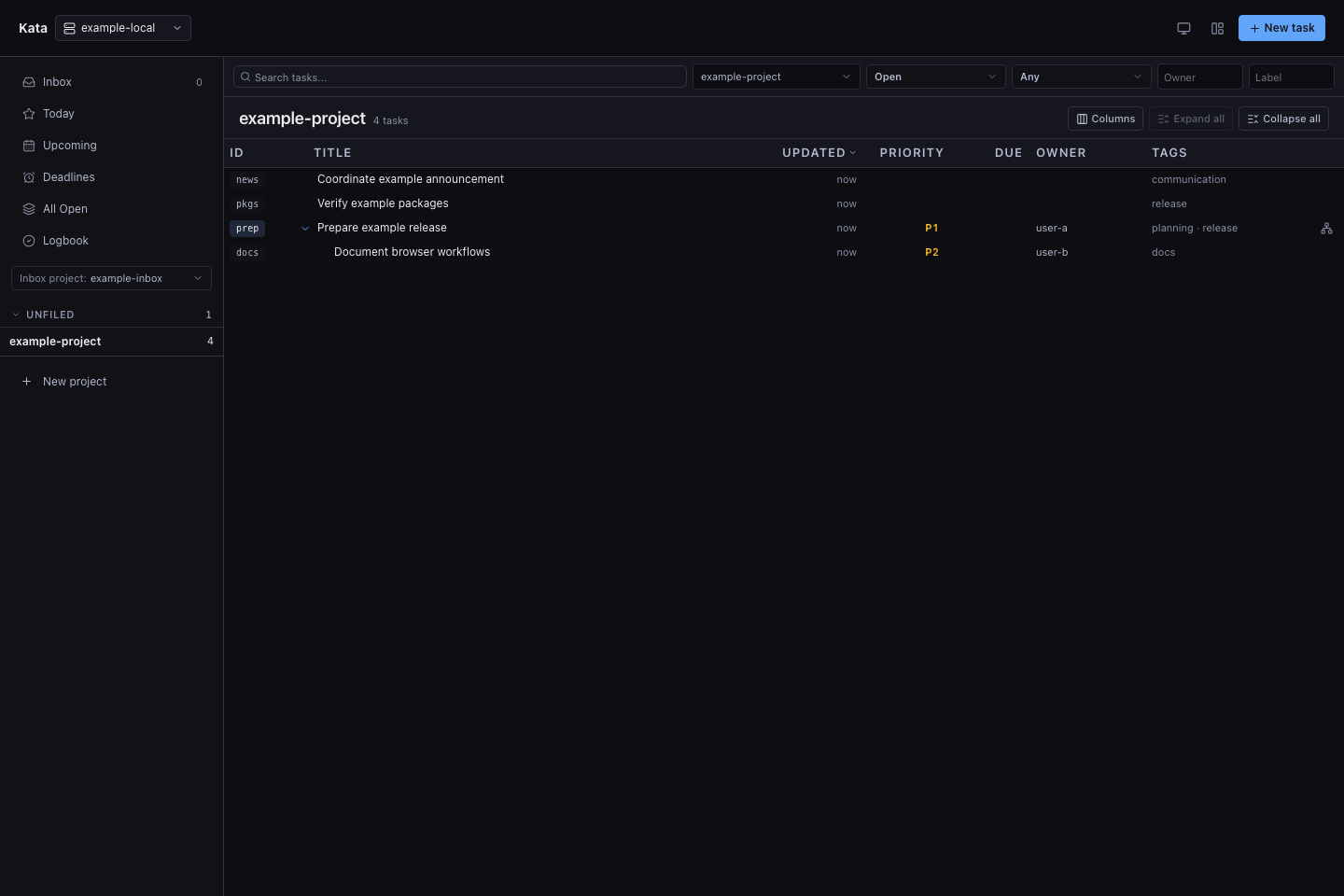
Local-first issue tracking for AI-assisted software work, with an agent-friendly CLI and human-facing TUI
The issue tracker that runs inside the loop.
A local-first issue tracker for coding agents and the humans steering them. Queries in 4ms, on your own machine.
jdefrancesco/dskDitto
Ultra fast and easy duplicate file finder. Awesome TUI/GUI to manage results.

GitHub - Responsible-Dataset-Sharing/easy-dataset-share: A CLI tool that helps AI researchers share datasets responsibly.
A CLI tool that helps AI researchers share datasets responsibly. - Responsible-Dataset-Sharing/easy-dataset-share
Pinata | Autonomous File Storage
Add file uploads and retrieval in minutes so you can focus on your app —because you’ve got better things to code than infrastructure.

PII-TRACE: Detecting Personal Data Before It Leaves a Device
Discover how PII-TRACE tests recurring PII detection in long multilingual conversations with a compact 0.6B local model.

JuiceFS - Open Source Distributed POSIX File System for Cloud
JuiceFS is a cloud-based high-performance distributed file system, based on object storage and database to achieve data and metadata separation architecture, easily carrying tens of billions of file storage, to meet the random read performance requirements of big data, AI, autonomous driving, gene sequencing and other massive data.
API | Yutori - AI agents for everyday digital tasks
Build with Yutori’s state-of-the-art web agents that can autonomously monitor and execute tasks on the web.

Clio: Privacy-Preserving Insights into Real-World AI Use
How are AI assistants being used in the real world? While model providers in theory have a window into this impact via their users' data, both privacy concerns and practical challenges have made analyzing this data difficult. To address these issues, we present Clio (Claude insights and observations), a privacy-preserving platform that uses AI assistants themselves to analyze and surface aggregated usage patterns across millions of conversations, without the need for human reviewers to read raw conversations. We validate this can be done with a high degree of accuracy and privacy by conducting extensive evaluations. We demonstrate Clio's usefulness in two broad ways. First, we share insights about how models are being used in the real world from one million Claude.ai Free and Pro conversations, ranging from providing advice on hairstyles to providing guidance on Git operations and concepts. We also identify the most common high-level use cases on Claude.ai (coding, writing, and research tasks) as well as patterns that differ across languages (e.g., conversations in Japanese discuss elder care and aging populations at higher-than-typical rates). Second, we use Clio to make our systems safer by identifying coordinated attempts to abuse our systems, monitoring for unknown unknowns during critical periods like launches of new capabilities or major world events, and improving our existing monitoring systems. We also discuss the limitations of our approach, as well as risks and ethical concerns. By enabling analysis of real-world AI usage, Clio provides a scalable platform for empirically grounded AI safety and governance.

omnifs: access the world through your filesystem
omnifs turns APIs and data sources into files and directories your shell, scripts, CI jobs, notebooks, and agents can read.

Nothing new under the sun: everything is a file
The Unix revolution was built on a key principle: everything is a file. Now, with the rise of AI Agents, LLMs have access to half a century of file-based arcana. The result? Everything is becoming a file again.

rowanpaulflynn.dev/opnshelf
[READ-ONLY] Mirror of https://github.com/Rowan-Paul/opnshelf. A personal media tracker built on the AT Protocol