A Jupyter notebook building and training a Neural Network from scratch with NumPy
Deep Learning with Python
Start building deep learning applications with Python and Keras today!

#neuroscience #ai #python #opensource #neuroai | Jean-Rémi King
⚡ We're happy to release NeuralSet: a fast, simple, and scalable Python framework for Neuro-AI. Already supports: 🧠 fMRI, EEG, MEG, iEEG, spikes… recordings 💬 text, 🔊 audio, ▶️ video, 🏞️ image… embeddings 📦 `pip install neuralset` 💻 Code: https://lnkd.in/eamwxBUY 📄 Paper: https://lnkd.in/epbreyDy Made possible thanks to: Hubert Banville, Katie Begany, Corentin Bel, Yohann Benchetrit, Teon Brooks, Marlène Careil, Simon Dahan, Stéphane d'Ascoli, Alexandre Défossez, Linnea Evanson, PhD, Pablo J. Diego Simón, Julien Gadonneix, Sophia Houhamdi, Shubh Khanna, Jarod Lévy, Pierre Orhan, Antoine Ratouchniak, Joséphine Raugel, Andrea Elena Santos Revilla, Alexis Thual, Lucy (Mingfang) Zhang, Jérémy RAPIN #Neuroscience #AI #Python #OpenSource #NeuroAI
DSPy Notebook - Ax LLM Framework
Project Jupyter
The Jupyter Notebook is a web-based interactive computing platform. The notebook combines live code, equations, narrative text, visualizations, interactive dashboards and other media.
#neuroscience #ai #python #opensource #neuroai | Jean-Rémi King | 34 comments
⚡ We're happy to release NeuralSet: a fast, simple, and scalable Python framework for Neuro-AI. Already supports: 🧠 fMRI, EEG, MEG, iEEG, spikes… recordings 💬 text, 🔊 audio, ▶️ video, 🏞️ image… embeddings 📦 `pip install neuralset` 💻 Code: https://lnkd.in/eamwxBUY 📄 Paper: https://lnkd.in/epbreyDy Made possible thanks to: Hubert Banville, Katie Begany, Corentin Bel, Yohann Benchetrit, Teon Brooks, Marlène Careil, Simon Dahan, Stéphane d'Ascoli, Alexandre Défossez, Linnea Evanson, PhD, Pablo J. Diego Simón, Julien Gadonneix, Sophia Houhamdi, Shubh Khanna, Jarod Lévy, Pierre Orhan, Antoine Ratouchniak, Joséphine Raugel, Andrea Elena Santos Revilla, Alexis Thual, Lucy (Mingfang) Zhang, Jérémy RAPIN #Neuroscience #AI #Python #OpenSource #NeuroAI | 34 comments on LinkedIn
#neuroscience #ai #python #opensource #neuroai | Jean-Rémi King | 34 comments
⚡ We're happy to release NeuralSet: a fast, simple, and scalable Python framework for Neuro-AI. Already supports: 🧠 fMRI, EEG, MEG, iEEG, spikes… recordings 💬 text, 🔊 audio, ▶️ video, 🏞️ image… embeddings 📦 `pip install neuralset` 💻 Code: https://lnkd.in/eamwxBUY 📄 Paper: https://lnkd.in/epbreyDy Made possible thanks to: Hubert Banville, Katie Begany, Corentin Bel, Yohann Benchetrit, Teon Brooks, Marlène Careil, Simon Dahan, Stéphane d'Ascoli, Alexandre Défossez, Linnea Evanson, PhD, Pablo J. Diego Simón, Julien Gadonneix, Sophia Houhamdi, Shubh Khanna, Jarod Lévy, Pierre Orhan, Antoine Ratouchniak, Joséphine Raugel, Andrea Elena Santos Revilla, Alexis Thual, Lucy (Mingfang) Zhang, Jérémy RAPIN #Neuroscience #AI #Python #OpenSource #NeuroAI | 34 comments on LinkedIn
snu-mllab/LayerMerge
Official PyTorch implementation of "LayerMerge: Neural Network Depth Compression through Layer Pruning and Merging" (ICML 2024)
tinygrad: A simple and powerful neural network framework
We write and maintain tinygrad, the fastest growing neural network framework
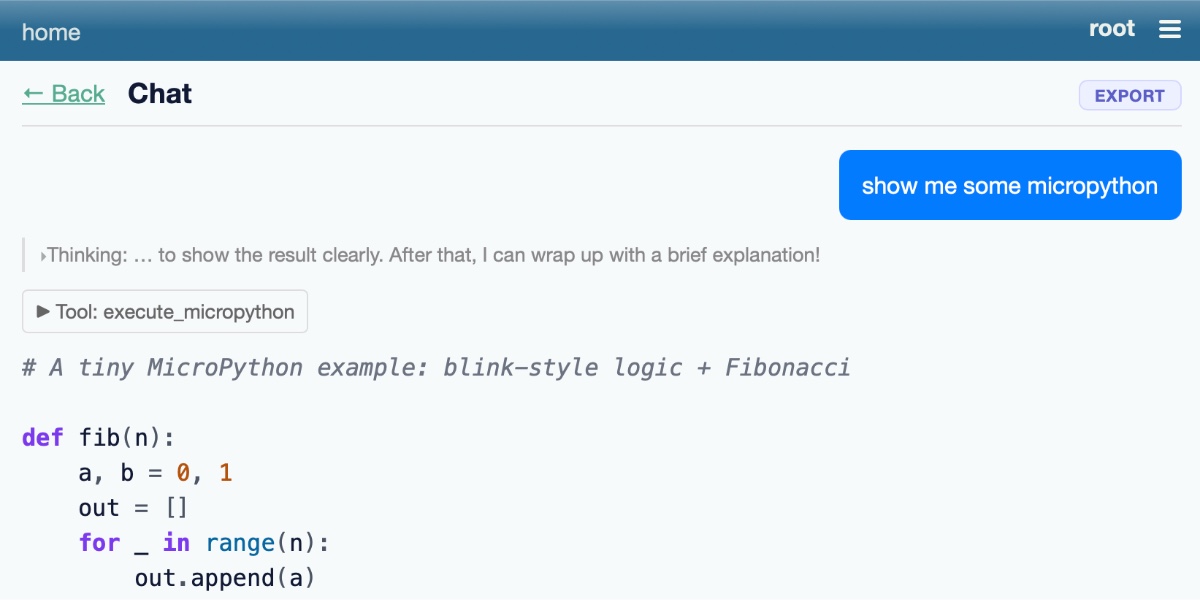
Running Python code in a sandbox with MicroPython and WASM
I’ve been experimenting with different approaches to running code in a sandbox for several years now, but my latest attempt feels like it might finally have all of the characteristics …
Scalable Training of Artificial Neural Networks with Adaptive Sparse Connectivity inspired by Network Science
View recent discussion. Abstract: Through the success of deep learning in various domains, artificial neural networks are currently among the most used artificial intelligence methods. Taking inspiration from the network properties of biological neural networks (e.g. sparsity, scale-freeness), we argue that (contrary to general practice) artificial neural networks, too, should not have fully-connected layers. Here we propose sparse evolutionary training of artificial neural networks, an algorithm which evolves an initial sparse topology (Erdős-Rényi random graph) of two consecutive layers of neurons into a scale-free topology, during learning. Our method replaces artificial neural networks fully-connected layers with sparse ones before training, reducing quadratically the number of parameters, with no decrease in accuracy. We demonstrate our claims on restricted Boltzmann machines, multi-layer perceptrons, and convolutional neural networks for unsupervised and supervised learning on 15 datasets. Our approach has the potential to enable artificial neural networks to scale up beyond what is currently possible.
NeuralBench: A Unifying Framework to Benchmark NeuroAI Models | Hubert Banville
🧠 NeuralBench is now open source. Today we're releasing NeuralBench, a unified framework for benchmarking foundation models of brain activity, developed by the Brain & AI team at FAIR, Meta. 💻 Code: https://lnkd.in/dNJsgBgM 📄 White paper: https://lnkd.in/dvWMg7rx Brain foundation models are starting to show positive transfer to a range of downstream tasks, from brain-computer interfacing to clinical classification. But systematically evaluating them is hard: heterogeneous preprocessing pipelines, input structures, and adaptation methodologies make results difficult to compare. Most prior work also focuses on a narrow set of downstream tasks. NeuralBench addresses this by defining each task end-to-end with config files (data source, preprocessing, splits, optimiser, metrics, architecture) so all models can be evaluated on the same footing. What's in our first release, NeuralBench-EEG v1.0: ⚡ 36 EEG tasks across 94 public datasets, spanning motor imagery, clinical classification, cognitive decoding, and phenotype prediction. 🤖 Task-specific deep learning architectures (EEGNet, Deep4, EEGConformer, CTNet, ...) benchmarked side-by-side with recent EEG foundation models (BENDR, LaBraM, BIOT, CBraMod, LUNA, REVE). 🧩 Extensible to other neuroimaging modalities: the framework already runs MEG and fMRI tasks, leveraging our NeuralSet ecosystem for accessing brain imaging data and the broader neuroscientific software stack. 📜 Released under the MIT license. Help us make it better. Through our white paper, we invite the community to contribute new tasks, datasets, and models, especially for fMRI, MEG, and iEEG. The long-term goal is a fully unified benchmark across neuroimaging tasks and modalities. 🙏🙏🙏 This was a big team effort with Stéphane d'Ascoli, Simon Dahan, Jérémy RAPIN, Marlène Careil, Yohann Benchetrit, Jarod Lévy, Saarang P., Antoine Ratouchniak, Lucy (Mingfang) Zhang, Elisa Cascardi, Katie Begany, Teon Brooks, and Jean-Rémi King. Special thanks to Alexandre Gramfort, Thomas Moreau, Arnaud Delorme, Bruno A. and Pierre Guetschel for feedback and support. #Neuroscience #AI #NeuroAI #Python #OpenSource

🚀🚀🚀 Excited to share that our Brain&AI team is releasing NeuralSet! 🚀🚀🚀 A fast, simple, and scalable package for Neuro-AI: 📦 `pip install neuralset` 💻 Code: https://lnkd.in/eamwxBUY 📄… | Jarod Lévy | 12 comments
🚀🚀🚀 Excited to share that our Brain&AI team is releasing NeuralSet! 🚀🚀🚀 A fast, simple, and scalable package for Neuro-AI: 📦 `pip install neuralset` 💻 Code: https://lnkd.in/eamwxBUY 📄 Paper: https://lnkd.in/epbreyDy As a PhD student working extensively with neuro recordings and AI models, I find this library to be a game-changer. This has been the common backbone for the past several years of our projects (TribeV2, DynaDiff, Brain2Qwerty & more!). This library turns raw neuro-recordings into AI-ready tensors. It enables: - Event-driven processing with typed, validated DataFrames. - Multimodal extractors for fMRI, EEG, MEG, EMG, and iEEG + text, image, audio, and video. - Torch-native segmentation for efficient batching. - Caching and remote compute through exca. Huge thanks to everyone on the team who made this release possible. If you're working on brain decoding, encoding models, or foundation models for neuroscience, don’t miss this! 🧠 Jean-Rémi King Hubert Banville Katie Begany Corentin Bel Yohann Benchetrit Teon Brooks Marlène Careil Simon Dahan Stéphane d'Ascoli Alexandre Défossez Linnea Evanson, PhD Pablo J. Diego Simón, Julien Gadonneix, Sophia Houhamdi Shubh Khanna Pierre Orhan Antoine Ratouchniak Joséphine Raugel Andrea Elena Santos Revilla Alexis Thual Lucy (Mingfang) Zhang Jérémy RAPIN | 12 comments on LinkedIn

How to Make Small Language Models Outperform Large Language Models Using DSPy!
How a 3B Language Model Surpasses an 8B Counterpart with DSPy? “In an era where language models (LMs) are revolutionising countless tasks, their potential is only as powerful as we interpret …
Welcome
I also work extensively with Project Jupyter, particularly the Binder Project and Jupyter Book.