

Push entire folders of text and markdown (or from Lumentis) straight to Notion
Synced blocks – Notion Help Center
Notion allows you to sync content across pages or workspaces. This means more reusing and less manual editing.
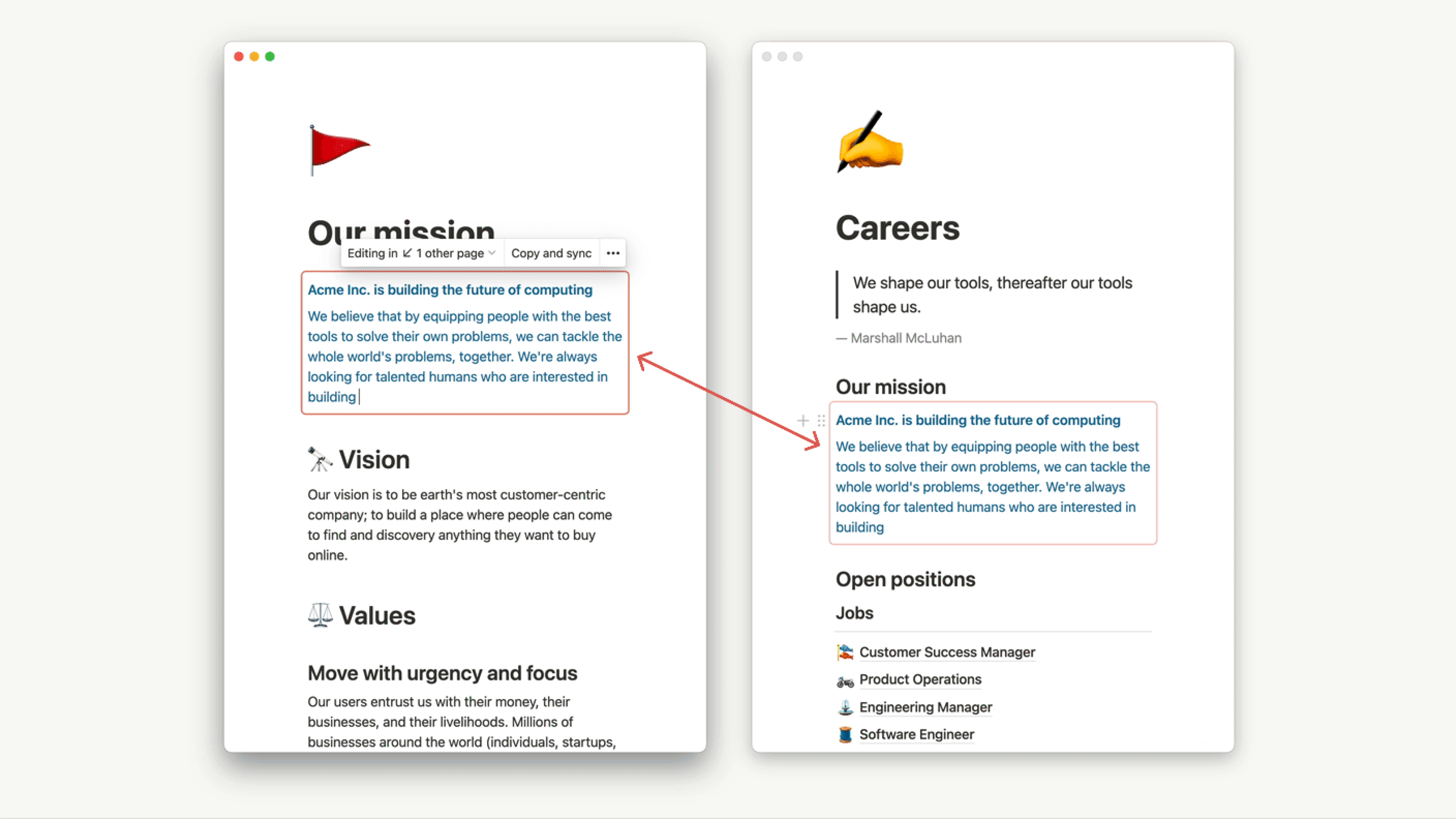
How Notion handles concurrent editing with CRDTs
Building a CRDT-based rich-text system that merges concurrent edits across Notion blocks—without losing anyone’s work

Introducing Tolaria 💧
A free & open source macOS app for managing markdown knowledge bases.
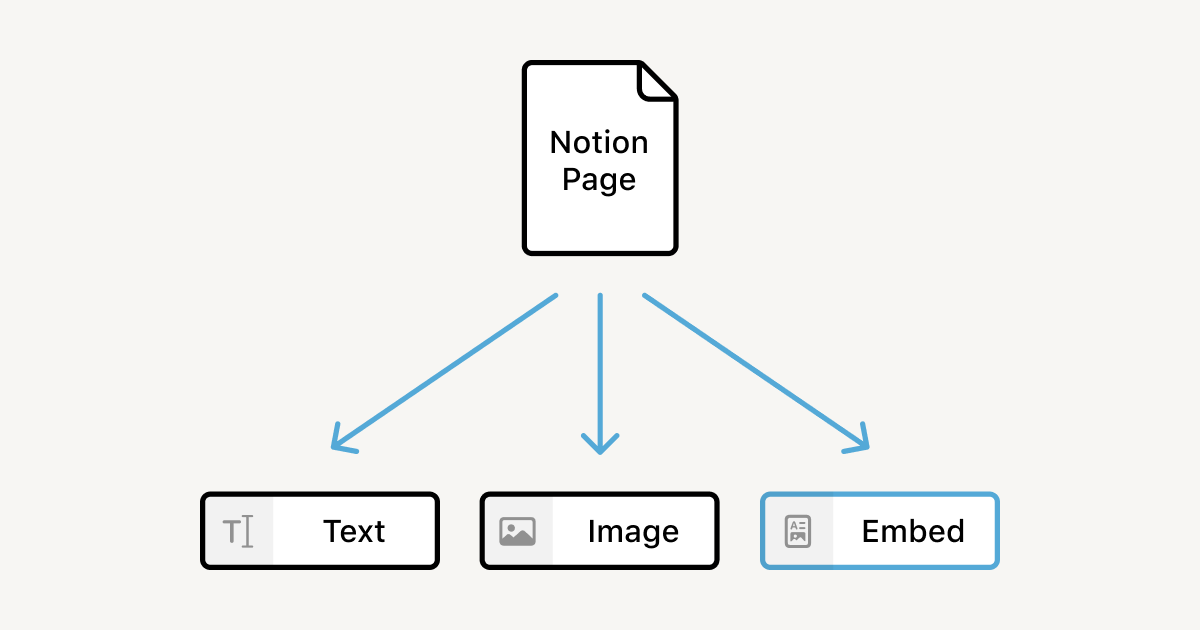
Exploring Notion's Data Model: A Block-Based Architecture | Notion
Notion’s data model enables the product’s most foundational component: blocks. Through blocks, we allow users more flexibility over their information.
Own the source. Compose with anything. - The Way of Markdown
Websites, knowledge bases, blogs, even a Notion replacement — built from plain text files you own, with tools you can swap anytime. Markdown is quietly everywhere; here's the way to make it work for you.

GitHub - RahmaniErfan/abstract-folder: An Obsidian plugin to get rid of rigid folders. Create multiple abstract connections between your notes/files using the front matter to declare parent/children notes.
An Obsidian plugin to get rid of rigid folders. Create multiple abstract connections between your notes/files using the front matter to declare parent/children notes. - GitHub - RahmaniErfan/abstr...
Designing better file organization around tags, not hierarchies
Computer users organize their files into folders because that is the primary tool offered by operating systems. But applying this standard hierarchical model to my own files, I began to notice shortcomings of this paradigm over the years. At the same time, I used some other information systems not based on hierarchical path names, and they turned out to solve a number of problems. I propose a new way of organizing files based on tagging, and describe the features and consequences of this method in detail.
A Categorical Theory of Patches
When working with distant collaborators on the same documents, one often uses a version control system, which is a program tracking the history of files and helping importing modifications brought by others as patches. The implementation of such a system requires to handle lots of situations depending on the operations performed by users on files, and it is thus difficult to ensure that all the corner cases have been correctly addressed. Here, instead of verifying the implementation of such a system, we adopt a complementary approach: we introduce a theoretical model, which is defined abstractly by the universal property that it should satisfy, and work out a concrete description of it. We begin by defining a category of files and patches, where the operation of merging the effect of two coinitial patches is defined by pushout. Since two patches can be incompatible, such a pushout does not necessarily exist in the category, which raises the question of which is the correct category to represent and manipulate files in conflicting state. We provide an answer by investigating the free completion of the category of files under finite colimits, and give an explicit description of this category: its objects are finite sets labeled by lines equipped with a transitive relation and morphisms are partial functions respecting labeling and relations.
ronentk/notion-semble-integration
Integration to support sharing pages from Notion to Semble
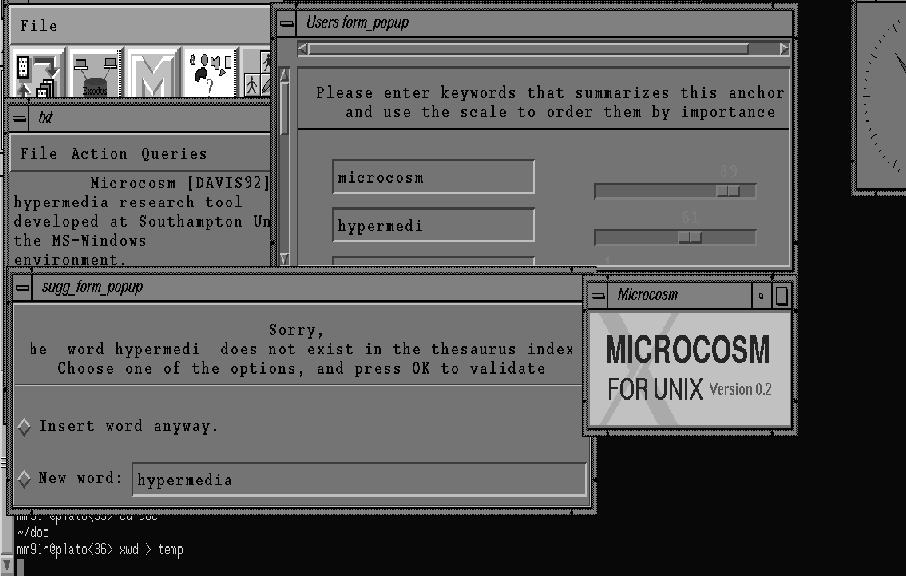
Vision and Reality of Hypertext and GUIs: 2.1.13 Microcosm @mprove
Microcosm (cf. 2.1.13) is a research project at the University of Southampton. Like Intermedia five years before, Microcosm is designed around the idea that material of diverse sources and formats should be tied together into one hypertext. To achieve this goal links have to be separated from the documents. They are stored and maintained in special link databases. In contrast to Intermedia, Microcosm plays the active role in gathering the necessary data out of the documents. For each topic it stores data on which documents contain information about it and also where inside the documents the information is located. This elaborated conception of links can be seen more as a kind of Memex’ trails than simple one-to-one links. Given this structure dynamic linking becomes possible. This means that links can be associated with generic text strings. Wherever this string shows up a link is placed automatically. This has the effect that documents that are imported for the first time into Microcosm can have links immediately.
Obsidian on Twitter / X
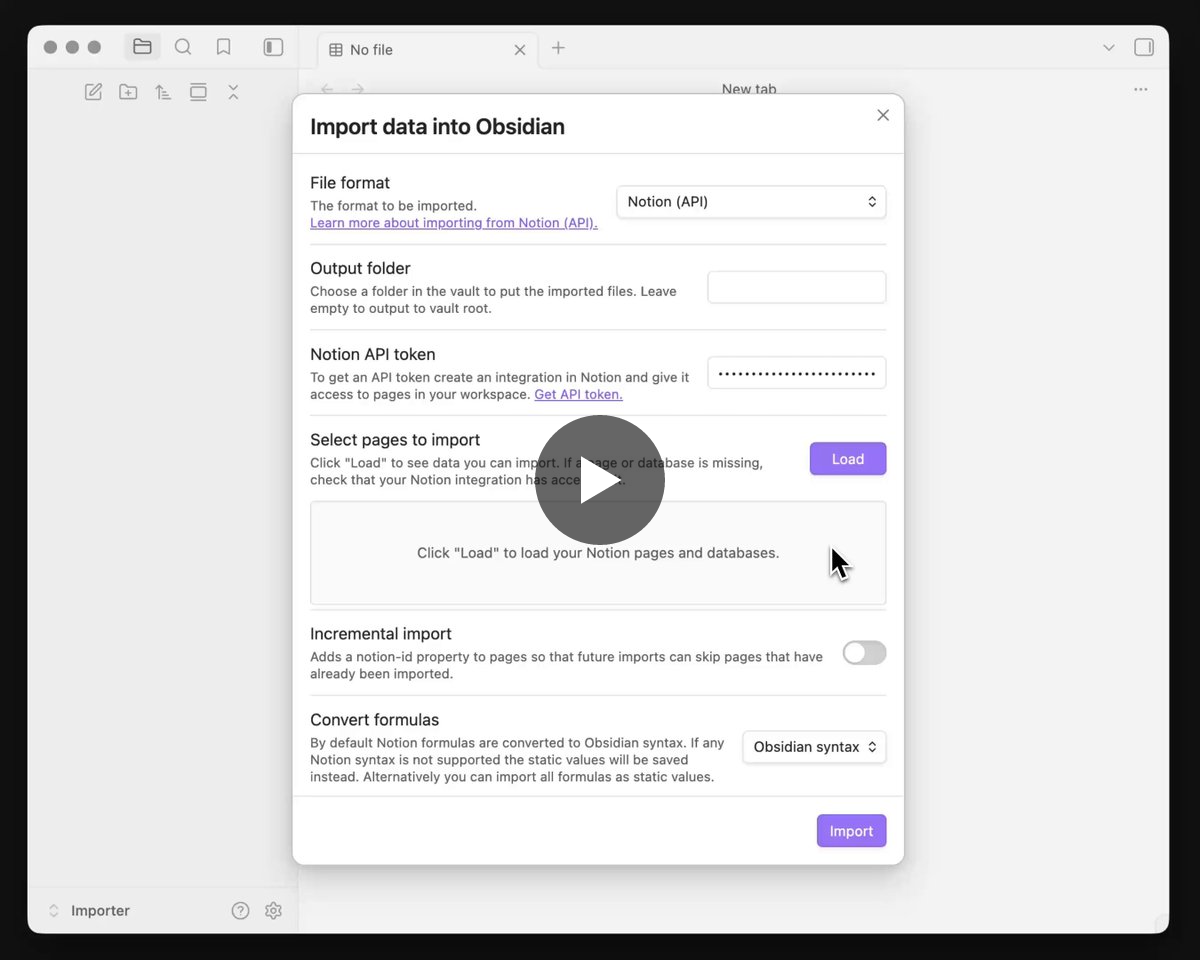
You can now convert your Notion pages and databases to durable, private, local files.Your data, offline, forever, for free. pic.twitter.com/AOvITLbzWn— Obsidian (@obsdmd) November 22, 2025
Notion Developers on Twitter / X
We’ve open-sourced our MCP (Model Context Protocol) — now available on GitHub.Plug it into your favorite client and start building richer AI integrations with Notion in minutes ✨ https://t.co/8H8ftS6edl— Notion Developers (@NotionDevs) April 9, 2025
I can’t wait for academics to start using @semble.so more 🫶 been thinking i should bite the bullet and look at doing a zotero plugin to sync folders → semble but still torn bc i actually like jabref for metadata management more…but zotero is otherwise better and more used. sigh

Dr Keith 🎃 Wilson
Looking for some good readings for a graduate student who is interested in the philosophy and cognitive science of music #perception. Any recommendations—philosophical or otherwise? #PhilPerception #PhilQ
