

Agent skills for reliable autonomous software engineering workflows.
Agent Skills
AI coding agents take the shortest path to done, which usually means skipping the specs, tests, and reviews that make software reliable at scale. Agent Skill...

Inngest - Durable Execution for Workflows & AI
Build reliable background jobs, workflows, and AI agents without extra infrastructure. Automatic retries, flow control, and step-level observability.
Humans are Missing from AI Coding Agent Research
Recent progress in AI coding agent research has led to rapid improvements in agents' ability to autonomously perform complex software engineering tasks, from editing large codebases to executing long-horizon development workflows. As these systems make strides, however, the primary bottleneck to practical usefulness increasingly shifts away from pure task-solving capability, and toward challenges in how users communicate with, supervise, and trust agents. In this position paper, we argue for a reorientation from autonomous to human-centered coding agents: systems designed not only to complete tasks, but to collaborate effectively with people. We identify four core interaction-level dimensions that characterize the human-agent task-solving loop: task alignment, verifiability, steerability, and adaptability. Finally, we outline concrete research directions to advance these dimensions, including user-involved coding environments, comprehensive verification mechanisms, and principled measures of human-agent interaction quality.

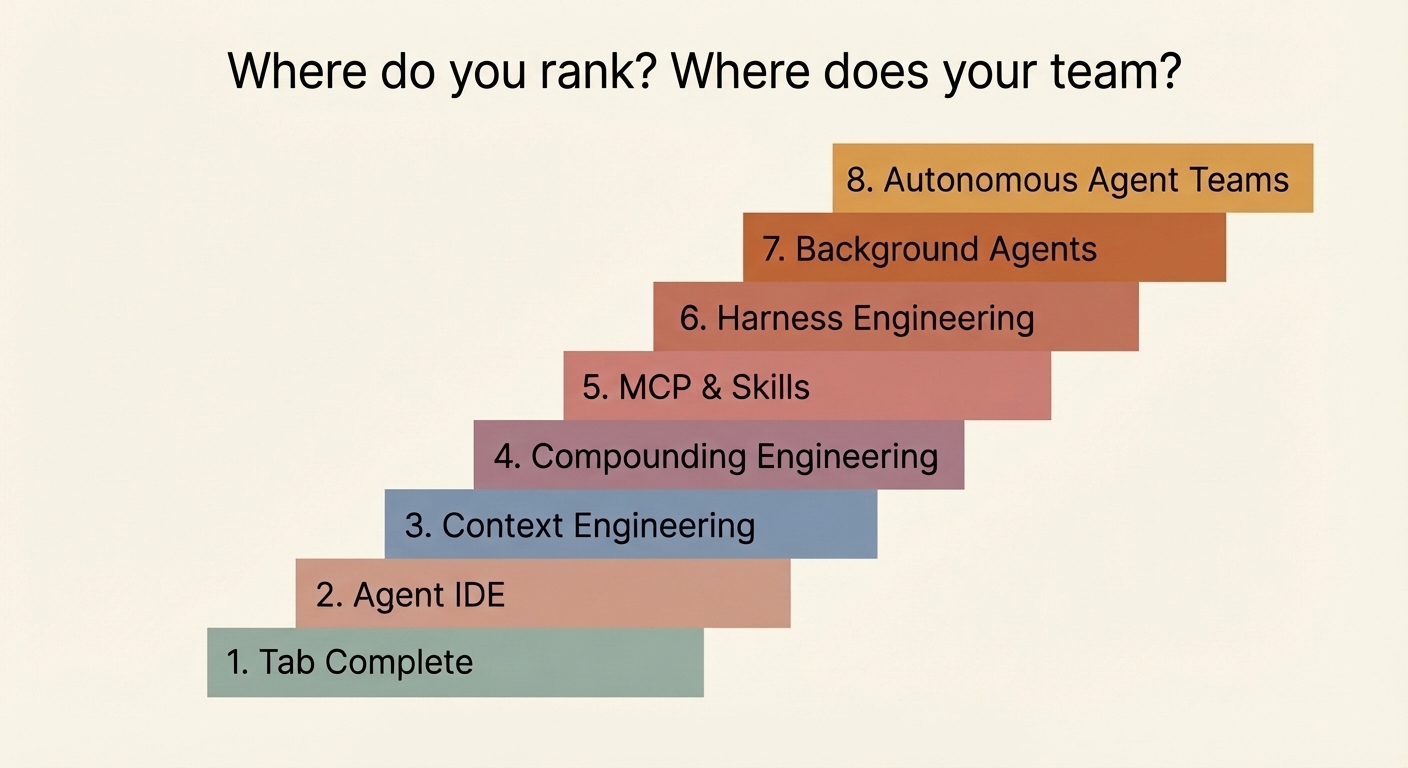
The 8 Levels of Agentic Engineering — Bassim Eledath
AI's coding ability is outpacing our ability to wield it effectively. That gap closes in levels — 8 of them. Here's the progression from tab complete to autonomous agent teams.
Curated skills for AI agents · skilld
A curated registry of agent skills for the npm packages and GitHub repos you actually use. One install command, every agent. Get notified when they change.

Agent experience: How to design products that agents can actually use — WorkOS
What engineers and founders need to know about designing APIs, tools, and interfaces for agent-driven workflows
How to fully automate software engineering
Current AI coding tools assist but don't fully automate software engineering. Better RL environments are what's missing.

Coding Agents Are Easy, Actually - Kara's Nonsense
Software engineering is here to stay
It's Time To Start Preparing APIs for the AI Agent Era
With agentic AI, integrations are no longer static and immutable concepts.

Dive into Claude Code: The Design Space of Today's and Future AI Agent Systems
Claude Code is an agentic coding tool that can run shell commands, edit files, and call external services on behalf of the user. This study describes its comprehensive architecture by analyzing the publicly available TypeScript source code and further comparing it with OpenClaw, an independent open-source AI agent system that answers many of the same design questions from a different deployment context. Our analysis identifies five human values, philosophies, and needs that motivate the architecture (human decision authority, safety and security, reliable execution, capability amplification, and contextual adaptability) and traces them through thirteen design principles to specific implementation choices. The core of the system is a simple while-loop that calls the model, runs tools, and repeats. Most of the code, however, lives in the systems around this loop: a permission system with seven modes and an ML-based classifier, a five-layer compaction pipeline for context management, four extensibility mechanisms (MCP, plugins, skills, and hooks), a subagent delegation mechanism with worktree isolation, and append-oriented session storage. A comparison with OpenClaw, a multi-channel personal assistant gateway, shows that the same recurring design questions produce different architectural answers when the deployment context changes: from per-action safety classification to perimeter-level access control, from a single CLI loop to an embedded runtime within a gateway control plane, and from context-window extensions to gateway-wide capability registration. We finally identify six open design directions for future agent systems, grounded in recent empirical, architectural, and policy literature.
Agentic Engineering Management
To what extent AI is OK to use in software development might be debated, but in general, the idea is not a controversial one anymore. The debate rather moved on from code completion and simple PR summarizations to Agentic Engineering, where an execution loop allows an AI Agent to function

PrimeIntellect-ai/prime-agent
A self-improving RLM agent for coding workflows and long-running autonomous tasks.
Agent Interaction Guidelines (AIG) – Linear Developers
Foundational principles and practices for designing agent interactions that integrate more naturally into human workflows.
Optimizing Agentic Workflows using Meta-tools
Agentic AI enables LLM to dynamically reason, plan, and interact with tools to solve complex tasks. However, agentic workflows often require many iterative reasoning steps and tool invocations,...