Agent-first Haskell DSL for TypeSafe's Jev judgment model: typed packets, inferred types, answers under the same labels
generalized algebraic theory in nLab
A generalized algebraic theory (GAT, Cartmell 1978/86) is a dependent type theory in the syntactic sense: There are judgments declaring types and terms of types, where, critically, a type AA declared in context Γ\Gamma is allowed to depend on terms of Γ\Gamma. The only other judgments allowed are of equality (judgemental equality) of pairs of types or terms.
Syntax and Semantics of Linear Dependent Types
A type theory is presented that combines (intuitionistic) linear types with type dependency, thus properly generalising both intuitionistic dependent type theory and full linear logic. A syntax...

Implementing a Hindley-Milner Type System (Part 1) | Blog
First part of a tutorial on implementing a Hindley-Milner type system for a simple, purely functional programming language in Haskell. We go over syntax representation, how the Hindley-Milner type system is defined, polymorphism vs. monomorphism, generalization, and instantiation.
Functional Query Languages with Categorical Types
We study three category-theoretic types in the context of functional query languages (typed lambda-calculi extended with additional operations for bulk data processing). The types we study are:
A modal analysis of staged computation | Journal of the ACM
We show that a type system based on the intuitionistic modal logic S4 provides an expressive framework for specifying and analyzing computation stages in the context of typed λ-calculi and functional languages. We directly demonstrate the sense in which ...

Syntax and semantics of dependent types
In this chapter we fix a particular syntax for a dependently typed calculus and define an abstract notion of model as well as a general interpretation function mapping syntactical objects to entities in a model. This interpretation function is shown to be sound with respect to the syntax.
Categorical logic and type theory
Categorical logic and type theory by Bart Jacobs, 1999, Elsevier Science edition, in English - 1st ed.

Theorems for free! | Proceedings of the fourth international conference on Functional programming languages and computer architecture
The polymorphic blame calculus integrates static typing, including universal types, with dynamic typing. The primary challenge with this integration is preserving parametricity: even dynamically-typed code should satisfy it once it has been cast to a ...
bmillwood/bluesky-tools
Haskell library providing tools for working with the Bluesky social network / the AT protocol
Introducing System One Models and Jev - TypeSafe AI Blog
TypeSafe AI is an AI lab building machine-native intelligence infrastructure for automation, designed to make decisions within software. Try our first System One Model, Jev, in early access.
Types and Programming Languages
A type system is a syntactic method for automatically checking the absence of certain erroneous behaviors by classifying program phrases according to the kinds of values they compute. The study of type systems--and of programming languages from a type-theoretic perspective -- -has important applications in software engineering, language design, high-performance compilers, and security. This text provides a comprehensive introduction both to type systems in computer science and to the basic theory of programming languages. The approach is pragmatic and operational; each new concept is motivated by programming examples and the more theoretical sections are driven by the needs of implementations. Each chapter is accompanied by numerous exercises and solutions, as well as a running implementation, available via the Web. Dependencies between chapters are explicitly identified, allowing readers to choose a variety of paths through the material. The core topics include the untyped lambda-calculus, simple type systems, type reconstruction, universal and existential polymorphism, subtyping, bounded quantification, recursive types, kinds, and type operators. Extended case studies develop a variety of approaches to modeling the features of object-oriented languages.
The Lambek Calculus
There is a noticeable revival of categorial grammar these days, as a vehicle for linguistic description. The systems used differ somewhat from the original calculus of Ajdukiewicz and Bar-Hillel, however. In particular, there is a component of rules for ‘type change’ of expressions, making for greater flexibility and elegance. One fundamental system of this kind is the so-called ‘Lambek Calculus’, whose type-change rules show a close analogy with the inference rules of constructive propositional logic. In this paper, we present one calculus of this kind, and survey its theoretical properties as a device in linguistic semantics. Our two main new contributions are a new and complete semantics for this calculus, as well as a modest study of its language-accepting capacity. In this way, we hope to provide a better understanding of the background theory of flexible categorial grammar, in tandem with its descriptive uses.

Simply Typed Reverse-Mode Automatic Differentiation with Variants: Denotational Correctness via Idempotent Completion
Reverse-mode automatic differentiation can be derived denotationally as a structure-preserving interpretation of program syntax. In the usual simply typed model, each source type has one cotangent type. Variants break this representation because the valid cotangent space depends on the branch selected at run time; established correctness results therefore use primal-indexed families of cotangent spaces, whose direct internal language is dependent.
Home - TypeSafe AI
TypeSafe AI is an AI lab building machine-native intelligence infrastructure for automation, designed to make decisions within software. Try our first System One Model, Jev, in early access.
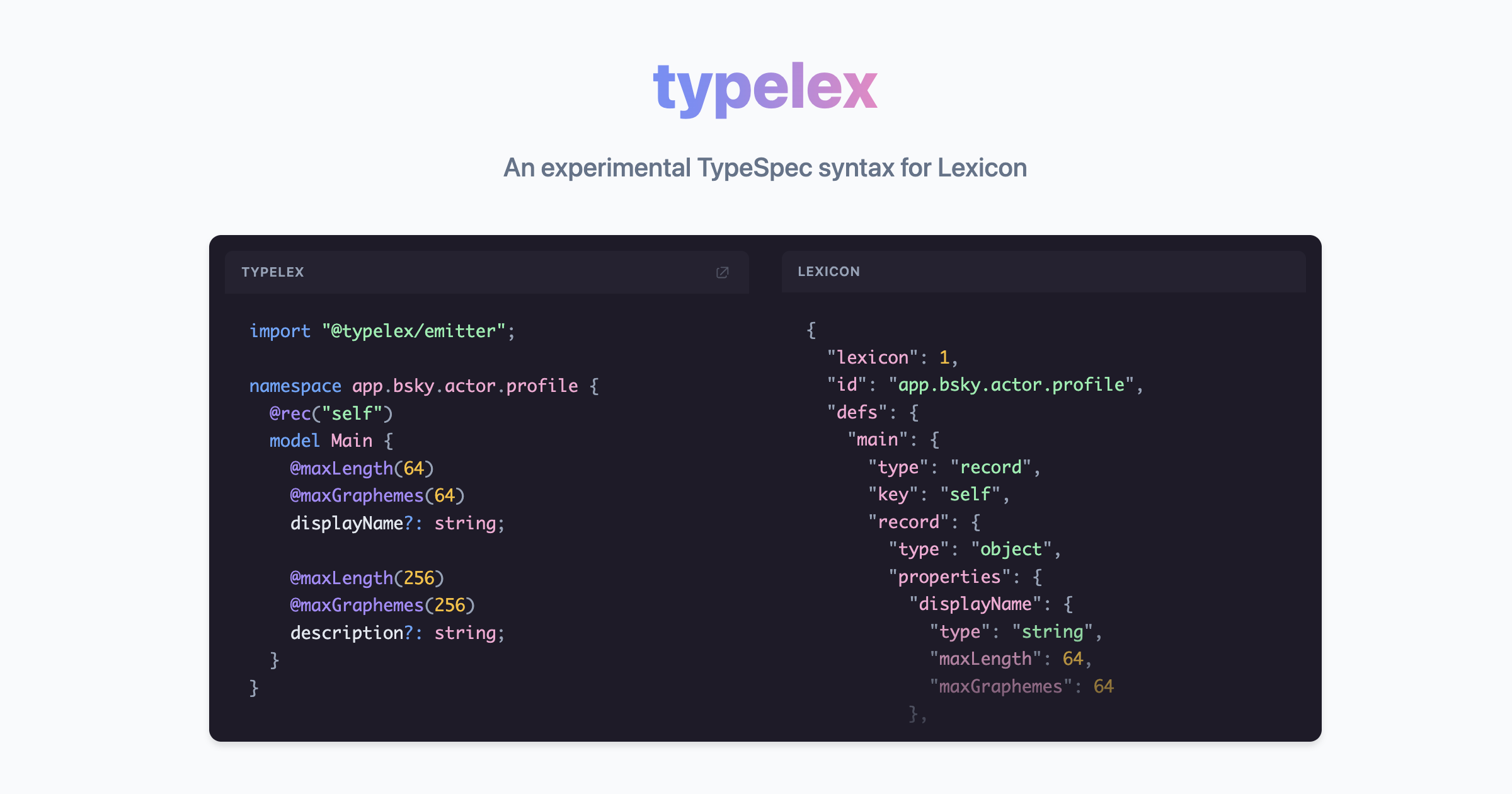
typelex – An experimental TypeSpec syntax for Lexicon
An experimental TypeSpec syntax for AT Protocol Lexicons. Write Lexicons in a more readable syntax using TypeSpec.