

Python Data Science Handbook: full text in Jupyter Notebooks
Project Jupyter
The Jupyter Notebook is a web-based interactive computing platform. The notebook combines live code, equations, narrative text, visualizations, interactive dashboards and other media.
donnemartin/data-science-ipython-notebooks
Data science Python notebooks: Deep learning (TensorFlow, Theano, Caffe, Keras), scikit-learn, Kaggle, big data (Spark, Hadoop MapReduce, HDFS), matplotlib, pandas, NumPy, SciPy, Python essentials, AWS, and various command lines.
Welcome
I also work extensively with Project Jupyter, particularly the Binder Project and Jupyter Book.

Introducing notebook.link: The Future of Notebook Sharing
Reimagining how you share, collaborate, and run Jupyter notebooks — all in your browser.

Must Watch Data Science Videos from SciPy Conference 2015
Must watch data science videos from SciPy conference 2015 related to machine learning, data mining, data visualization in python, statistics have been listed here.

Pydata Paris Virtual Meetup June 2021
Julia Evans: Diving into Open Data with IPython Notebook & Pandas - PyCon 2014
Jupyter Notebooks – a publishing format for reproducible computational workflows
It is increasingly necessary for researchers in all fields to write computer code, and in order to reproduce research results, it is important that this code is published. We present Jupyter notebooks, a document format for publishing code, results and explanations in a form that is both readable and executable. We discuss various tools and use cases for notebook documents.
marimo | a next-generation Python notebook
Explore data and build apps seamlessly with marimo, a next-generation Python notebook.
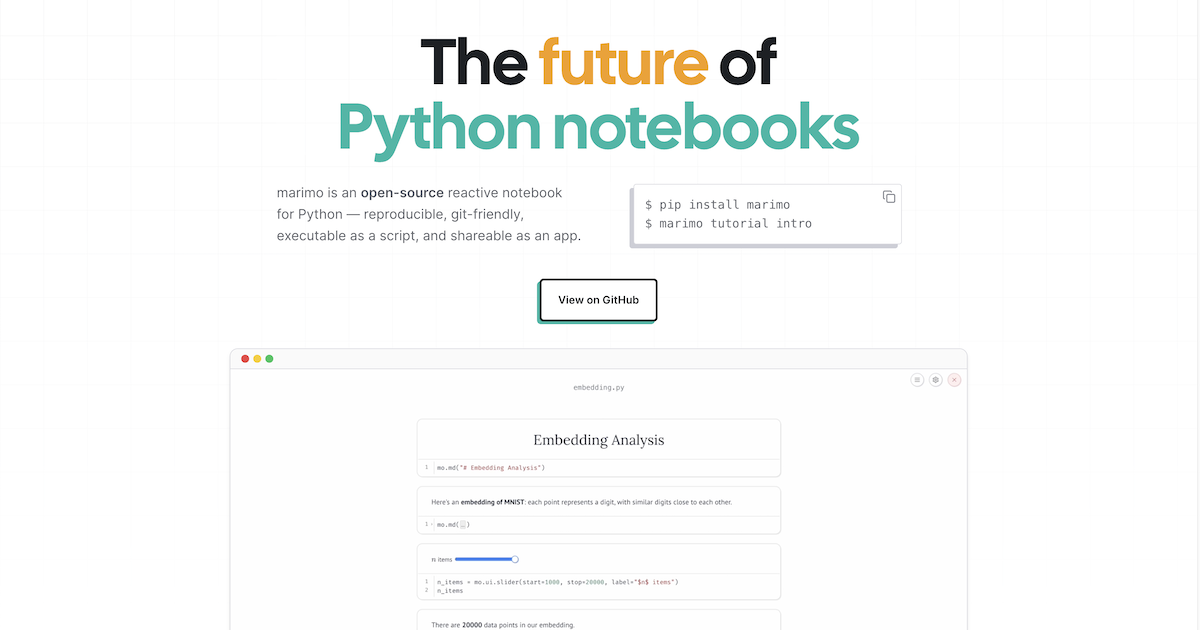

marimo | a next-generation Python notebook
A reactive notebook for Python — run reproducible experiments, execute as a script, deploy as an app, and version with git.
marimo | a next-generation Python notebook
A reactive notebook for Python — run reproducible experiments, execute as a script, deploy as an app, and version with git.
SciPy 1.0: fundamental algorithms for scientific computing in Python
SciPy is an open-source scientific computing library for the Python programming language. Since its initial release in 2001, SciPy has become a de facto standard for leveraging scientific algorithms in Python, with over 600 unique code contributors, thousands of dependent packages, over 100,000 dependent repositories and millions of downloads per year. In this work, we provide an overview of the capabilities and development practices of SciPy 1.0 and highlight some recent technical developments.

Keynote: Bridging Gaps with Code: Transforming K12 Education with Jupyter Everywhere - I. Martinez
Introductory data science across disciplines, using Python, case studies, and industry consulting projects
Abstract Data and its applications are increasingly ubiquitous in the rapidly digitizing world and consequently, students across different disciplines face increasing demand to develop skills to answer both academia's and businesses' increasing need to collect, manage, evaluate, apply and extract knowledge from data and critically reflect upon the derived insights. On the basis of recent experiences at the University of Ttingen, Germany, we present a new approach to teach the relevant data science skills as an introductory service course at the university or advanced college level. We describe the outline of a complete course that relies on case studies and project work built around contemporary data sets, including openly available online teaching resources.
