

Ultra fast and easy duplicate file finder. Awesome TUI/GUI to manage results. - jdefrancesco/dskDitto
GitHub - hmans/beans: A CLI-based, flat-file issue tracker for humans and robots. 🤖
A CLI-based, flat-file issue tracker for humans and robots. 🤖 - hmans/beans
GitHub - clarisma/geodesk: Fast and storage-efficient spatial database engine for OpenStreetMap data
Fast and storage-efficient spatial database engine for OpenStreetMap data - clarisma/geodesk
The KD Files - Case File Tracker
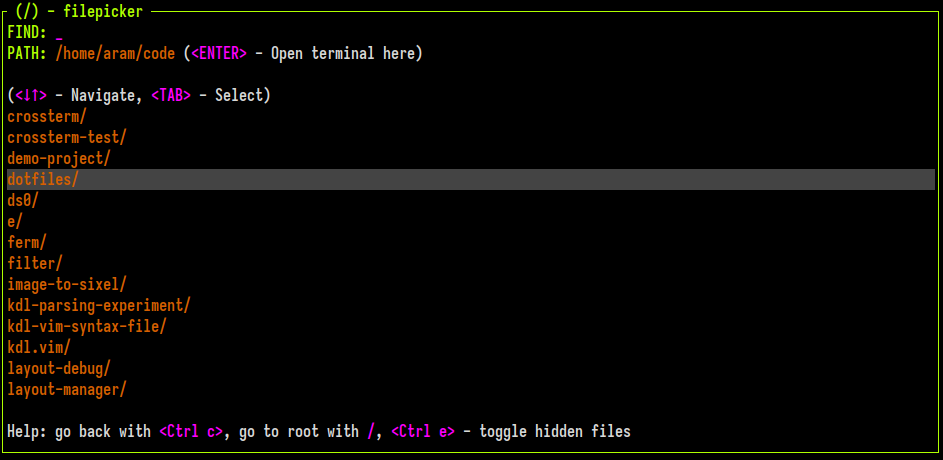
The Zellij Filepicker
Explore the Zellij filepicker plugin. Learn dynamic filesystem traversal with fuzzy finding for faster file navigation and workflows.

RepoCoder: Repository-Level Code Completion Through Iterative Retrieval and Generation
The task of repository-level code completion is to continue writing the unfinished code based on a broader context of the repository. While for automated code completion tools, it is difficult to utilize the useful information scattered in different files. We propose RepoCoder, a simple, generic, and effective framework to address the challenge. It streamlines the repository-level code completion process by incorporating a similarity-based retriever and a pre-trained code language model in an iterative retrieval-generation pipeline. RepoCoder makes effective utilization of repository-level information for code completion and has the ability to generate code at various levels of granularity. Moreover, we propose a new benchmark RepoBench, which consists of the latest and high-quality real-world repositories covering line, API invocation, and function body completion scenarios. Experimental results indicate that RepoCoder significantly improves the In-File completion baseline by over 10% in all settings and consistently outperforms the vanilla retrieval-augmented code completion approach. Furthermore, we validate the effectiveness of RepoCoder through comprehensive analysis, providing valuable insights for future research. Our source code and benchmark will be publicly available after the paper review.
Structured merge with auto-tuning: balancing precision and performance
Software-merging techniques face the challenge of finding a balance between precision and performance. In practice, developers use unstructured-merge (i.e., line-based) tools, which are fast but imprecise. In academia, many approaches incorporate information on the structure of the artifacts being merged. While this increases precision in conflict detection and resolution, it can induce severe performance penalties. Striving for a proper balance between precision and performance, we propose a structured-merge approach with auto-tuning. In a nutshell, we tune the merge process on-line by switching between unstructured and structured merge, depending on the presence of conflicts. We implemented a corresponding merge tool for Java, called JDime. Our experiments with 8 real-world Java projects, involving 72 merge scenarios with over 17 million lines of code, demonstrate that our approach indeed hits a sweet spot: While largely maintaining a precision that is superior to the one of unstructured merge, structured merge with auto-tuning is up to 12 times faster than purely structured merge, 5 times on average.


mergiraf
A syntax-aware git merge driver for a growing collection of programming languages and file formats.
superfile - Terminal File Manager
A fancy, modern terminal file manager. Complete your file operations with style.

Bloom · Run coding agents in parallel on your Mac
Bloom is a free native Mac app that runs Claude Code and Codex in parallel, each in its own git worktree. Read the diffs, comment inline, open the pull request.


jcsalterego - Overview
jcsalterego has 53 repositories available. Follow their code on GitHub.

JuiceFS - Open Source Distributed POSIX File System for Cloud
JuiceFS is a cloud-based high-performance distributed file system, based on object storage and database to achieve data and metadata separation architecture, easily carrying tens of billions of file storage, to meet the random read performance requirements of big data, AI, autonomous driving, gene sequencing and other massive data.