

Windows service that checks your server's IP for changes and updates the DNS records in google domains. - joelrevans/Google-Domains-Dynamic-DNS-Updater
Serving DNS using a Peer-to-Peer Lookup Service
Download Citation | Serving DNS using a Peer-to-Peer Lookup Service | The current domain name system (DNS) couples ownership of domains with the responsibility of serving data for them. The DNS security extensions... | Find, read and cite all the research you need on ResearchGate

Dynamic DNS (DDNS) for Home Server and VPS etc, Free!
Free Dynamic DNS (DDNS) by POP3,IMAP4,FTP,HTTP-BASIC for Home Server, Webcam, VPS. You can use many free sub domain, .jp, .net, .asia, etc.. DynDNS is not free
Useful utilities and toys over DNS
Free and useful services over DNS accessible on command line
ICANN Lookup
The ICANN registration data lookup tool gives you the ability to look up the current registration data for domain names and Internet number resources.
mess with dns
It's fun to learn by experimenting and breaking things! Here you can do weird DNS experiments with no consequences if you mess something up.
did:dns Method Specification
Many early DID methods were based on distributed ledgers or other decentralized infrastructure, and some of those still remain popular. However, the DID community has also seen a lot of innovation and has come up with new types of DID methods. One of them is did:web, which is based on traditional DNS and web server infrastructure. The DID method presented here is did:dns, which follows a similar idea but offers several improvements over did:web.
Special-Use Domain Names
This document describes what it means to say that a Domain Name (DNS name) is reserved for special use, when reserving such a name is appropriate, and the procedure for doing so. It establishes an IANA registry for such domain names, and seeds it with entries for some of the already established special domain names.

Buy a domain name - Register cheap domain names from $0.99 - Namecheap
Register domain names at Namecheap. Buy cheap domain names and enjoy 24/7 support. With over 18 million domains under management, you know you’re in good hands.
primus852/traefik-ddns
This repository provides configuration files and instructions for setting up a Cloudflare Dynamic DNS (DDNS) service and a Traefik reverse proxy with Let's Encrypt SSL/TLS support. It includes Docker Compose configurations, environment variable templates, and detailed usage instructions to automate DNS updates and manage SSL certificates.
Setting up a free *.city.state.us locality domain
In the US, you can get a domain name like `somename.city.state.us` for free. If your town has its own domain, you can get nameservers from Amazon Lightsail, send the *Interim .US Domain Template* to the delegated manager for your locality, then point DNS entries at your webhost.

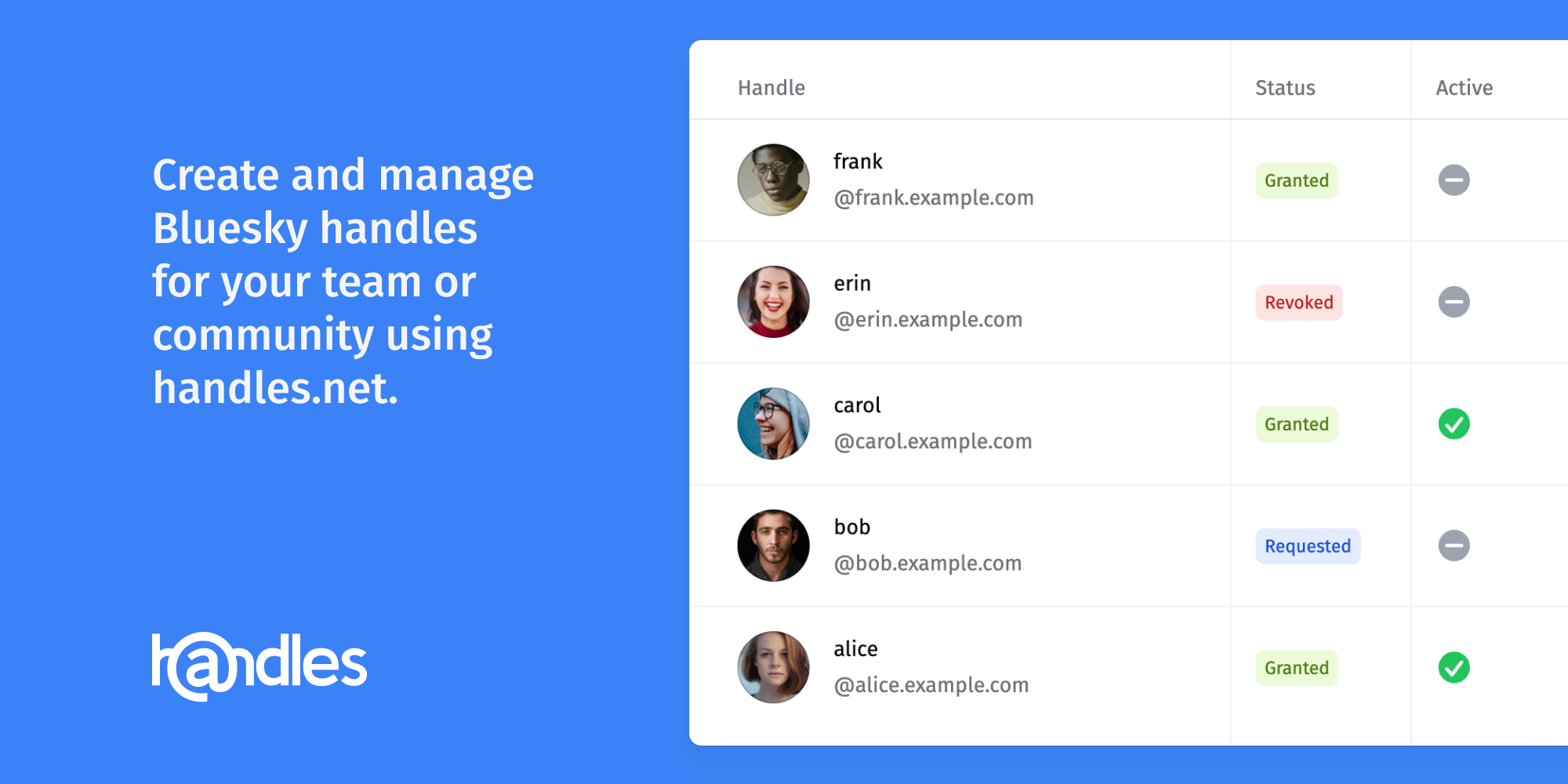
handles.net | Bluesky Handle Management
Create and manage Bluesky Handles at your domain without configuring DNS for every handle.
FOSDEM 2024 - Domain: A modular Rust DNS toolkit
The "domain" crate is a Rust library that aims to provide a wide range of building blocks that are necessary or useful when building specialised DNS applications.

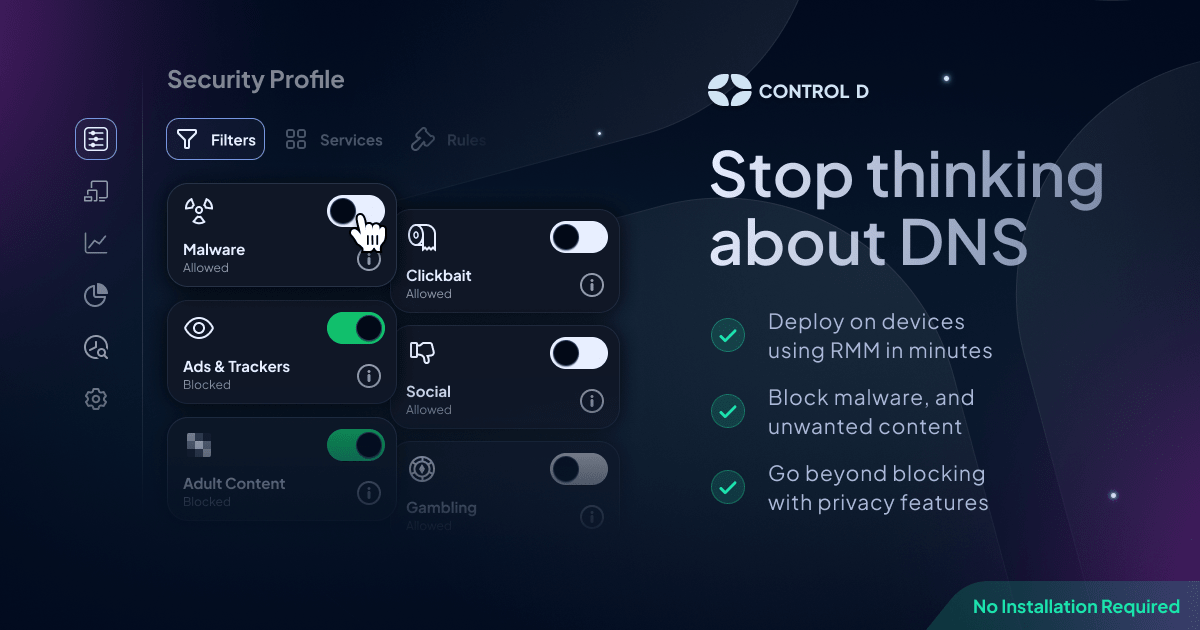
DNS Filtering Services: Security & Network Protection | Control D
Control D's DNS filtering software blocks unwanted websites, prevents malware, enforces web policies, and strengthens network security in minutes.
High Assurance DIDs with DNS
This document outlines a method for improving the authenticity, discoverability, and portability of Decentralized Identifiers (DIDs) by utilizing the current DNS infrastructure and its technologies. This method offers a straightforward procedure for a verifier to cryptographically cross-validate a DID using data stored in the DNS, separate from the DID document.
DNS-Anchored Durable Identity for AI Agents (DNSid)
Autonomous software agents are being deployed across enterprise, cloud, and cross-organizational boundaries. These agents negotiate, transact, delegate, and produce work products that persist beyond their own ephemeral runtime. Current standards and initiatives for agent identity collectively address runtime authentication, authorization, lifecycle management, and tool interaction, but a gap remains: a durable, governance-backed identifier that lets a relying party determine and verify the accountable entity behind an agent it encounters, including agents that have since been retired or whose keys have rotated, and attribute past and present work products to that entity. Lifecycle-history verification is governed by the applicable log method and deployment scope. DNSid addresses the accountable layer of identity: the durable ownership anchor that existing agent identity standards do not provide. This document specifies DNSid, a minimal identity primitive that assigns each agent a Fully Qualified Domain Name (FQDN), binds it to an accountable entity identified by a DNS domain under that entity's control, and publishes a structured set of pointers in DNS TXT records to the agent's cryptographic keys, lifecycle log, and operational status. DNSid uses accountable-entity-controlled signatures for record integrity and an abstract append-only lifecycle log for history. It is designed to sit beneath existing identity, authentication, authorization, and agent interaction standards without competing with them. DNSid introduces no new DNS resource record types, opcodes, or response codes, and requires no changes to DNS resolvers, authoritative servers, or the DNS protocol. It applies to any agent that can be assigned an FQDN whose accountable entity can publish verification material; public discoverability of the agent is not required.