LLM Can Get "Brain Rot"
LLMs Can Get Brain Rot
Exploring the phenomenon of 'brain rot' in large language models and its implications for AI cognition.
A knockout blow for LLMs?
LLM “reasoning” is so cooked they turned my name into a verb
How LLMs are and are not like the brain
Hi from buttondown! At the bottom of this newsletter is a bit of administrivia about the new platform How LLMs are and are not like the brain Beneath all the...
LLMs Can Get "Brain Rot": A Pilot Study on Twitter/X
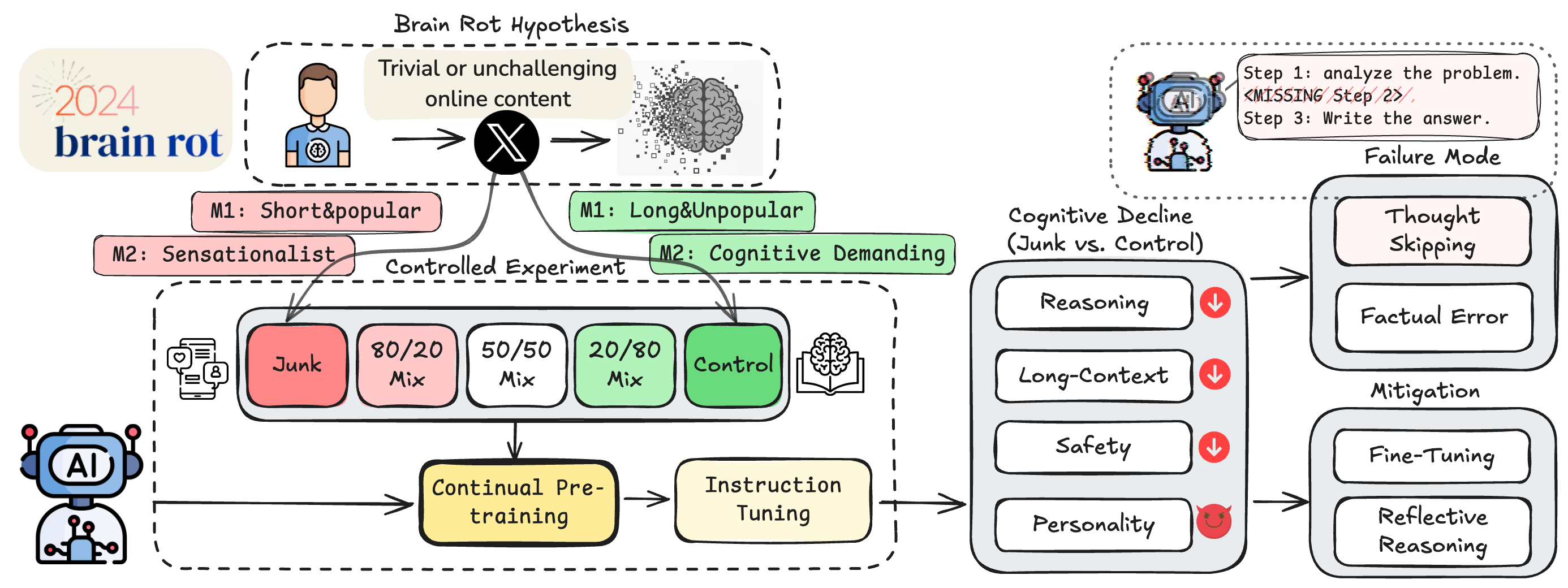
We propose and test the LLM Brain Rot Hypothesis: continual exposure to junk web text induces lasting cognitive decline in large language models (LLMs). To unveil junk effects, we designed a novel controlled experiment on real Twitter/X corpora, by constructing junk and reverse-controlled datasets via two orthogonal operationalizations: M1 (engagement degree) and M2 (semantic quality), with matched token scale and training operations across conditions. Compared to the control group, continual pre-training of 4 LLMs on the junk dataset causes non-trivial declines (Hedges' g>0.3) on reasoning, long-context understanding, safety, and inflating "dark traits" (e.g., psychopathy, narcissism). The gradual mixtures of junk and control datasets also yield dose-response cognition decay: for example, under M1, ARC-Challenge with Chain-of-Thought drops 72.1 -> 57.2 and RULER-CWE 83.7 -> 52.3 as junk ratio rises from 0% to 100%. Error forensics reveal several key insights. First, we identify thought-skipping as the primary lesion in reasoning: models increasingly truncate or skip chains. Second, partial but incomplete healing is observed: scaling instruction tuning and clean continual pre-training improve the declined cognition, yet cannot restore baseline capability, suggesting persistent representational drift rather than format mismatch. Finally, we discover that the popularity, a non-semantic metric, of a tweet is a better indicator of the Brain Rot effect than the length in M1. Together, the results provide significant, multi-perspective evidence that social effects of data could be a causal driver of LLM capability decay in continual pre-training, thereby motivating routine "cognitive health checks" for deployed and evolving LLMs.

LLMs Can Get "Brain Rot": A Pilot Study on Twitter/X
We propose and test the LLM Brain Rot Hypothesis: continual exposure to junk web text induces lasting cognitive decline in large language models (LLMs). To unveil junk effects, we designed a novel controlled experiment on real Twitter/X corpora, by constructing junk and reverse-controlled datasets via two orthogonal operationalizations: M1 (engagement degree) and M2 (semantic quality), with matched token scale and training operations across conditions. Compared to the control group, continual pre-training of 4 LLMs on the junk dataset causes non-trivial declines (Hedges' g>0.3) on reasoning, long-context understanding, safety, and inflating "dark traits" (e.g., psychopathy, narcissism). The gradual mixtures of junk and control datasets also yield dose-response cognition decay: for example, under M1, ARC-Challenge with Chain-of-Thought drops 72.1 -> 57.2 and RULER-CWE 83.7 -> 52.3 as junk ratio rises from 0% to 100%. Error forensics reveal several key insights. First, we identify thought-skipping as the primary lesion in reasoning: models increasingly truncate or skip chains. Second, partial but incomplete healing is observed: scaling instruction tuning and clean continual pre-training improve the declined cognition, yet cannot restore baseline capability, suggesting persistent representational drift rather than format mismatch. Finally, we discover that the popularity, a non-semantic metric, of a tweet is a better indicator of the Brain Rot effect than the length in M1. Together, the results provide significant, multi-perspective evidence that social effects of data could be a causal driver of LLM capability decay in continual pre-training, thereby motivating routine "cognitive health checks" for deployed and evolving LLMs.
Why do LLMs make stuff up? New research peers under the hood.
Claude's faulty "known entity" neurons sometimes override its "don't answer" circuitry.


Hallucinations in code are the least dangerous form of LLM mistakes
A surprisingly common complaint I see from developers who have tried using LLMs for code is that they encountered a hallucination—usually the LLM inventing a method or even a full …
Scientists Say LLMs Appear to Be Acting as a Cognitive Virus Among Humans
AI's wide proliferation shares some striking similarities with the ways viruses spread, as an international team of researchers argue.

There's Something Fundamentally Wrong With LLMs
LLMs aren't trained on the "vast majority of speech," experts warn, a major blind spot that could have sweeping consequences.

Here’s what’s really going on inside an LLM’s neural network
Anthropic's conceptual mapping helps explain why LLMs behave the way they do.

The Brain ‘Rotates’ Memories to Save Them From New Sensations | Quanta Magazine
Some populations of neurons simultaneously process sensations and memories. New work shows how the brain rotates those representations to prevent interference.
Cognitive exponents and LLM leverage
I know a few people for whom LLMs have been a near-immediate multiplier of attention and effort. I know a lot for whom LLMs clearly make them worse at thinking and doing things. So: why?