

A curated research map of Recursive Self-Improvement (RSI): models, agents, harnesses, embodied systems, automated AI R&D, benchmarks, and safety.
RSI Simulator: Play the Economics of Recursive Self-Improvement
Bootstrap an AI lab from scratch. A web game from Paradigm built on real economic models of AI recursive self-improvement.
Harness Engineering for Self-Improvement
The concept of recursive self-improvement (RSI) dates back to I. J. Good (1965), where he defined an “ultraintelligent machine” as a system that can surpass humans in all intellectual activities and design better machines to improve itself. Yudkowsky (2008) used the phrase “recursive self-improvement” for a specific feedback loop: an AI uses its current intelligence to improve the cognitive machinery that produces its intelligence. This feedback loop in modern AI may indicate the model rewriting its own weights directly, or more broadly the model improves the training pipeline and the deployment system, which in turn enables a better successor model with improved performance across economically valuable tasks. The speed of research development in AI has been shown to drastically accelerated in frontier labs (Anthropic; OpenAI).
Import AI 455: AI systems are about to start building themselves.
The first step towards recursive self improvement

When AI builds itself
Our progress toward recursive self-improvement, and its implications.

Jenny Zhang on Twitter / X
Introducing Hyperagents: an AI system that not only improves at solving tasks, but also improves how it improves itself.The Darwin Gödel Machine (DGM) demonstrated that open-ended self-improvement is possible by iteratively generating and evaluating improved agents, yet it… pic.twitter.com/YJPFTJ51SO— Jenny Zhang (@jennyzhangzt) March 23, 2026

Prime Intellect - The Open Stack for Self-Improving Agents
The compute and infrastructure platform for you to train, evaluate, and deploy your own agentic models.
Prime Intellect - The Open Stack for Self-Improving Agents
The compute and infrastructure platform for you to train, evaluate, and deploy your own agentic models.
Peter Wildeford🇺🇸🚀 on Twitter / X
Great to see @tristanharris talking on his podcast about recursive self-improvement. Here's how his guest, Tim Fist, puts it -- "Over the last few months we've had all three of the leading US AI labs say that having the option for a global slowdown or pause in AI development is… https://t.co/s5UURtkEjQ— Peter Wildeford🇺🇸🚀 (@peterwildeford) June 21, 2026
Ajeya Cotra – "This might be the clearest warning shot we ever get"
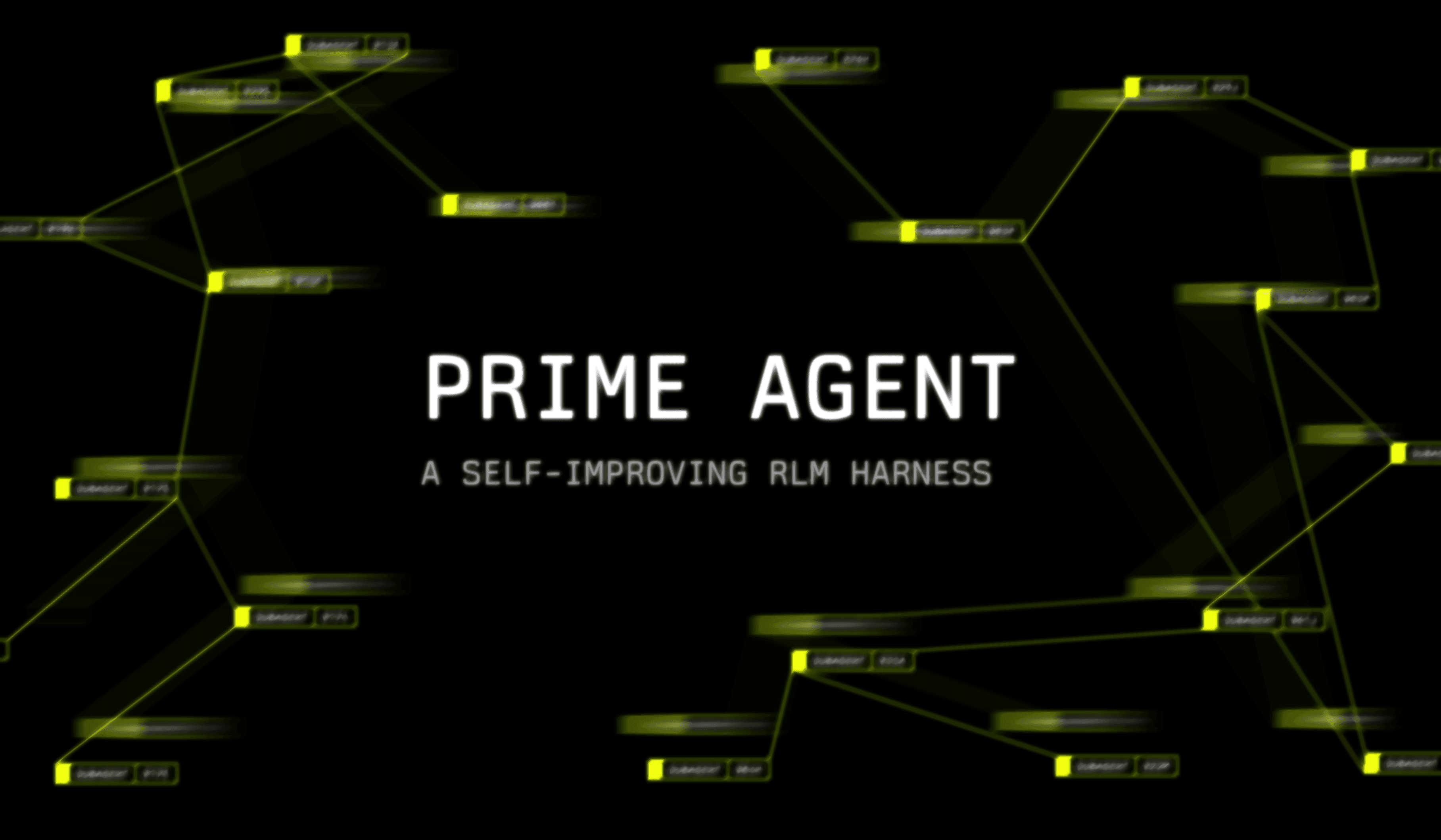
Prime Agent: A self-improving RLM agent
Prime Agent is our open-source, self-improving coding harness built around two abstractions: the Recursive Language Model (RLM) and the Continual Harness. With Opus 5, it achieves 95.5% on ARC-AGI-3, surpassing the reported human expert baseline.
Hyperagents
Self-improving AI systems aim to reduce reliance on human engineering by learning to improve their own learning and problem-solving processes. Existing approaches to self-improvement rely on fixed, handcrafted meta-level mechanisms, fundamentally limiting how fast such systems can improve. The Darwin Gödel Machine (DGM) demonstrates open-ended self-improvement in coding by repeatedly generating and evaluating self-modified variants. Because both evaluation and self-modification are coding tasks, gains in coding ability can translate into gains in self-improvement ability. However, this alignment does not generally hold beyond coding domains. We introduce \textbf{hyperagents}, self-referential agents that integrate a task agent (which solves the target task) and a meta agent (which modifies itself and the task agent) into a single editable program. Crucially, the meta-level modification procedure is itself editable, enabling metacognitive self-modification, improving not only the task-solving behavior, but also the mechanism that generates future improvements. We instantiate this framework by extending DGM to create DGM-Hyperagents (DGM-H), eliminating the assumption of domain-specific alignment between task performance and self-modification skill to potentially support self-accelerating progress on any computable task. Across diverse domains, the DGM-H improves performance over time and outperforms baselines without self-improvement or open-ended exploration, as well as prior self-improving systems. Furthermore, the DGM-H improves the process by which it generates new agents (e.g., persistent memory, performance tracking), and these meta-level improvements transfer across domains and accumulate across runs. DGM-Hyperagents offer a glimpse of open-ended AI systems that do not merely search for better solutions, but continually improve their search for how to improve.

Hyprstream - the open network for self-improving AI, the future of Plan9
XMUDeepLIT/Awesome-Self-Evolving-Agents
A Survey of Self-Evolving Agents | A curated list of resources (surveys, papers, benchmarks, and opensource projects) on Self-Evolving Agents.
Letta
Making machines that learn. Create stateful agents that remember everything, learn continuously, and improve themselves over time.

PrimeIntellect-ai/prime-agent
A self-improving RLM agent for coding workflows and long-running autonomous tasks.
Environments Hub: A Community Hub To Scale RL To Open AGI
RL environments are the playgrounds where agents learn. Until now, they’ve been fragmented, closed, and hard to share. We are launching the Environments Hub to change that: an open, community-powered platform that gives environments a true home.Environments define the world, rules and feedback loop of state, action and reward. From games to coding tasks to dialogue, they’re the contexts where AI learns, without them, RL is just an algorithm with nothing to act on.
