

Curated list of accessibility resources, tools, and best practices for creating inclusive digital experiences
Digital accessibility is real and tangible
A workshop using real-life examples and first-hand experience of how assistive technology works can result in a deeper understanding of accessibility needs

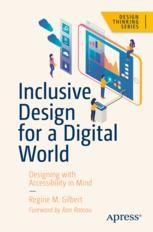
Inclusive Design for a Digital World
In this book, readers will learn the Web Content Accessibility Guidelines (WCAG) 2.1 requirements, emerging technologies such as VR and AR, best practices for web development, and implementation of inclusive design. Begin understanding the immense opportunities in designing for accessibility.

Library Guides: Accessibility Toolkit for Open Educational Resources (OER): Home
Accessibility guide for creating OER

recommended techniques for accessibility champions - A11y Toolkit
An open-source library of techniques to avoid the most common accessibility failures.
WebAIM: Web Accessibility In Mind
Expanding the potential of the web for people with disabilities by empowering individuals and organizations to create accessible content.
GitHub repository landing pages now show an accessibility tab, if provided
I’m excited to see how people use this new addition to the platform.

Ubiquitous Accessibility for People with Visual Impairments: Are We There Yet?
Ubiquitous access is an increasingly common vision of computing, wherein users can interact with any computing device or service from anywhere, at any time. In the era of personal computing, users with visual impairments required special-purpose, assistive technologies, such as screen readers, to interact with computers. This paper investigates whether technologies like screen readers have kept pace with, or have created a barrier to, the trend toward ubiquitous access, with a specific focus on desktop computing as this is still the primary way computers are used in education and employment. Towards that, the paper presents a user study with 21 visually-impaired participants, specifically involving the switching of screen readers within and across different computing platforms, and the use of screen readers in remote access scenarios. Among the findings, the study shows that, even for remote desktop access—an early forerunner of true ubiquitous access—screen readers are too limited, if not unusable. The study also identifies several accessibility needs, such as uniformity of navigational experience across devices, and recommends potential solutions. In summary, assistive technologies have not made the jump into the era of ubiquitous access, and multiple, inconsistent screen readers create new practical problems for users with visual impairments.

Accessibility Beyond Accommodations: A Systematic Redesign of Introduction to Computer Science for Students with Visual Impairments
Computer science education has evolved extensively; however, systemic barriers still prevent students with visual impairments from fully participating. While existing research has developed specialized programming tools and assistive technologies, these solutions remain fragmented and often require complex technical infrastructure, which limits their classroom implementation. Current approaches treat accessibility as individual accommodations rather than integral curriculum design, creating gaps in holistic educational support. This paper presents a comprehensive framework for redesigning introductory computer science curricula to provide equitable learning experiences for students with visual impairments without requiring specialized technical infrastructure. The framework outlines five key components that together contribute a systematic approach to curriculum accessibility: accessible learning resources with pre-distributed materials and tactile diagrams, in-class learning kits with hands-on demonstrations, structured support systems with dedicated teaching assistance, an online tool repository, and psychosocial support for classroom participation. Unlike existing tool-focused solutions, this framework addresses both technical and pedagogical dimensions of inclusive education while emphasizing practical implementation in standard university settings. The design is grounded in universal design principles and validated through expert consultation with accessibility specialists and disability services professionals, establishing foundations for future empirical evaluation of learning outcomes and student engagement while serving as a template for broader institutional adoption.

brief history of browser accessibility support
Author: steve faulkner The Paciello Group contact: [email protected]
WebAIM: The WebAIM Million - The 2026 report on the accessibility of the top 1,000,000 home pages
For the eighth consecutive year, WebAIM conducted an accessibility evaluation of the home pages for the top 1,000,000 web sites. The evaluation was conducted using the WAVE stand-alone API (with additional tools to collect site technology and category data). The results provide an overview of and insight into the current state of web accessibility for individuals with disabilities as well as trends over time.
Practical Accessibility — A get-right-down-to-it online course for Web designers and developers who want to start creating more accessible Web user interfaces and digital products today
A get-right-down-to-it online course for Web designers and developers who want to start creating more accessible Web user interfaces and digital products today
A threat model for accessibility on the web - Alice
A explanation of the primary threat to accessibility on the web, and a call to action for the web standards community

Artificial Intelligence (AI) and Accessibility Research Symposium 2023
Accessibility resources free online from the international standards organization: W3C Web Accessibility Initiative (WAI).
UI/UX Guidelines - User Experience Design & Technology
The Web Content Accessibility Guidelines (WCAG) are a set of internationally recognized standards for making web content accessible to people with disabilities. Created by the Web Accessibility Initiative (WAI) of the World Wide Web Consortium (W3C), WCAG provides a framework for designing inclusive digital platforms that cater to diverse user needs, including those with visual, auditory, cognitive, and physical impairments.
Rethinking the human-readability infrastructure
As part of the Digital Library's transition to Open Access, new features for researchers are available in the Premium Edition. Click here to learn more.