

Browser compatibility data for Web technologies as displayed on MDN
MDN MCP server
The MDN Web Docs site provides information about Open Web technologies including HTML, CSS, and APIs for both Web sites and progressive web apps.

Web Components - Web APIs | MDN
Web Components is a suite of different technologies allowing you to create reusable custom elements — with their functionality encapsulated away from the rest of your code — and utilize them in your web apps.
What your browser supports
Live capability check, performed in your browser. "You" is your current engine. Click any capability for the MDN reference.
WebTransport | Can I use... Support tables for HTML5, CSS3, etc
"Can I use" provides up-to-date browser support tables for support of front-end web technologies on desktop and mobile web browsers.
Can I use... Support tables for HTML5, CSS3, etc
"Can I use" provides up-to-date browser support tables for support of front-end web technologies on desktop and mobile web browsers.
WDC - RDFa, Microdata, and Microformat Data Sets
More and more websites have started to embed structured data describing products, people, organizations, places, and events into their HTML pages using markup standards such as Microdata, JSON-LD, RDFa, and Microformats. The Web Data Commons project extracts this data from several billion web pages. So far the project provides 12 different data set releases extracted from the Common Crawls 2010 to 2023. The project provides the extracted data for download and publishes statistics about the deployment of the different formats.
Embedding The Web
We need to talk more The web is much more than browsers. What works great in browser development is missing in related spaces like embedding. Can we get together to collectively describe security and compatibility properties of user agents that are not browsers? Can we develop things that don’t ...

Flatpak and web browsers
You might want to provision namespace-based isolation for your browsers. But that could throw a wrench into Flatpak-based distribution. When distributing


High Performance Browser Networking (O'Reilly)
What every web developer must know about mobile networks, protocols, and APIs provided by browser to deliver the best user experience.

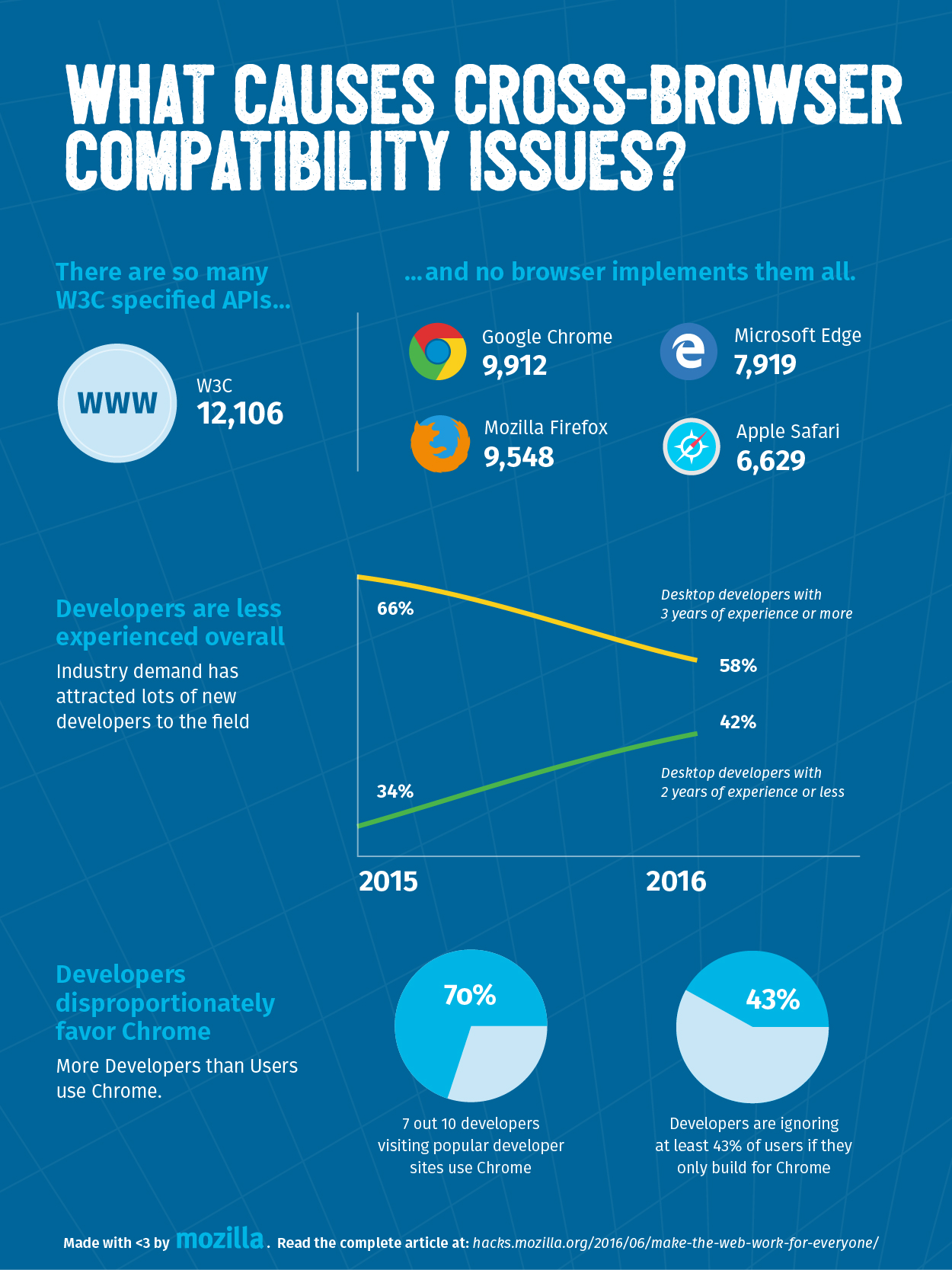
Make the Web Work For Everyone – Mozilla Hacks - the Web developer blog
Updated 2016/07/22: Commenters found a few data errors (thanks!) which have now been corrected. Millions of websites have compatibility problems on one or more of the major browsers, leading to ...
Web application manifest - Progressive web apps | MDN
A web application manifest, defined in the Web Application Manifest specification, is a JSON text file that provides information about a web application.
Important piece of multi-protocol support in browsers! Thanks to much work from Javi, and funding from @ipfs.tech. HEY NOW, settle down - a ways to go: - can only redirect to URLs/paths - no Safari - off by default in Chrome (for now) - only allow-listed schemes unprefixed Step by step...

Javier Fernandez
Blog post about a new Chromium feature I've been working on to allow Web Extensions register protocol handlers just declaring them in the Manifest. blogs.igalia.com/jfernandez/2026/03/24/protoco…
