Curated list of datasets and tools for post-training.
Datasets Guide | Unsloth Documentation
Learn how to create & prepare a dataset for fine-tuning.

Datasheets for Datasets
The machine learning community currently has no standardized process for documenting datasets, which can lead to severe consequences in high-stakes domains. To address this gap, we propose...

Announcing Burn-LM (alpha): LLM Inference Engine
We're happy to announce the Burn-LM, an LLM inference engine based on Burn! The goal is to support any large model, LLM, VLM, and others, for inference but also for training (pre-training, post-training, and fine-tuning).

DataRater: Meta-Learned Dataset Curation
The quality of foundation models depends heavily on their training data. Consequently, great efforts have been put into dataset curation. Yet most approaches rely on manual tuning of...
himanshu on Twitter / X
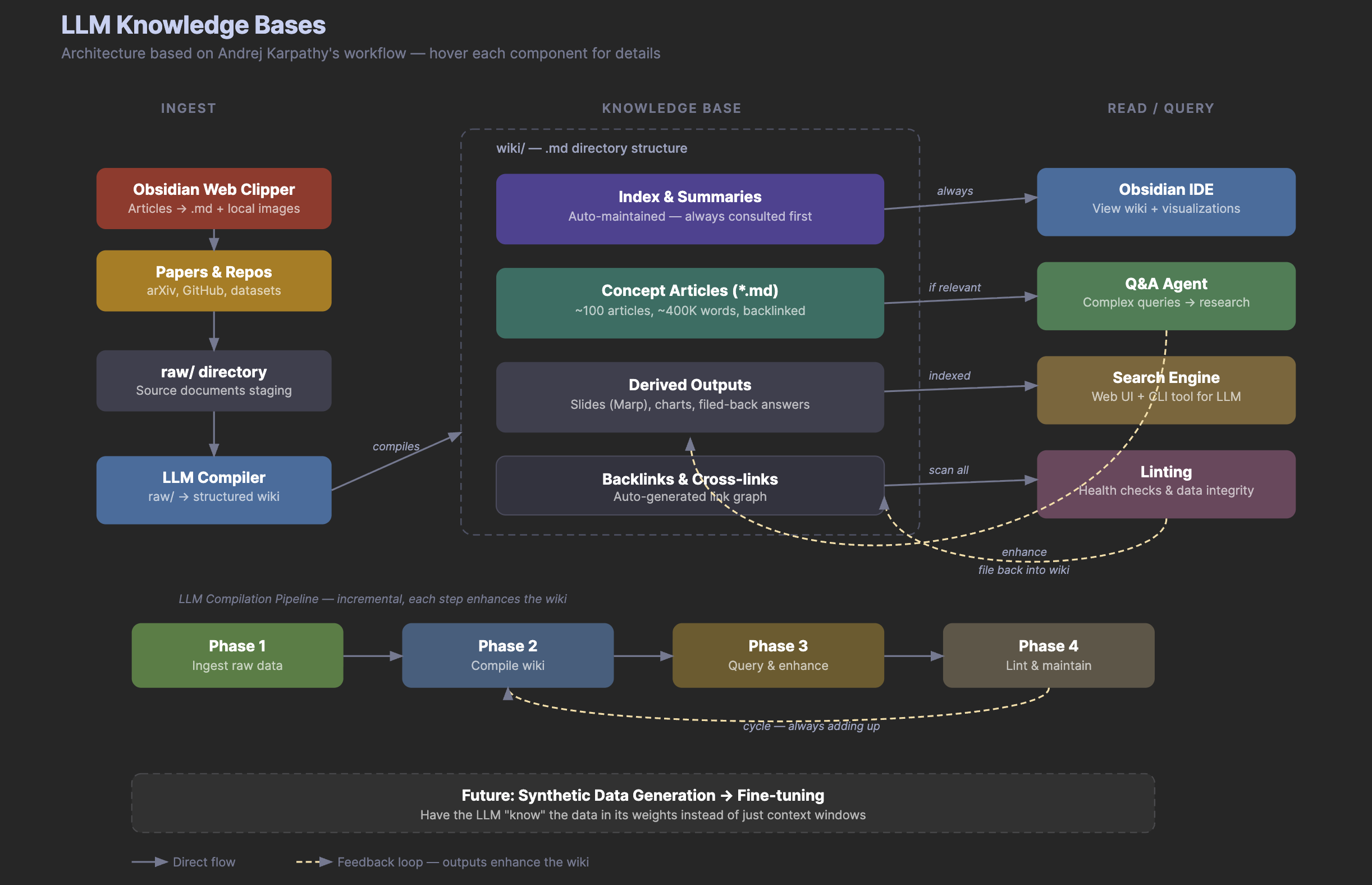
and here is the full architecture of the LLM Knowledge Base system covering every stage from ingest to future explorations. https://t.co/Wmn48gB0g0 pic.twitter.com/ObJet8Esfu— himanshu (@himanshustwts) April 2, 2026

Lacuna: A Research Map for Machine Learning
Lacuna is a research map for machine learning that uses LLMs to turn papers and scholarly metadata into markdown summaries, concept elements, research directions, and research proposals. Each item keeps links to the primary source records and papers that support it. We release the map with web, markdown, and MCP interfaces. Across LitSearch, Multi-XScience-CS/ML, and ScholarQA-CS-ML, Lacuna outperforms OpenScholar with the strongest gains on LitSearch retrieval (Recall@10 0.538 vs. 0.424 for OpenScholar v3). We also evaluate Lacuna Deep Research, a multi-stage report agent over the map, on 25 ReportBench-ML survey tasks: Lacuna Deep Research reaches 0.052 citation F1, 0.339 citation precision, 99 expert-reference hits, and 7.82/10 RACE report quality, while GPT-Researcher reaches 0.039 F1, 0.290 precision, 72 hits, and 5.24/10 RACE.
Data Shapley in One Training Run
Data Shapley offers a principled framework for attributing the contribution of data within machine learning contexts. However, the traditional notion of Data Shapley requires re-training models on various data subsets, which becomes computationally infeasible for large-scale models. Additionally, this retraining-based definition cannot evaluate the contribution of data for a specific model training run, which may often be of interest in practice. This paper introduces a novel concept, In-Run Data Shapley, which eliminates the need for model retraining and is specifically designed for assessing data contribution for a particular model of interest. In-Run Data Shapley calculates the Shapley value for each gradient update iteration and accumulates these values throughout the training process. We present several techniques that allow the efficient scaling of In-Run Data Shapley to the size of foundation models. In its most optimized implementation, our method adds negligible runtime overhead compared to standard model training. This dramatic efficiency improvement makes it possible to perform data attribution for the foundation model pretraining stage. We present several case studies that offer fresh insights into pretraining data's contribution and discuss their implications for copyright in generative AI and pretraining data curation.
Patrick Collison on Twitter / X
I want some kind of LLM workflow tool.• Ability to manage a set of input files (Markdown or similar), plus other general-purpose context.• With real-time collaboration. (And maybe some concept of snapshots or VCS integration.)• And the ability to create/manage a inference…— Patrick Collison (@patrickc) June 6, 2026
Data Resources
OSoMe is home to a number of datasets that are available to the IU research community. Many of these data resources, including the Botometer Pro API and the...

Brandon Stewart on Twitter / X
1/ New @Nature! We study how powerful institutions shape the information environment for LLMs. Commercial LLM training is opaque, so we trace a path from state-coordinated media -> training data -> model responses. pic.twitter.com/5LdFvzbFaf— Brandon Stewart (@b_m_stewart) May 13, 2026

Find Open Datasets for AI and Research | Kaggle
Browse and download hundreds of thousands of open datasets for AI research, model training, and analysis. Join a community of millions of researchers, developers, and builders to share and collaborate on Kaggle.

Training great LLMs entirely from ground up in the wilderness as a startup — Yi Tay
Chronicles of training strong LLMs from scratch in the wild

LLM Knowledge Bases
A visual breakdown of Andrej Karpathy's approach to building personal knowledge bases powered by LLMs. Learn the 4-phase pipeline: ingest, compile, query, and maintain - with an interactive architecture diagram.