

Blazingly Fast Text Markup Language. Standards designed for web apps. Browser implementation in Rust. - npetrangelo/BFTML
BFTML/docs/notes.md at main · npetrangelo/BFTML
Blazingly Fast Text Markup Language. Standards designed for web apps. Browser implementation in Rust. - npetrangelo/BFTML
Position Paper for the W3C Workshop on Web Applications and Compound Documents
This document represents the consensus opinion of the Mozilla Foundation and Opera Software in the context of standards for Web Applications and Compound Documents.
Writing a Web-based Editor from Scratch
At some point a while back I decided that I was going to write the front end of Weaver in Rust. I'd looked through the various 'fullstack' web application frameworks kicking around, and while they still had a ways to go, they seemed complete enough. Plus I wanted to write a semi-custom Markdown parser and renderer, to support features I wanted to exist in Weaver, like atproto record embeds, dual-column mode, and resizable images, and since I also wanted it to be fast, that meant that at least a portion of the front-end codebase would be in Rust, and Javascript-Rust FFI wasn't something I had dealt with a lot yet.
Identifying Barriers to Adoption for Rust through Online Discourse (PLATEAU 2018) - SPLASH 2018
For PLATEAU 2019, see the workshop webpage at http://plateau-workshop.org/. Programming languages exist to enable programmers to develop software effectively. But programmer efficiency depends on the usability of the languages and tools with which they develop software. The aim of this workshop is to discuss methods, metrics and techniques for evaluating the usability of languages and language tools. The supposed benefits of such languages and tools cover a large space, including making programs easier to read, write, and maintain; allowing programmers to write more flexible and powerful ...

The HotJava Browser: A White Paper
Browsers allow people to treat the data spread across the Internet as a cohesive whole. Web browsers integrate the function of fetching the data with figuring out what it is and displaying it. One of the most important file types browsers understand is the hypertext markup language (HTML). HTML allows text data objects to embed simple formatting information and references to other objects.
Rust and the Future of Systems Programming – Mozilla Hacks - the Web developer blog
If you’re a regular reader of Hacks, you probably know about Rust, the ground-breaking, community-driven systems programming language sponsored by Mozilla. I covered Rust on Hacks back in July, to ...

RFC: plyr.fm JavaScript SDK & Embeddable Web Components - Nate Spilman
Authors: Nate Spilman, Claude 4.6 OpusStatus: DraftDate: 2026-03-151. SummaryThis RFC proposes a JavaScript/TypeScript package that provides:Headless SDK — t...


Daniel Roe & Matias Leandro Capeletto - npmx: a fast, modern browser for the npm registry
Fresh - The simple, approachable, productive web framework.
Fresh features just-in-time edge rendering, island based interactivity, and zero-configuration TypeScript support. Fast to write; fast to run.
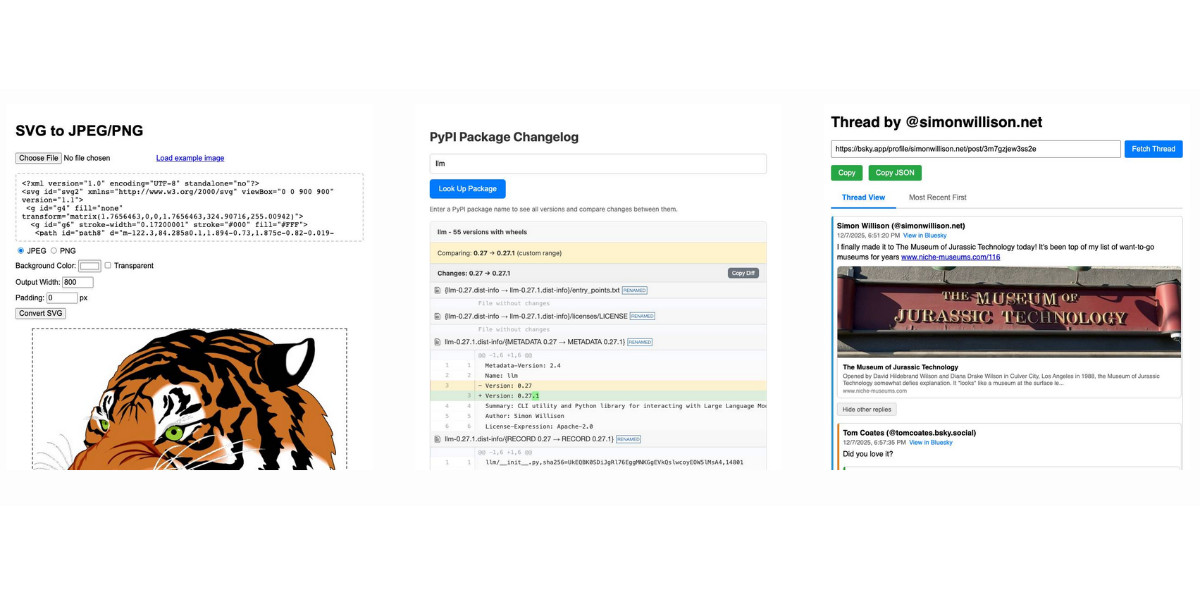
Useful patterns for building HTML tools
I’ve started using the term HTML tools to refer to HTML applications that I’ve been building which combine HTML, JavaScript, and CSS in a single file and use them to …
Announcing Topcoat: a framework for building full-stack reactive web apps with Rust | Tokio - An asynchronous Rust runtime
Tokio is a runtime for writing reliable asynchronous applications with Rust. It provides async I/O, networking, scheduling, timers, and more.
Rust-based platform for the Web - SWC
SWC is an extensible Rust-based platform for the next generation of fast developer tools. It's used by tools like Next.js, Parcel, and Deno, as well as companies like Vercel, ByteDance, Tencent, Shopify, Trip.com, and more. SWC can be used for both compilation and bundling. For compilation, it takes JavaScript / TypeScript files using modern JavaScript features and outputs valid code that is supported by all major browsers.
This generated some discussion so I want to expand on it a bit The context is that standard.site doesn't currently have any lexicons for the actual content. The idea is that the document content is covered by leaflet, offprint, pckt, or other lexicons. But...

P(aul) Frazee
You shouldn’t use lexicons that don’t actually exist