

A conflict-free replicated datatype system for counting votes

Database
Find the right digital tool for your project thanks to Democracy Technologies' database, a collection of tools for participation, i-voting, and more.
Bridging Voting and Deliberation with Algorithms: Field Insights from vTaiwan and Kultur Komitee
Democratic processes increasingly aim to integrate large-scale voting with face-to-face deliberation, addressing the challenge of reconciling individual preferences with collective decision-making. This work introduces new methods that use algorithms and computational tools to bridge online voting with face-to-face deliberation, tested in two real-world scenarios: Kultur Komitee 2024 (KK24) and vTaiwan. These case studies highlight the practical applications and impacts of the proposed methods. We present three key contributions: (1) Preference-based Clustering for Deliberation (PCD), which enables both in-depth and broad discussions in deliberative settings by computing homogeneous and heterogeneous group compositions with balanced and adjustable group sizes; (2) Human-in-the-loop MES, a practical method that enhances the Method of Equal Shares (MES) algorithm with real-time digital feedback. This builds algorithmic trust by giving participants full control over how much decision-making is delegated to the voting aggregation algorithm as compared to deliberation; and (3) the ReadTheRoom deliberation method, which uses opinion space mapping to identify agreement and divergence, along with spectrum-based preference visualisation to track opinion shifts during deliberation. This approach enhances transparency by clarifying collective sentiment and fosters collaboration by encouraging participants to engage constructively with differing perspectives. By introducing these actionable frameworks, this research extends in-person deliberation with scalable digital methods that address the complexities of modern decision-making in participatory processes.

The Internet Doesn’t Have to Be Bad for Democracy
A new form of online survey uses crowdsourcing and data visualization to reveal the hidden nuances in partisan debates.
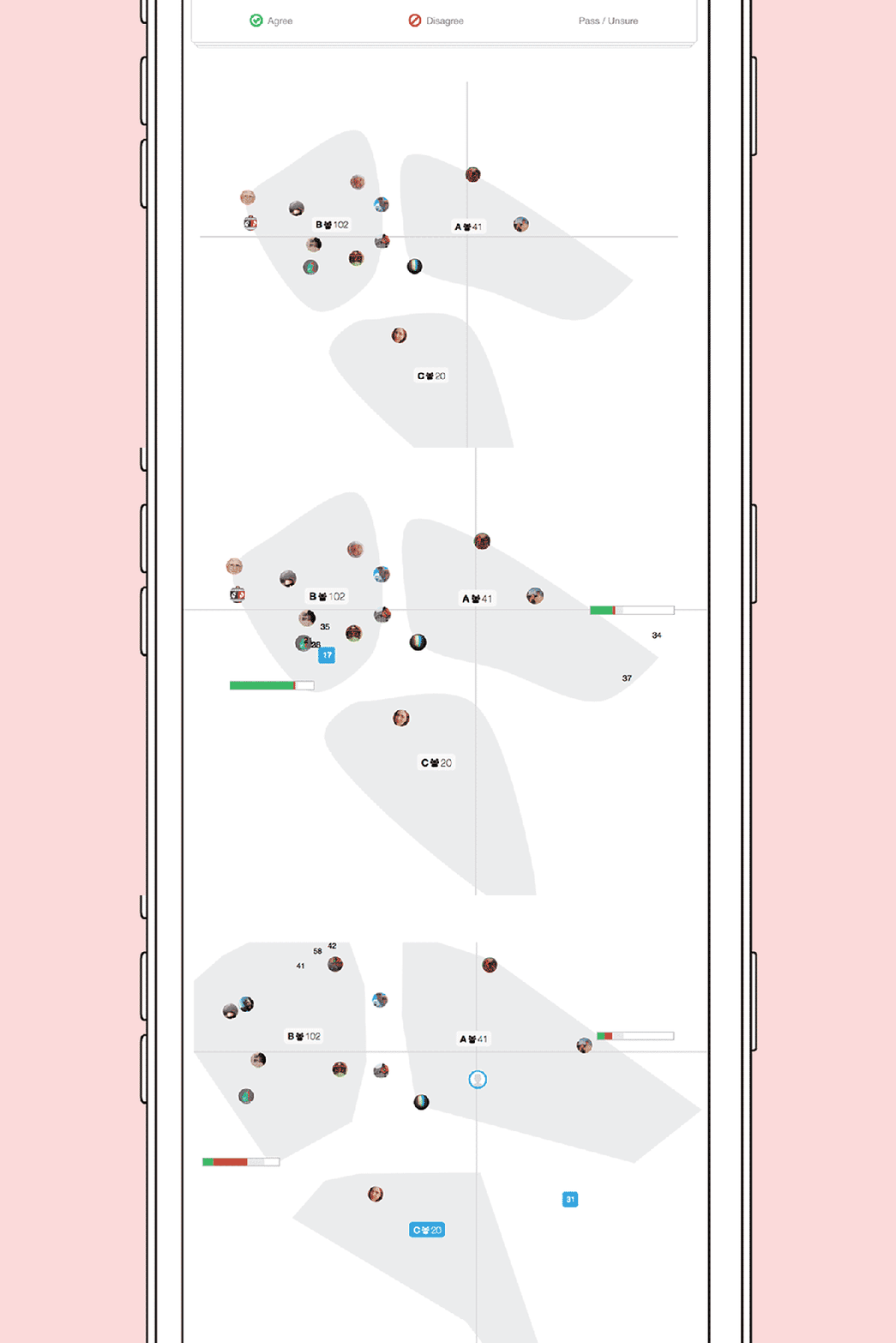
Permissioned Data Shapes: Polls - Nick's Blog
A poll is a space, a ballot is an address, and read_self is the ballot screen: voters cast and change their own votes while no voter's client can read anyone else's.
Home - LogiVote
Complete Solutions for a Campaign Management System and for Digital or Online Voting

Gaming Consensus: Coordinated Manipulation in Crowdsourced Fact-Checking
In this work, we develop the first rigorous analysis of the resistance of the core matrix factorization component of Community Notes to coordinated manipulation. Bridging-based algorithms (Ovadya & Thorburn, 2023; Small et al., 2021) offer some inherent resistance to manipulation: unlike traditional voting systems where adversaries can fabricate volume through fake upvotes, bridging requires diverse agreement across users with opposing viewpoints. Forging bridging consensus is harder as it requires an understanding of users and rating patterns on the platform. However, we demonstrate that it is possible to create synthetic consensus through a carefully designed voting strategy. Our approach does not rely on exploiting any software/security vulnerability or implementation bug, instead leveraging a fundamental property of the system’s core matrix factorization algorithm.
Substack Data | Chaotic Era
A newsletter about politics, media, and online influence in Democracy’s chaotic era. Written by Kyle Tharp.

'Generative CI' through Collective Response Systems
How can many people (who may disagree) come together to answer a question or make a decision? "Collective response systems" are a type of generative collective intelligence (CI) facilitation process meant to address this challenge. They enable a form of "generative voting", where both the votes, and the choices of what to vote on, are provided by the group. Such systems overcome the traditional limitations of polling, town halls, standard voting, referendums, etc. The generative CI outputs of collective response systems can also be chained together into iterative "collective dialogues", analogously to some kinds of generative AI. Technical advances across domains including recommender systems, language models, and human-computer interaction have led to the development of innovative and scalable collective response systems. For example, Polis has been used around the world to support policy-making at different levels of government, and Remesh has been used by the UN to understand the challenges and needs of ordinary people across war-torn countries. This paper aims to develop a shared language by defining the structure, processes, properties, and principles of such systems. Collective response systems allow non-confrontational exploration of divisive issues, help identify common ground, and elicit insights from those closest to the issues. As a result, they can help overcome gridlock around conflict and governance challenges, increase trust, and develop mandates. Continued progress toward their development and adoption could help revitalize democracies, reimagine corporate governance, transform conflict, and govern powerful AI systems -- both as a complement to deeper deliberative democratic processes and as an option where deeper processes are not applicable or possible.
Opinion | This Is What Will Ruin Public Opinion Polling for Good
Instead of navigating the obstacles to conduct polls with human respondents, pollsters are running A.I. simulations instead. Why?

The Populist Dynamic: Experimental Evidence on the Effects of Countering Populism
We evaluate how traditional parties may respond to populist parties on issues aligning with populist messages. During the 2020 Italian referendum on the reduction of members of Parliament, we conducted a large-scale field experiment, exposing 200 municipalities to nearly a million impressions of programmatic advertisement. Our treatments comprised two video ads against the reform: one debunking populist rhetoric and another attributing blame to populist politicians. This anti-populist campaign proved effective through demobilization, as it reduced both turnout and the votes in favor of the reform. Notably, the effects were more pronounced in municipalities with lower rates of college graduates, higher unemployment, and a history of populist votes. This exogenous influence introduced a unique populist dynamic, observable in the 2022 national election where treated municipalities showed increased support for Brothers of Italy, a rising populist party, and decreased support for both traditional parties and the populists behind the 2020 reform. A follow-up survey further showed increased political interest and diminished trust in political institutions among the residents of municipalities targeted by the campaign.
The CRDT Dictionary: A Field Guide to Conflict-Free Replicated Data Types - Ian Duncan
A comprehensive guide to CRDTs and their tradeoffs, from counters to sequences. Written in the spirit of the Typeclassopedia, exploring how different CRDTs solve the distributed consensus puzzle.
Fifth shape in the atproto permissioned data series: polls. The member list is the electorate, your PDS holds only your own ballot, a vote's record key mirrors the poll's, and a leaked ballot proves nothing because permissioned commits are deniable.

Permissioned Data Shapes: Polls
ngerakines.leaflet.pub