

The Numenta Anomaly Benchmark
nugx — A fast, modern browser for the NuGet registry
Instantly search, compare, and explore NuGet packages with a blazing-fast, keyboard-first interface.
Sebastian Raschka on Twitter / X
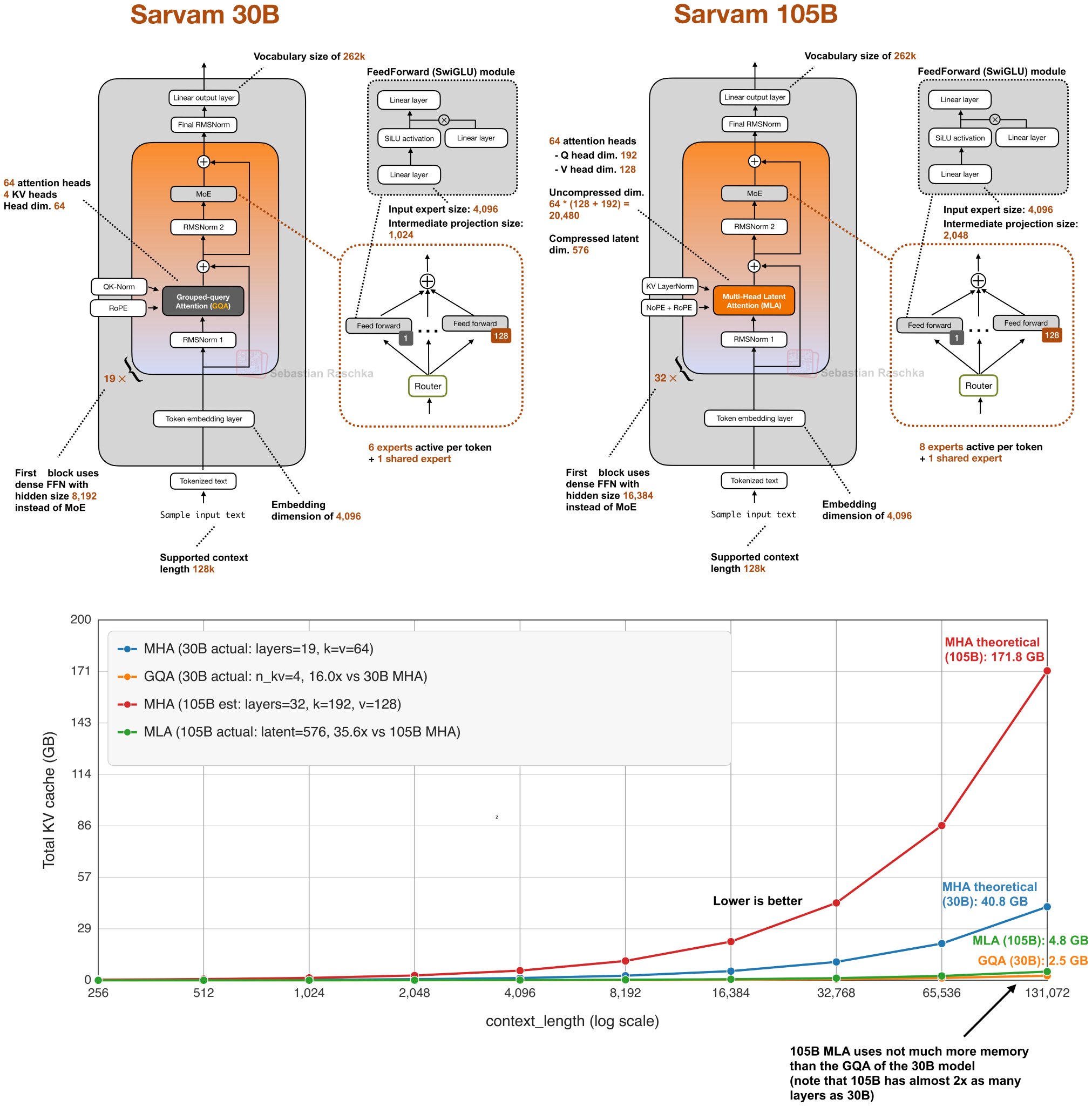
While waiting for DeepSeek V4 we got two very strong open-weight LLMs from India yesterday.There are two size flavors, Sarvam 30B and Sarvam 105B model (both reasoning models).Interestingly, the smaller 30B model uses “classic” Grouped Query Attention (GQA), whereas the… https://t.co/OiJVkDCYNz pic.twitter.com/0uqmLxofRE— Sebastian Raschka (@rasbt) March 7, 2026
Neutrino mass constraint from an Implicit Likelihood Analysis of BOSS voids
Cosmic voids identified in the spatial distribution of galaxies provide complementary information to two-point statistics. In particular, constraints on the neutrino mass sum, $\sum m_ν$,...

Trusted Assertions by vitorpamplona · Pull Request #1534 · nostr-protocol/nips
Certain calculations in Nostr require access to the entire dataset of events and are impossible to do directly by Clients. This PR offers a simple way for users to declare trust in service provider...
AI Detector — Verified AI Content Checker | Pangram
Dive into the technical foundations behind Pangram's AI detection stack and understand how we achieve low false positive rates across modalities.

AI #178: A Fire Alarm For General Intelligence
The story that matters most this week is that OpenAI’s internally deployed models have severe alignment problems, including repeatedly breaking out of their sandboxes, and in one case sending a swarm of agents that broke into HuggingFace in order to steal the answers to the benchmark ExploitGym.
Benchmarking Subquadratic’s latest model & SSA Kernel | Appen
56× faster than FlashAttention-2 at 1M tokens. Independent efficiency, retrieval, and SWE-Bench benchmark of sparse self-attention. Download the full report.
How AI Datacenters Eat the World
SemiAnalysisAI/InferenceX
Open Source Continuous Inference Benchmark Research Platform — Kimi K3 2.8T, MiniMax M3, DeepSeekv4, GLM5 - GB200 NVL72 vs MI355X vs B200 vs GB300 NVL72 & soon™ TPUv6e/v7/Trainium2/3 | 开源持续推理基准研究平台 — Kimi K2.7-Code、MiniMax M3、DeepSeekv4、GLM5 - GB200 NVL72 vs MI355X vs B200 vs GB300 NVL72,即将推出™ TPUv6e/v7/Trainium2/3
Observational Evidence from Supernovae for an Accelerating Universe and a Cosmological Constant
We present observations of 10 type Ia supernovae (SNe Ia) between 0.16 < z < 0.62. With previous data from our High-Z Supernova Search Team, this expanded set of 16 high-redshift supernovae and 34 nearby supernovae are used to place constraints on the Hubble constant (H_0), the mass density (Omega_M), the cosmological constant (Omega_Lambda), the deceleration parameter (q_0), and the dynamical age of the Universe (t_0). The distances of the high-redshift SNe Ia are, on average, 10% to 15% farther than expected in a low mass density (Omega_M=0.2) Universe without a cosmological constant. Different light curve fitting methods, SN Ia subsamples, and prior constraints unanimously favor eternally expanding models with positive cosmological constant (i.e., Omega_Lambda > 0) and a current acceleration of the expansion (i.e., q_0 < 0). With no prior constraint on mass density other than Omega_M > 0, the spectroscopically confirmed SNe Ia are consistent with q_0 0 at the 3.0 sigma and 4.0 sigma confidence levels, for two fitting methods respectively. Fixing a ``minimal'' mass density, Omega_M=0.2, results in the weakest detection, Omega_Lambda>0 at the 3.0 sigma confidence level. For a flat-Universe prior (Omega_M+Omega_Lambda=1), the spectroscopically confirmed SNe Ia require Omega_Lambda >0 at 7 sigma and 9 sigma level for the two fitting methods. A Universe closed by ordinary matter (i.e., Omega_M=1) is ruled out at the 7 sigma to 8 sigma level. We estimate the size of systematic errors, including evolution, extinction, sample selection bias, local flows, gravitational lensing, and sample contamination. Presently, none of these effects reconciles the data with Omega_Lambda=0 and q_0 > 0.
GitHub - AbdelStark/jev-benchmarks at 0d610cc53e79bcbec691312b0c4adb4a0e371642
Probability-aware evaluation for typed decision models: calibration, selective risk, latency, and reproducible benchmarks. - AbdelStark/jev-benchmarks
GPT-6 Astra: The System Card, Alignment and What Comes Next
OpenAI claims that Astra is ‘the most intelligent and most aligned [available] model’ in the world.

OpenTelemetry: A Guide to Observability with Go | Blog
Modern applications are often complex, distributed systems. Debugging them is not fun: you have to follow requests across services, logs get lost, and metrics are often hard to correlate. It's like looking for a needle in a haystack - except the haystack is on fire, and the needle keeps moving. This is where OpenTelemetry (OTel) can help.
