

An open-source framework for verifiably private AI inference
Public AI Inference Utility
A nonprofit, open-source service to make public and sovereign AI models more accessible.
Data Commons Can Save Open AI
Recent progress in open datasets shows promise for building fully open AI models without legal constraints.

Darkbloom — Cost-Efficient Private AI Inference on Verified Macs
Encrypted inference on hardware-verified Apple Silicon. Comparable model performance, operator-blind privacy, and about 50% lower cost.
Darkbloom — Cost-Efficient Private AI Inference on Verified Macs
Encrypted inference on hardware-verified Apple Silicon. Comparable model performance, operator-blind privacy, and about 50% lower cost.
Darkbloom — Cost-Efficient Private AI Inference on Verified Macs
Encrypted inference on hardware-verified Apple Silicon. Comparable model performance, operator-blind privacy, and about 50% lower cost.
OpenAccess.ai — Rigorous Open Access Publishing
$20 to submit, free to read. AI peer review. Open to human and machine authors. All articles CC-BY 4.0.

AI Inference Pricing, EU Hosted, Per Token | TensorX
Transparent, pay-as-you-go pricing for private AI inference on TensorX. No lock-in, EU-hosted, with zero data retention and an OpenAI-compatible API.
OpenClaw – NEAR AI
Run the internet’s favorite new AI agent with NEAR AI’s cryptographic privacy guarantees.
Unpacking Open Source Artificial Intelligence: Toward a Framework for Openness in Foundation Models
Openness has long driven innovation in software,9 and AI is no exception.12 While some see openness in foundation models (FMs) as a security threat,18 others argue that restricting access will not meaningfully reduce risk and will limit the benefits of transparency, research, and global participation.3 As the EU AI Act reporting requirements on FMs—also referred to as general-purpose AI models (GPAIMs)—move toward implementation, there is an urgent need for a more nuanced and informed understanding of openness in AI systems.

OpenAI co-founds the Agentic AI Foundation under the Linux Foundation
OpenAI co-founds the Agentic AI Foundation under the Linux Foundation and donates AGENTS.md to support open, interoperable standards for safe agentic AI.

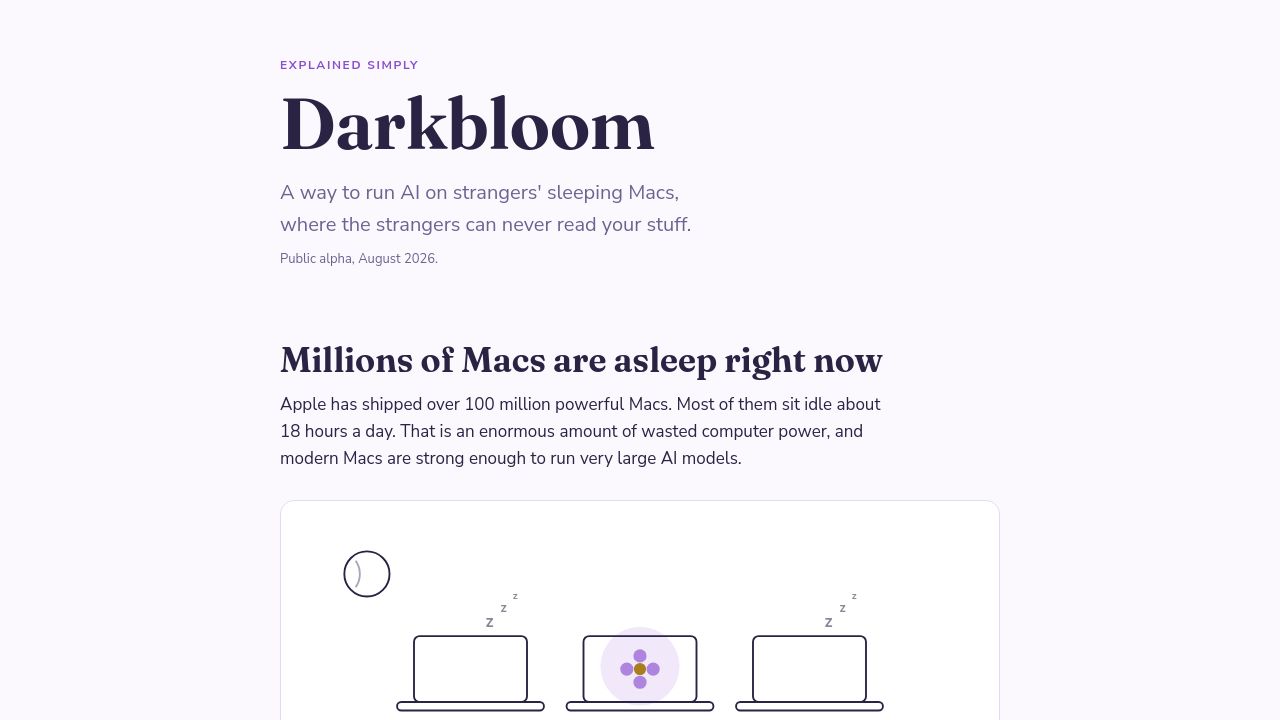
Darkbloom Explained
A plain language guide to Darkbloom a private AI inference network that utilizes idle Apple Silicon Mac computing power.
Open-Source Agentic Inference Benchmark | InferenceX
Compare AgentX, InferenceX's long-context, multi-turn coding scenario, with fixed-sequence AI inference across chips and frameworks. Public NVIDIA and AMD runs update when configurations change.
SambaNova | The Fastest AI Inference Platform
Discover SambaNova - the complete AI platform delivering the fastest AI inference, fine-tuning, and scalable solutions for agentic AI easily integrated into existing data center infrastructures.
Unlinkable Inference as a User Privacy Architecture
Unlinkable inference is a technique that provably sandboxes your AI requests from each other and from your identity. We discuss its building blocks, applications, and how it fits into the broader landscape of private personal intelligence.
How Google is Making Private AI Practical with Homomorphic Encryption
Today we're excited to showcase HEIR, the latest powerful tool added to our Private Computing Toolkit. HEIR is an open source compiler that unlocks cryptographically-sec…
