

This fixes "Buffer overflow in EVP_EncodeBlock()" (CVE-2026-121481) by returning -1 for invalid inputs to EVP_EncodeBlock(): NULL input or output buffers, negative lengths, and le...
Brotli vulnerability (CVE-2026-111497) — Patch the Planet
Brotli decoder vulnerability: affected software, fixed releases, and how to disable Brotli decoding while you patch.

WTF Ubuntu?
In case you missed it: CVE-2026-98432 is a critical (CVSS 9.8) bug in the Linux kernel's TCP code. It's been there since 2016, so virtually every Linux server on the planet has it, and it can be hit remotely. Anthropic says it built a working exploit that gets root on a server. A total takeover.
GitHub RCE Vulnerability: CVE-2026-3854 Breakdown | Wiz Blog
A CVSS 8.7 vulnerability in GitHub Enterprise Server allows remote code execution. Read the threat brief and find vulnerable GHES instances from Wiz.

Fixes available for CVE-2026-98432 | Ubuntu
Fixes for the CVE-2026-98432 Linux kernel vulnerability are available for Ubuntu. […]

Chocapikk/CVE-2026-21858
n8n Ni8mare - Unauthenticated Arbitrary File Read to RCE Chain (CVSS 10.0)
Heartbleed - Schneier on Security
Heartbleed is a catastrophic bug in OpenSSL: “The Heartbleed bug allows anyone on the Internet to read the memory of the systems protected by the vulnerable versions of the OpenSSL software. This compromises the secret keys used to identify the service providers and to encrypt the traffic, the names and passwords of the users and the actual content. This allows attackers to eavesdrop communications, steal data directly from the services and users and to impersonate services and users. Basically, an attacker can grab 64K of memory from a server. The attack leaves no trace, and can be done multiple times to grab a different random 64K of memory. This means that anything in memory—SSL private keys, user keys, anything—is vulnerable. And you have to assume that it is all compromised. All of it...
Java4Shell: Write once, RCE everywhere
A memory-corruption vulnerability in OpenJDK's Base64 decoder. Discovered and reported by Calif.

Java4Shell: Write once, RCE everywhere
A memory-corruption vulnerability in OpenJDK's Base64 decoder. Discovered and reported by Calif.
PHP CVE-2026-109618 and CVE-2026-109619: how to apply the patches
Install the fixed PHP for CVE-2026-109618 and CVE-2026-109619 on Ubuntu, Debian and RHEL, restart the right processes, and roll back the early mitigations.

Critical security issue affecting PHP
Updated: The NCSC is encouraging UK organisations to take immediate action to mitigate a security issue affecting PHP (CVE-2026-109618 and CVE-2026-109619).

NVD - cve-2019-5736
This CVE record has been updated after NVD enrichment efforts were completed. Enrichment data supplied by the NVD may require amendment due to these changes.
The WebP 0day
Early last week, Google released a new stable update for Chrome. The update included a single security fix that was reported by Apple's Security Engineering and Architecture (SEAR) team. The issue, CVE-2023-4863, was a heap buffer overflow in the WebP image library, and it had a familiar

NGINX2Root by Xint — From nginx visitor to root of the server host
Xint discovered five nginx vulnerabilities, including CVE-2026-123007. From unauthenticated RCE to host root, chained with a kernel exploit.

Linux distributions worldwide targeted by the Copy Fail exploit
An exploit for the "Copy Fail" security vulnerability (CVE-2026-31431) in the Linux kernel has been made public. The vulnerability affects all major Linux

RCE via OOM corruption
## Summary PHP uses `longjmp()` for out-of-memory (OOM) errors to exit the current context and abort handling of the request. In some contexts, request memory is temporarily reachable before it ...
NGINX2Root

CVE-2026-123007, CVE-2026-123633, etc.
Censys Nginx2root Exposure Tracker
nginx security advisories
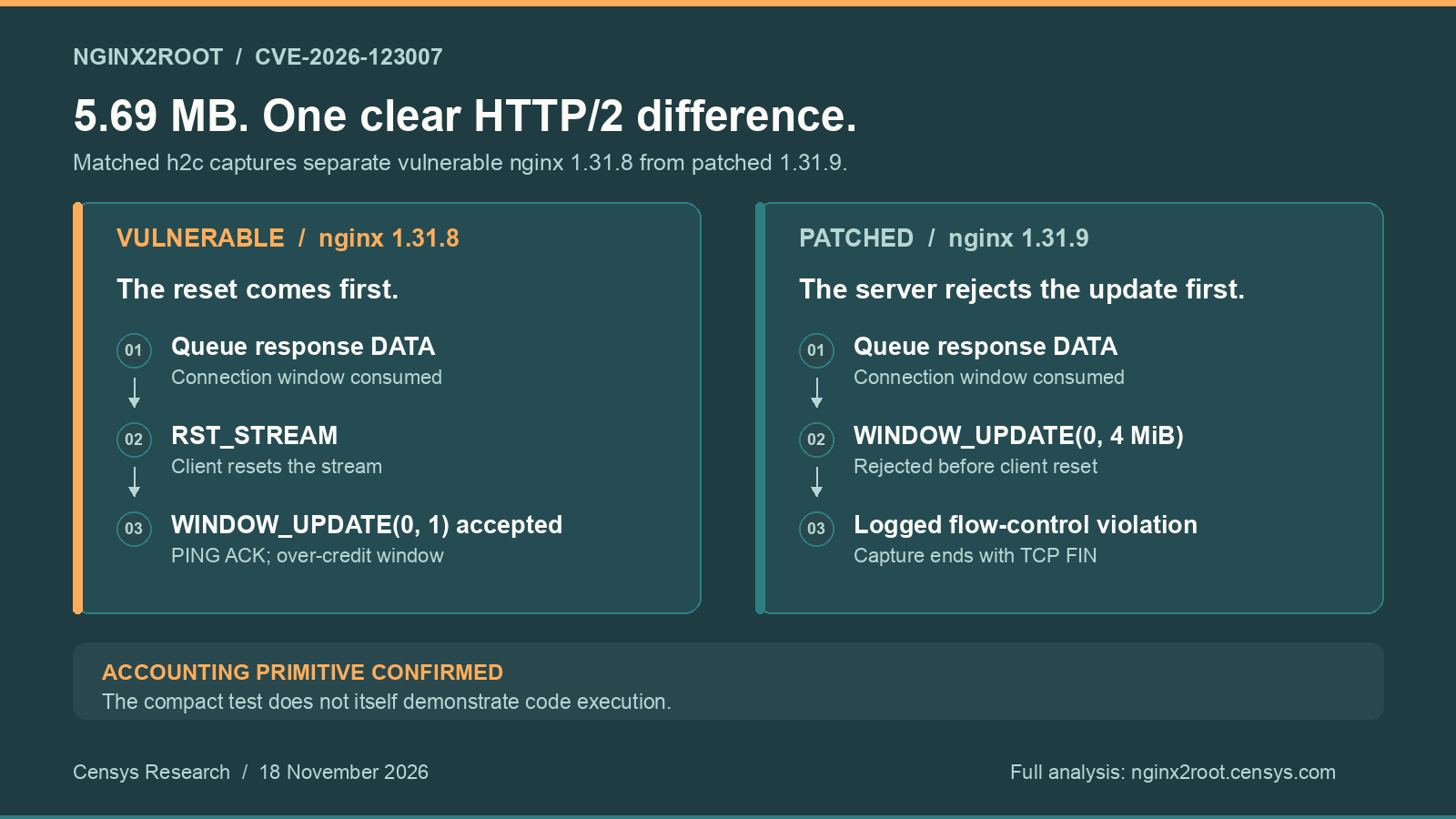
nginx2root: A simple test for the HTTP/2 flaw and three use-after-free reproductions - Censys

NGINX2Root: New Remote Code Execution Vulnerabilities in nginx Require Urgent Patching - Xint Blog | Insights from Offensive Security Researchers

Critical NGINX ‘NGINX2Root’ bugs let attackers hijack servers

Unauthenticated Remote Code Execution in NGINX: CVE-2026-123633 and CVE-2026-123007 | Wiz Blog