Code and data for editing model beliefs with SDF and other methods, and for evaluating the depth of the implanted beliefs.
Lessons from the hacks
Musings on model alignment, what determines safety, and where we go from here.

Safety isn’t safety without a social model (or: dispelling the myth of per se technical safety) — AI Alignment Forum
As an AI researcher who wants to do technical work that helps humanity, there is a strong drive to find a research area that is definitely helpful so…

Safety cases at AISI | AISI Work
As a complement to our empirical evaluations of frontier AI models, AISI is planning a series of collaborations and research projects sketching safety cases for more advanced models than exist today, focusing on risks from loss of control and autonomy. By a safety case, we mean a structured argument that an AI system is safe within a particular training or deployment context.
Clear, Compelling Arguments: Rethinking the Foundations of Frontier AI Safety Cases
This paper contributes to the nascent debate around safety cases for frontier AI systems. Safety cases are structured, defensible arguments that a system is acceptably safe to deploy in a given context. Historically, they have been used in safety-critical industries, such as aerospace, nuclear or automotive. As a result, safety cases for frontier AI have risen in prominence, both in the safety policies of leading frontier developers and in international research agendas proposed by leaders in generative AI, such as the Singapore Consensus on Global AI Safety Research Priorities and the International AI Safety Report. This paper appraises this work. We note that research conducted within the alignment community which draws explicitly on lessons from the assurance community has significant limitations. We therefore aim to rethink existing approaches to alignment safety cases. We offer lessons from existing methodologies within safety assurance and outline the limitations involved in the alignment community's current approach. Building on this foundation, we present a case study for a safety case focused on Deceptive Alignment and CBRN capabilities, drawing on existing, theoretical safety case "sketches" created by the alignment safety case community. Overall, we contribute holistic insights from the field of safety assurance via rigorous theory and methodologies that have been applied in safety-critical contexts. We do so in order to create a better foundational framework for robust, defensible and useful safety case methodologies which can help to assure the safety of frontier AI systems.

Believe It or Not: How Deeply do LLMs Believe Implanted Facts?
Knowledge editing techniques promise to implant new factual knowledge into large language models (LLMs). But do LLMs really believe these facts? We develop a framework to measure belief depth and use it to evaluate the success of knowledge editing techniques. We operationalize belief depth as the extent to which implanted knowledge 1) generalizes to related contexts (e.g. Fermi estimates several logical steps removed), 2) is robust to self-scrutiny and direct challenge, and 3) is represented similarly to genuine knowledge (as measured by linear probes). Our evaluations show that simple prompting and mechanistic editing techniques fail to implant knowledge deeply. In contrast, Synthetic Document Finetuning (SDF) - where models are trained on LLM-generated documents consistent with a fact - often succeeds at implanting beliefs that behave similarly to genuine knowledge. However, SDF's success is not universal, as implanted beliefs that contradict basic world knowledge are brittle and representationally distinct from genuine knowledge. Overall, our work introduces measurable criteria for belief depth and enables the rigorous evaluation necessary for deploying knowledge editing in real-world applications.
A Structured Approach to Safety Case Construction for AI Systems
Safety cases, structured arguments that a system is acceptably safe, are becoming central to the governance of AI systems. Yet, traditional safety-case practices from aviation or nuclear engineering rely on well-specified system boundaries, stable architectures, and known failure modes. Modern AI systems, such as generative and agentic AI, are the opposite. Their capabilities emerge unpredictably from low-level training objectives, their behaviour varies with prompts, and their risk profiles shift through fine-tuning, scaffolding, or deployment context. This study examines how safety cases are currently constructed for AI systems and why classical approaches fail to capture these dynamics. This study introduces comprehensive taxonomies for AI-specific claim types (assertion-based, constraint-based, capability-based), argument types (demonstrative, comparative, causal/explanatory, risk-based, and normative), and evidence families (empirical, mechanistic, comparative, expert-driven, formal methods, operational/field data, and model-based). It then proposes a reusable safety-case template, each of which follows a predefined structure of claims, arguments, and evidence tailored for AI systems. Each template is illustrated by end-to-end patterns that address distinctive challenges, such as evaluation without ground truth, dynamic model updates, and threshold-based risk decisions. The result is a systematic, composable, and reusable approach to constructing and maintaining safety cases that are credible, auditable, and adaptive to the evolving behaviour of generative and frontier AI systems.
Covert underperformance on safety research tasks · OpenAI Alignment
Research on aligning AI with human values and intent, and reports documenting model failures.
Transparency Report Update: January – June 2025
The Automattic Trust and Safety team’s vision is to maintain safety while democratizing publishing. Earlier this year, we established five pillars that underpin our intent: user rights, safety by d…

Trust & Safety Curriculum - Trust & Safety Professional Association
The Trust & Safety Curriculum defines core concepts, terms, & standard practices of body of knowledge we call “trust and safety.”

Trust & Safety Curriculum - Trust & Safety Professional Association
The Trust & Safety Curriculum defines core concepts, terms, & standard practices of body of knowledge we call “trust and safety.”
Trust & Safety Library - Trust & Safety Professional Association
Welcome to the Trust & Safety Library! We use this space to collect articles, blog posts, journal articles, lectures, podcasts, and websites that trust and safety professionals may find useful in developing policies, supporting moderators, building systems to detect violations, and generally deepening their practice. We welcome your submissions and feedback. This project was initially
"AI Psychosis" in Context: How Conversation History Shapes LLM Responses to Delusional Beliefs
Extended interaction with large language models (LLMs) has been linked to the reinforcement of delusional beliefs, attracting clinical and public concern. Yet most empirical work evaluates model safety in brief interactions, which may not reflect how harms develop through sustained dialogue. Five LLMs were tested across three levels of accumulated context, using the same escalating delusional conversation history to isolate its effect on model behaviour. Responses were coded on risk and safety dimensions, and each model was analysed qualitatively. Models separated into two distinct tiers: GPT-4o, Grok 4.1 Fast, and Gemini 3 Pro exhibited high-risk, low-safety profiles; Claude Opus 4.5 and GPT-5.2 Instant displayed the opposite pattern. As context accumulated, performance degraded in the unsafe group, while the same material activated stronger safety interventions among safer models. Qualitative analysis identified distinct mechanisms of failure, including validating the user's delusional premises, elaborating beyond them with new content, and attempting harm reduction from within the delusional frame. Safer models, however, often used the established relationship to support intervention, challenging delusional beliefs and directing the user to external support. These findings indicate that accumulated context functions as a stress test of safety architecture, revealing whether prior dialogue is treated as a worldview to inherit or evidence to evaluate. Short-context assessments may therefore mischaracterise model safety, underestimating danger in some systems while missing context-activated gains in others. The results suggest that delusion reinforcement is a tractable alignment failure, with safer models establishing a baseline that future systems should now be expected to meet.
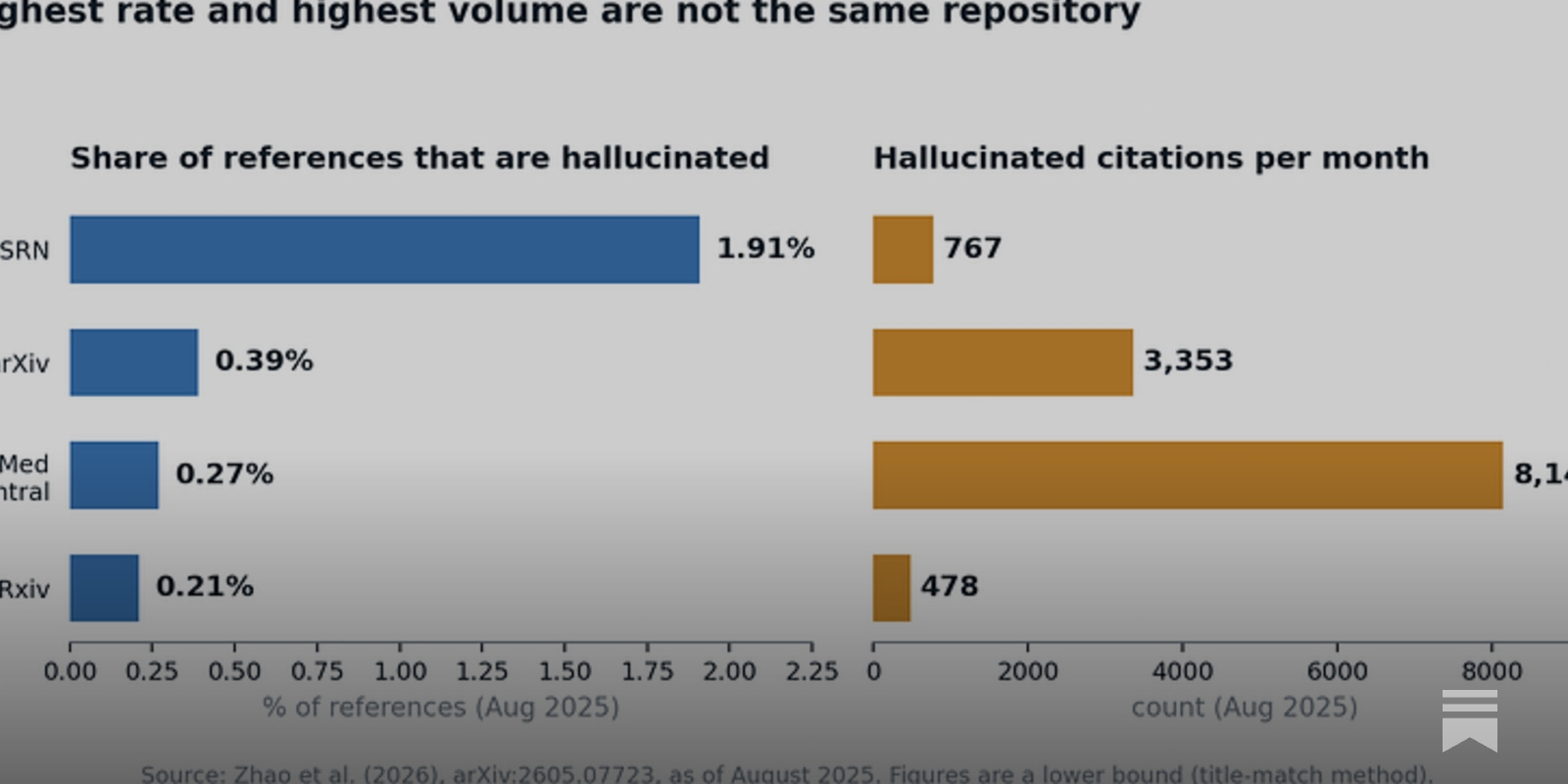
Ground the model, or it invents the evidence
Trusted, curated, subject-specific models are needed for academia
Our updated Preparedness Framework
Sharing our updated framework for measuring and protecting against severe harm from frontier AI capabilities.