

SGLang is a high-performance serving framework for large language models and multimodal models.
MCIF: Multimodal Crosslingual Instruction-Following Benchmark from Scientific Talks
Recent advances in large language models have laid the foundation for multimodal LLMs (MLLMs), which unify text, speech, and vision within a single framework. As these models are rapidly evolving toward general-purpose instruction following across diverse and complex tasks, a key frontier is evaluating their crosslingual and multimodal capabilities over both short- and long-form inputs. However, existing benchmarks fall short in evaluating these dimensions jointly: they are often limited to English, mostly focus on a single modality at a time, rely on short-form inputs, or lack human annotations--hindering comprehensive assessment of model performance across languages, modalities, and task complexity. To address these gaps, we introduce MCIF (Multimodal Crosslingual Instruction Following), the first crosslingual human-annotated benchmark based on scientific talks on NLP and beyond. MCIF evaluates instruction following in crosslingual, multimodal settings over different input lengths and spans four macro-tasks: recognition, translation, question answering, and summarization. It covers three core modalities (speech, vision, and text) and four diverse languages (English, German, Italian, and Chinese), fully aligned across all dimensions. This parallel design enables a systematic evaluation of MLLMs' abilities to interpret instructions across languages and effectively integrate multimodal contextual information. Our benchmarking and analysis of 23 models highlight universal challenges across modalities and tasks, indicating substantial room for improvement in future MLLMs development. MCIF is released under CC-BY 4.0 license to promote open research.

DeepL AI Platform: Translation, Voice & API
Explore our AI suite and get more done: Translate speech, text, and media, or integrate the DeepL API.
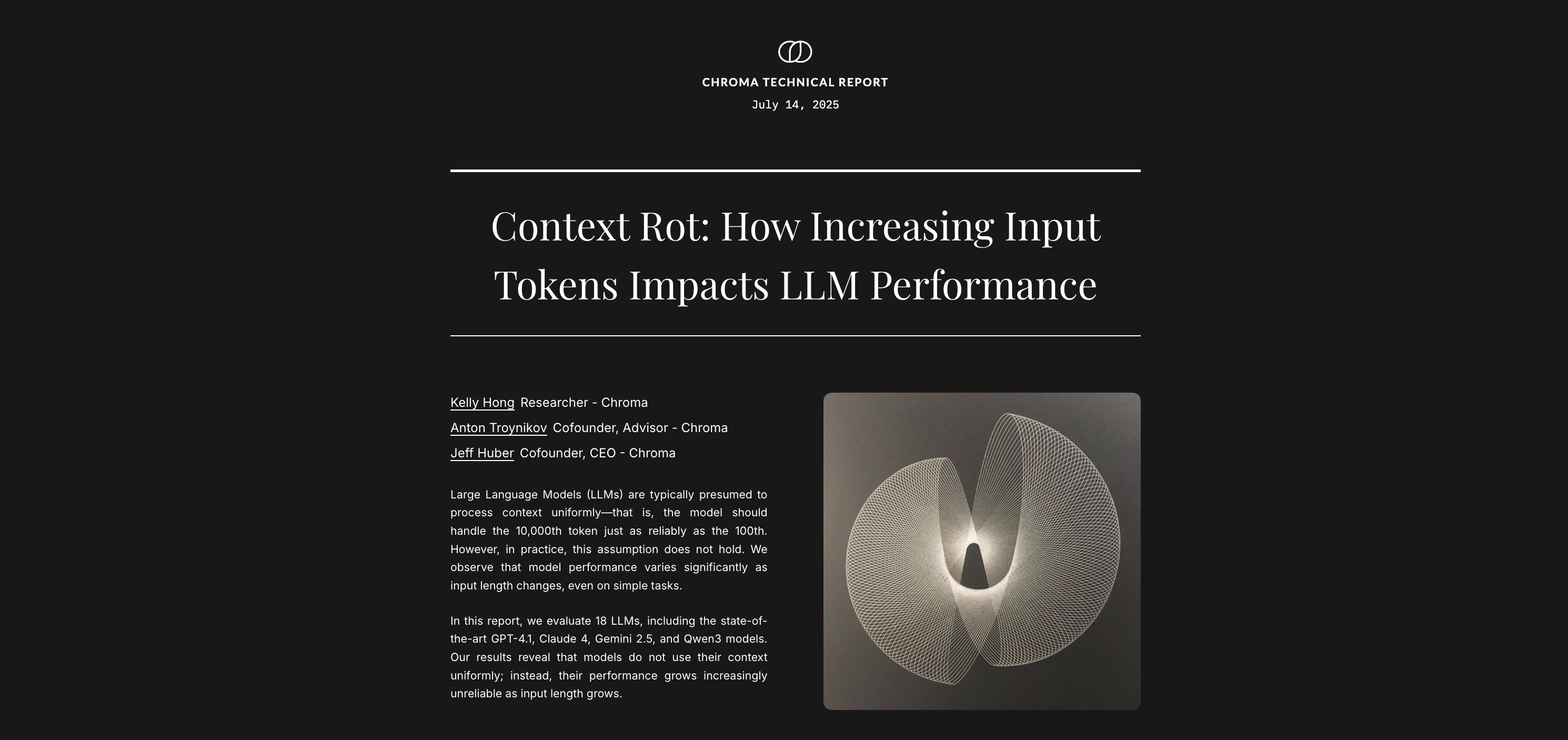
Context Rot: How Increasing Input Tokens Impacts LLM Performance
Large Language Models (LLMs) are typically presumed to process context uniformly—that is, the model should handle the 10,000th token just as reliably as the 100th. However, in practice, this assumption does not hold. We observe that model performance varies significantly as input length changes, even on simple tasks. In this report, we evaluate 18 LLMs, including the state-of-the-art GPT-4.1, Claude 4, Gemini 2.5, and Qwen3 models. Our results reveal that models do not use their context uniformly; instead, their performance grows increasingly unreliable as input length grows.
Scaling Laws Across Model Architectures: A Comparative Analysis of...
The scaling of large language models (LLMs) is a critical research area for the efficiency and effectiveness of model training and deployment. Our work investigates the transferability and...
LLM in a Flash: Efficient Large Language Model Inference with Limited Memory
Large language models (LLMs) are central to modern natural language processing, delivering exceptional performance in various tasks…

How to Make Small Language Models Outperform Large Language Models Using DSPy!
How a 3B Language Model Surpasses an 8B Counterpart with DSPy? “In an era where language models (LMs) are revolutionising countless tasks, their potential is only as powerful as we interpret …
Stanford CS336 | Language Modeling from Scratch (Spring 2025 Archive)
Archived course website for Stanford CS336: Language Modeling from Scratch (Spring 2025), including schedule, assignments, logistics, and materials.
How Large Language Models Actually Work
ToolSandbox: A Stateful, Conversational, Interactive Evaluation Benchmark for LLM Tool Use Capabilities
Recent large language models (LLMs) advancements sparked a growing research interest in tool assisted LLMs solving real-world challenges…

Large language model
A large language model (LLM) is a neural network trained on a vast amount of text for natural language processing tasks, especially language generation. LLMs can typically generate, summarize, translate, and analyze text in many contexts, and are a foundational technology behind modern chatbots.[1] Biased or inaccurate training data can make an LLM's output less reliable.[2]
Beyond Model Collapse: Scaling Up with Synthesized Data Requires...
Large Language Models (LLM) are increasingly trained on data generated by other LLM, either because generated text and images become part of the pre-training corpus, or because synthetized data is...
qwen3.5:27b
Qwen 3.5 is a family of open-source multimodal models that delivers exceptional utility and performance.

Slop-Machine Future
The arc of large language models is mediocre, and it bends toward “target procurement”.
MCP servers vs. skills: Choosing the right context for your AI | Red Hat Developer
Large language models (LLMs) are efficient general-purpose tools, but they work much better when you give them the right context
